Strategies for Enhancement in Food Production
Hey everyone! Welcome to examspark.in. In this post, we will cover Class 12 Biology Chapter 9: Strategies for Enhancement in Food Production. Food demand kaafi tezi se badh rahi hai, isliye farming aur breeding techniques samajhna bahut zaroori hai. This chapter is super scoring for CBSE Boards and NEET 2026. Yahan humne easy notes, complete NCERT solutions, aur important questions compile kiye hain taaki aap apne exams mein top kar sakein. Let's start!
Learning Objectives
After completing this chapter, students will be able to:
- Understand the principles of Animal Husbandry and dairy/poultry farm management.
- Explain different Animal Breeding techniques (Inbreeding, Outcrossing, Cross-breeding).
- Describe the steps involved in Plant Breeding for disease resistance and better yield.
- Define Biofortification and its role in public health.
- Understand advanced techniques like Tissue Culture, Micropropagation, and Somatic Hybridization.
Key Concepts & Definitions
Revision ke time par in terms ko yaad rakhna bahut zaroori hai:
- Animal Husbandry: The agricultural practice of breeding and raising livestock (cows, buffaloes, pigs, etc.) for human use.
- Breed: A group of animals related by descent and similar in most characters like general appearance, features, size, configuration, etc.
- Inbreeding Depression: Continuous inbreeding, especially close inbreeding, usually reduces fertility and even productivity. Isko overcome karne ke liye outcrossing ki jaati hai.
- MOET (Multiple Ovulation Embryo Transfer Technology): A program for herd improvement where a cow is administered hormones (FSH-like) to produce 6-8 eggs instead of one.
- Biofortification: Breeding crops with higher levels of vitamins, minerals, or higher protein and healthier fats.
- Totipotency: Ek single plant cell ki capacity jisse wo pura naya plant generate kar sakti hai.
- Explant: Any part of a plant taken out and grown in a test tube under sterile conditions in a special nutrient media.
- Single Cell Protein (SCP): Alternate sources of proteins for animal and human nutrition produced by microbes like Spirulina on an industrial scale.
Full NCERT Solutions (Step-by-Step)
Neeche chapter ke saare exercise questions ke detailed aur easy answers diye gaye hain. Exam mein exact aise hi likhna to get maximum marks!
Question 1: Explain in brief the role of animal husbandry in human welfare.
Step 1: Food Production. It provides essential food products like milk, meat, and eggs which are rich sources of high-quality animal protein.
Step 2: Commercial Products. It yields commercial products like wool, silk, honey, wax, and leather.
Step 3: Draft Power. Animals like horses, bullocks, and camels are used for agricultural operations like ploughing, and for transportation.
Step 4: Employment. It provides a livelihood to a large population in rural areas.
Step 5: Agricultural By-products. Animal excreta (dung) is an excellent organic fertilizer and is used to produce biogas.
Question 2: If your family owned a dairy farm, what measures would you undertake to improve the quality and quantity of milk production?
Step 1: Selection of Good Breeds. Selecting high-yielding breeds that are well-acclimatized to the local environment and have disease resistance.
Step 2: Proper Housing. Providing well-ventilated, clean sheds with adequate water and protection from harsh weather.
Step 3: Scientific Feeding. Providing a balanced diet containing roughage and concentrates (proteins, vitamins, minerals) in precise proportions based on the cow's lactation stage.
Step 4: Hygiene and Sanitation. Maintaining strict cleanliness of the animals, the milking area, and the handlers to prevent infections like mastitis.
Step 5: Regular Veterinary Checks. Routine check-ups and timely vaccinations to keep the herd disease-free.
Question 3: What is meant by the term 'breed'? What are the objectives of animal breeding?
Step 1: Concept of Breed. A "breed" refers to a group of animals of the same species that share a common descent and are similar in general appearance, features, size, and configuration (e.g., Leghorn in poultry, Jersey in cattle).
Step 2: Objective 1 (Yield enhancement). To increase the yield of animal products (milk, meat, wool, etc.).
Step 3: Objective 2 (Quality upgrade). To improve the desirable qualities of the produce (e.g., protein content in milk, quality of meat).
Step 4: Objective 3 (Resistance & Growth). To develop resistance to various diseases, increase the reproductive rate, and improve growth rate.
Question 4: Name the methods employed in animal breeding. According to you which of the methods is best? Why?
Step 1: Categorization of Methods. The methods employed in animal breeding are:
1. Inbreeding (mating within the same breed for 4-6 generations).
2. Outbreeding, which includes: Out-crossing, Cross-breeding, and Interspecific hybridization.
Step 2: Identifying the Best Method. Cross-breeding is generally considered the best method.
Step 3: Justification. Because it combines the desirable qualities of two different breeds into a single hybrid progeny (e.g., Hisardale is a new breed of sheep developed in Punjab by crossing Bikaneri ewes and Merino rams). It effectively avoids inbreeding depression while maximizing hybrid vigor.
Question 5: What is apiculture? How is it important in our lives?
Step 1: Definition. Apiculture (Bee-keeping) is the maintenance of hives of honeybees for the production of honey and beeswax.
Step 2: Nutritional Value. Honey is a highly nutritious food and is widely used in indigenous systems of medicine (Ayurveda).
Step 3: Industrial Utility. Beeswax is extensively used in the preparation of cosmetics, polishes, and ointments.
Step 4: Ecological Benefit. Honeybees are excellent pollinators for crops like sunflower, Brassica, apple, and pear. Keeping beehives in crop fields during the flowering period significantly increases crop yield.
Question 6: Discuss the role of fishery in enhancement of food production.
Step 1: Scope of Industry. Fishery is an industry devoted to the catching, processing, or selling of fish, shellfish, or other aquatic animals.
Step 2: Nutritional Profile. Fish is an excellent, easily digestible source of animal protein, iodine, and omega-3 fatty acids.
Step 3: Economic Support. It provides stable income and employment to millions of fishermen and farmers, especially in coastal areas.
Step 4: The Blue Revolution. Through aquaculture and pisciculture, the production of freshwater fishes (Rohu, Catla) and marine fishes (Hilsa, Mackerel) has multiplied, meeting the food demands of a growing population.
Question 7: Briefly describe various steps involved in plant breeding.
Step 1: Collection of Variability. Gathering and preserving all wild relatives and existing varieties of a crop to collect all different alleles. This complete library is called germplasm.
Step 2: Evaluation and Selection of Parents. The germplasm is evaluated to identify plants with desirable characters. The selected plants are multiplied.
Step 3: Cross-hybridization among Selected Parents. Pollen grains from the desired male parent are dusted onto the stigma of the desired female parent to combine targeted traits.
Step 4: Selection and Testing of Superior Recombinants. The progeny are evaluated, and the ones having the desired traits are self-pollinated for several generations to achieve homozygosity.
Step 5: Testing, Release, and Commercialization. The newly selected lines are grown in research fields for evaluation of yield, quality, and disease resistance across varying climatic conditions for 3 seasons before being released as new varieties to farmers.
Question 8: Explain what is meant by biofortification.
Step 1: Definition. Biofortification is the process of breeding crops with higher levels of vitamins, minerals, proteins, and healthier fats to improve public health and solve "hidden hunger."
Step 2: Quality Markers. Objectives include improving protein content/quality, oil content/quality, vitamin content, and micronutrient/mineral content.
Step 3: Key Examples. Examples include Maize hybrids with twice the amount of lysine and tryptophan, Atlas 66 wheat variety with high protein content, and Vitamin A enriched carrots/spinach developed by IARI, New Delhi.
Question 9: Which part of the plant is best suited for making virus-free plants and why?
Step 1: Ideal Part. The Meristem (apical and axillary) is the best-suited part for making virus-free plants.
Step 2: Explanation. Even if the entire plant is infected with a virus, the meristem remains free of viruses because the rate of cell division in the meristem is significantly faster than the rate of viral multiplication.
Step 3: Practical Application. By culturing meristems in vitro, healthy, virus-free plants can be successfully obtained in banana, sugarcane, and potato.
Question 10: What is the major advantage of producing plants by micropropagation?
Step 1: Rapid Multiplication. Thousands of plants can be produced in a very short duration from a small piece of tissue.
Step 2: Clonal Uniformity. The plants produced are genetically identical to the original plant (somaclones), perfectly maintaining desired commercial traits.
Step 3: Health Status. It allows the recovery of healthy, completely disease-free plants from infected parental varieties using specialized meristem culture.
Question 11: Find out what the various components of the medium used for propagation of an explant in vitro are?
Step 1: Energy Source. Carbon source, which is usually sucrose (sugar).
Step 2: Mineral Framework. Inorganic salts comprising vital macronutrients and micronutrients.
Step 3: Organic Growth Factors. Essential vitamins and amino acids.
Step 4: Hormonal Swaps. Plant Growth Regulators (Phytohormones) like Auxins (for root development) and Cytokinins (for shoot development).
Step 5: Matrix Support. Solidifying agents like Agar are added to convert the solution into a manageable semi-solid gel.
Question 12: Name any five hybrid varieties of crop plants which have been developed in India.
Step 1: Variety 1. Sonalika (Wheat - high yielding and disease resistant).
Step 2: Variety 2. Kalyan Sona (Wheat).
Step 3: Variety 3. Jaya (Rice - semi-dwarf variety).
Step 4: Variety 4. Ratna (Rice).
Step 5: Variety 5. Himgiri (Wheat - resistant to leaf and stripe rust).
Extra Important Questions (Board Exam Questions 2026)
Examspark.in ke students ke liye yahan kuch high-probability questions hain. Inko practice zaroor karein!
Multiple Choice Questions (MCQs)
Q1. Which of the following is not an objective of biofortification in crops?
(a) Improve protein content and quality
(b) Improve oil content and quality
(c) Reduce micronutrient content
(d) Improve vitamin content
Step 1: Analyze options. (c) Reduce micronutrient content.
Step 2: Explanation. Biofortification increases nutritional value, it doesn't reduce it.
Q2. The term 'Somaclones' is used to describe:
(a) Plants produced by cross-pollination
(b) Genetically identical plants produced via micropropagation
(c) Animals produced through MOET
(d) Cloned animals like Dolly sheep
Step 1: Check baseline terminology. (b) Genetically identical plants produced via micropropagation.
Q3. Himgiri developed by hybridization and selection for disease resistance against rust pathogens is a variety of:
(a) Chilli
(b) Maize
(c) Sugarcane
(d) Wheat
Step 1: Core matching. (d) Wheat.
Short Answer Questions (2-3 Marks)
Q4. Differentiate between Inbreeding and Outcrossing.
Step 1: Inbreeding Parameters. Mating of more closely related individuals within the same breed for 4-6 generations. It increases homozygosity but can lead to inbreeding depression.
Step 2: Outcrossing Parameters. Mating of animals within the same breed, but having no common ancestors on either side of their pedigree up to 4-6 generations. It is the best practical method to overcome inbreeding depression.
Q5. Write a short note on Single Cell Protein (SCP).
Step 1: Concept Definition. SCP is the production of edible microbial biomass on a large scale for human and animal nutrition.
Step 2: Practical Example. The blue-green alga Spirulina can be grown easily on agricultural waste, straw, or sewage molasses to yield compounds rich in protein, minerals, and vitamins.
Step 3: Added Advantage. Industrial scaling helps to safely utilize waste materials and drastically minimizes local environmental pollution.
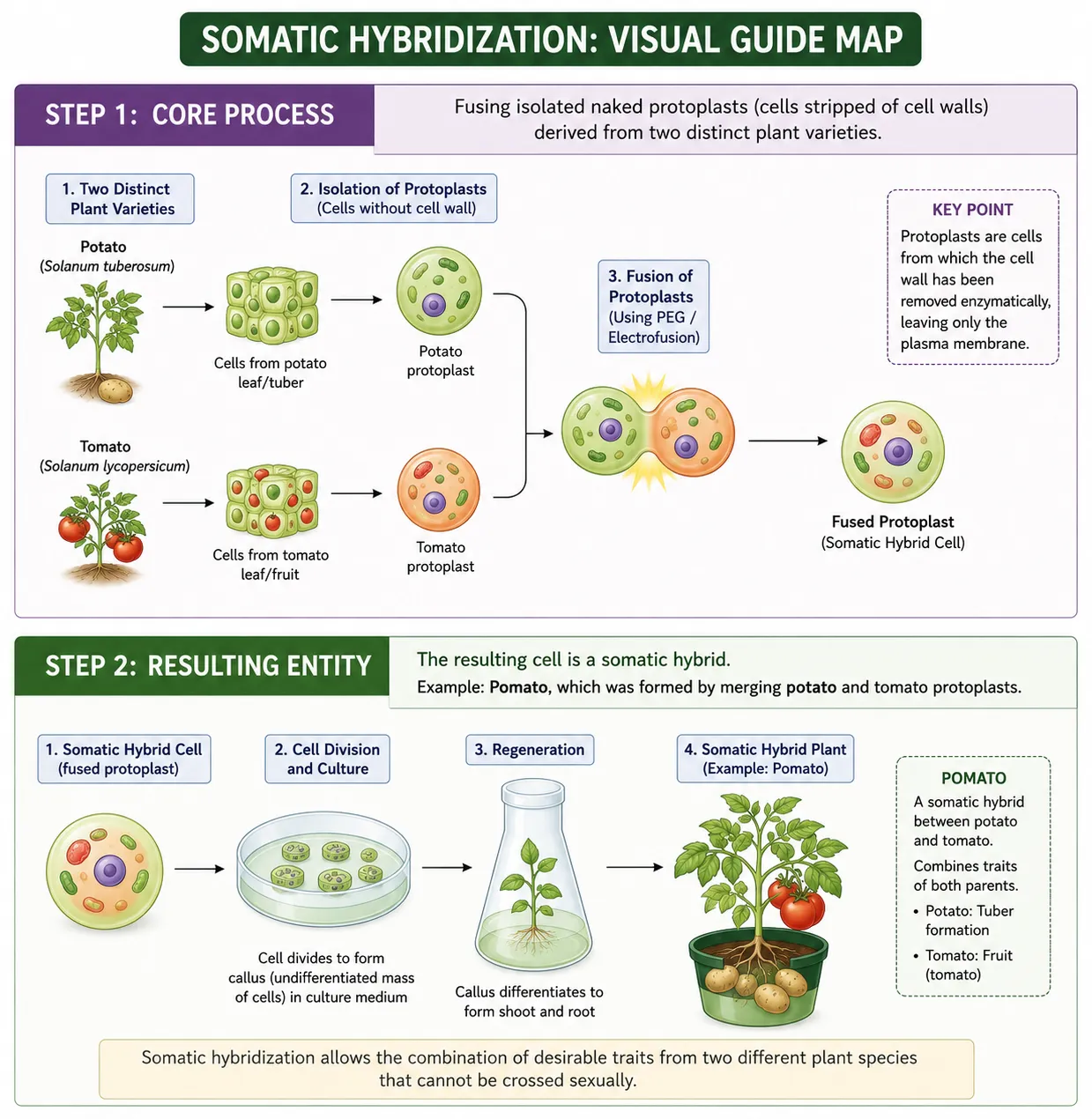
Q6. What is Somatic Hybridization?
Step 1: Core Process. Fusing isolated naked protoplasts (cells stripped of cell walls) derived from two distinct plant varieties.
Step 2: Resulting Entity. The resulting cell is a somatic hybrid. Example: Pomato, which was formed by merging potato and tomato protoplasts.
Q7. Mention the hormones administered in the MOET technique. What is their function?
Step 1: Target Hormone. Hormones exhibiting FSH-like (Follicle Stimulating Hormone) activity are injected into the donor animal.
Step 2: Functional Role. They induce follicular maturation and drive super-ovulation, forcing the ovaries to release 6-8 mature eggs per cycle instead of the customary single egg.
Long Answer Questions (5 Marks)
Q8. Describe the steps of the MOET technique. How is it useful?
Step 1: Administration. A high-quality donor cow is injected with hormones showing FSH-like properties.
Step 2: Super-ovulation. The cow responds by producing multiple (6-8) eggs instead of one.
Step 3: Mating/Insemination. The animal is mated with an elite bull or artificially inseminated using high-grade semen.
Step 4: Non-surgical recovery. Fertilized embryos at the stable 8-32 cell checkpoint are extracted non-surgically.
Step 5: Transfer. These embryos are safely implanted into matching surrogate mothers. The genetic mother is immediately cleared for another dynamic cycle of super-ovulation.
Step 6: Benefits. This technique rapidly speeds up multiplication and expansion of herd sizes with superior genetic variants in minimal time.
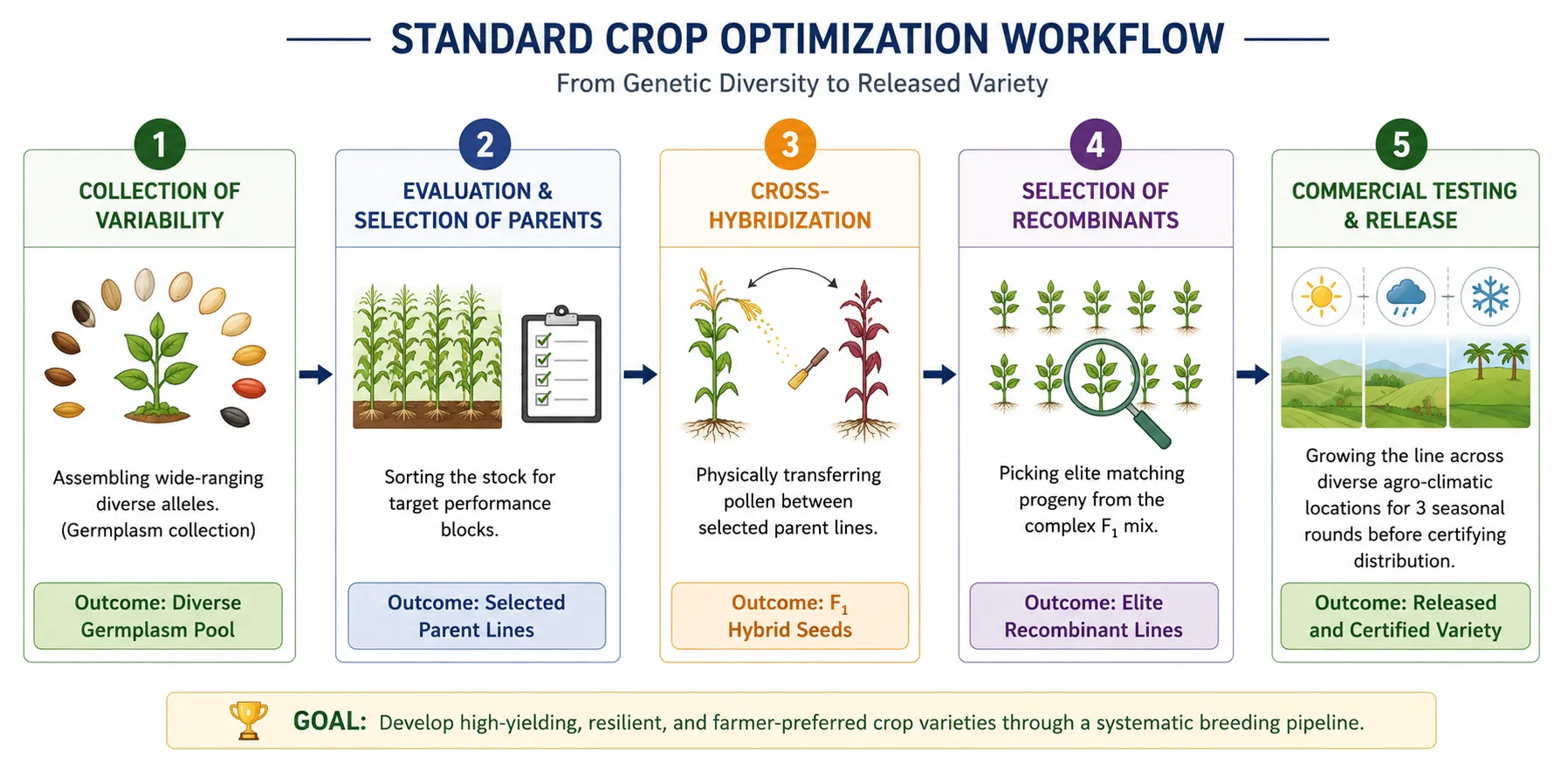
Q9. Trace the steps of plant breeding programs in agriculture with proper flow.
Step 1: Flow Chart Breakdown. The systematic workflow of a standard crop optimization project is mapped below:
1. Collection of Variability → Assembling wide-ranging diverse alleles (Germplasm collection).
2. Evaluation & Selection of Parents → Sorting the stock for target performance blocks.
3. Cross-hybridization → Physically transferring pollen between selected parent lines.
4. Selection of Recombinants → Picking elite matching progeny from the complex F1 mix.
5. Commercial Testing & Release → Growing the line across diverse agro-climatic locations for 3 seasonal rounds before certifying distribution.
Q10. Explain Tissue Culture. What are its applications in food enhancement?
Step 1: Core Definition. An in-vitro laboratory system where specialized cells or structural fragments (explants) are cultivated under completely sterile nutrient parameters to construct whole plants via totipotency.
Step 2: Application 1 (Micropropagation). Rapid propagation models can synthesize thousands of exact genetic replicas (somaclones) simultaneously.
Step 3: Application 2 (Disease Cleanup). Utilizing apical/axillary meristems enables growers to obtain completely virus-free crops from heavily contaminated parent variants.
Step 4: Application 3 (Protoplast Synthesis). Erasing cellular boundaries allows somatic hybridization options to generate completely unique cultivars like Pomato.
Case-Based Questions
Read the passage and answer: A dairy farmer, Mr. Sharma, noticed that continuous breeding of his purebred Jersey cows within the same herd for the last 5 generations has resulted in a sudden drop in milk production and fertility. He consulted a veterinary doctor.
Q11. What biological phenomenon is Mr. Sharma's herd suffering from?
Step 1: Evaluation. The herd is directly suffering from Inbreeding Depression due to continuous mating of close relatives over multiple generations.
Q12. What immediate solution should the doctor suggest to restore fertility and milk yield?
Step 1: Action Plan. The doctor must suggest a single round of Out-crossing. Mating the affected female cows with an completely unrelated, superior bull of the same breed instantly resolves inbreeding depression.
Q13. If Mr. Sharma wants to introduce the genes of a disease-resistant local breed into his Jersey herd, which breeding method should he use?
Step 1: Solution Mapping. He must employ Cross-breeding. This practice combines the high milk-yielding attributes of the Jersey line with the strong local defense systems of the indigenous variant.
Assertion-Reason Questions
Directions: Use the standard matching index: (A) Both True + R explanation, (B) Both True but R not explanation, (C) A True, R False, (D) A False, R True.
Q14. Assertion: Apical and axillary meristems are used for tissue culture to get disease-free plants.
Reason: Meristems divide faster than viruses can multiply.
Step 1: Verify statement correctness. Option (A) is correct. Both statements are accurate, and the reason explicitly justifies why the targeted tissues are virus-free.
Q15. Assertion: Inbreeding is completely harmful and should never be practiced.
Reason: Inbreeding exposes harmful recessive genes.
Step 1: Verify statement correctness. Option (D) is correct. The assertion statement is fundamentally false because structured inbreeding is vital to form distinct purelines, while the reason is fully accurate.
Common Mistakes Students Make
- Inbreeding Depression Fix Confusion: Students often mistakenly write "cross-breeding" to solve inbreeding depression. Remember, out-crossing fixes it, not cross-breeding. Keep this distinction clear!
- Misordering Breeding Cascades: Shifting the chronological order of the 5 standard plant optimization steps will result in a heavy loss of marks. Stick to the exact timeline.
- Somatic Merging vs Micropropagation: Micropropagation generates exact clones (somaclones). Somatic hybridization dissolves cell walls to fuse distinct lines altogether.
- Leaving Out Examples: Writing conceptual statements without providing practical examples (like Sonalika for wheat, Jaya for rice) makes answers appear incomplete to board examiners.
Exam Preparation Tips for CBSE 2026
- Flowcharts Rule: Convert complex, text-heavy architectures like MOET or Plant Breeding pipelines into dynamic vertical flowcharts. It guarantees higher visibility.
- Bold Technical Anchors: Always highlight or underline core vocabulary items like 'Totipotency', 'Explant', 'Somaclones', or 'Biofortification' during your revisions.
- Solve Prior Material: Target the past 5 seasons of Previous Year Questions (PYQs). Board frameworks tend to cycle standard problems frequently.
- Pacing: Do not rush long-answer 5-mark blocks toward the final moments. Keep your point-wise configurations clean with structural sub-headings.
Frequently Asked Questions (FAQs)
1. Is Chapter 9 Strategies for Enhancement in Food Production important for boards?
2. Where can I download the updated NCERT PDF for Biology Class 12?
3. Which questions from Chapter 9 are most important for 2026?
4. How to remember the steps of Plant breeding easily?
5. What is the difference between Somaclones and Somatic Hybrids?
Conclusion:
Toh dosto, yeh the detailed NCERT Solutions for Class 12 Biology Chapter 9 along with extra board-level important questions. Regular revision is the key to mastering Biology. In terms aur definitions ko baar-baar likh kar practice karein. Agar aapko yeh notes helpful lage, toh examspark.in par aate rahiye. Make sure to solve PYQS, download our free PDF notes, and step into that examination hall with full confidence. All the best for your 2026 exams! You've got this! — Lucky (Founder, examspark.in)