Reproduction in Organisms Complete Solutions
Hey Lucky! Class 12 Biology ka Chapter 1 thoda basic lag sakta hai, but it sets the foundation for genetics and human reproduction. In this guide, hum Updated NCERT Solutions for Class 12 Biology Chapter 1 ke sath-sath Board Exam Questions 2026 cover karenge. Boards ho ya NEET, this chapter is highly scoring. Tension mat lo, just follow these simple explanations and clear all your concepts easily!
Learning Objectives
After completing this chapter, students will be able to:
- Understand the fundamental concept of lifespan and the necessity of reproduction.
- Differentiate clearly between asexual and sexual modes of reproduction.
- Identify various types of vegetative propagation in plants.
- Explain the three major events of sexual reproduction: pre-fertilization, fertilization, and post-fertilization.
- Distinguish between external and internal fertilization and oviparous vs viviparous animals.
Key Concepts, Definitions & Rules
- Lifespan: The period from birth to the natural death of an organism. It is not necessarily correlated with the size of the organism.
- Reproduction: A biological process in which an organism gives rise to young ones (offspring) similar to itself.
- Clone: Morphologically and genetically identical individuals produced through asexual reproduction.
- Asexual Reproduction: Reproduction involving a single parent without the fusion of gametes. Common in single-celled organisms (e.g., Amoeba, Yeast).
- Sexual Reproduction: Involves the formation and fusion of male and female gametes to form a zygote, leading to genetic variation.
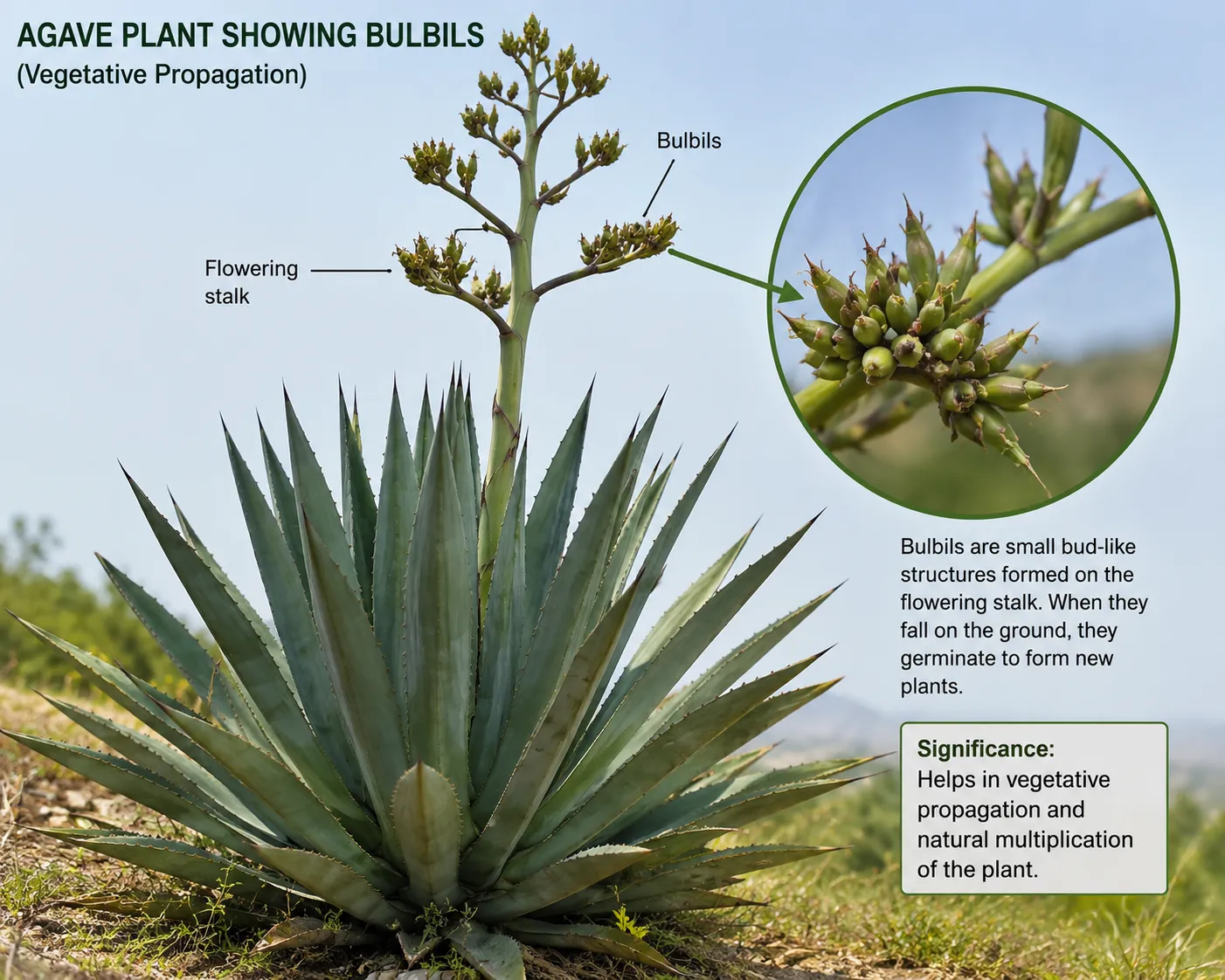
- Vegetative Propagation: A form of asexual reproduction in plants where new plants are formed from vegetative parts like roots, stems, and leaves (e.g., Rhizome in ginger, Bulbil in Agave).
- Parthenogenesis: Development of an unfertilized egg into a complete individual (e.g., Rotifers, honeybees, some lizards).
- Syngamy (Fertilization): The complete and permanent fusion of male and female gametes to form a diploid zygote.
Full NCERT Solutions (Step-by-Step)
Here are the complete, step-by-step NCERT Solutions for Class 12 Biology Chapter 1.
Question 1: Why is reproduction essential for organisms?
Step 1: Species Survival. Reproduction is essential for the survival of a species on Earth. It ensures the continuity of life generation after generation. Bina reproduction ke, koi bhi species dheere-dheere extinct ho jayegi.
Step 2: Adaptation. It also introduces genetic variations (in sexual reproduction), which help organisms adapt to changing environments.
Question 2: Which is a better mode of reproduction: sexual or asexual? Why?
Step 1: The Better Mode. Sexual reproduction is considered better.
Step 2: Reason for Variation. It involves the fusion of male and female gametes from two different parents, which leads to genetic recombination.
Step 3: Evolutionary Benefit. This genetic variation is crucial for evolution and provides better adaptability to changing environmental conditions, increasing the chances of survival.
Question 3: Why is the offspring formed by asexual reproduction referred to as clone?
Step 1: Single Parent Nature. Asexual reproduction involves only a single parent. There is no crossing over or fusion of gametes.
Step 2: Resulting Offspring. As a result, the offspring are exact copies of their parent—both morphologically (physically) and genetically. Hence, they are called clones.
Question 4: Offspring formed due to sexual reproduction have better chances of survival. Why? Is this statement always true?
Step 1: Why chances are better. Yes, they generally have better survival chances because sexual reproduction introduces genetic variations, which help the offspring adapt to diverse environmental changes.
Step 2: Is it always true? However, this statement is not always true. If the offspring are born in a highly stable environment where the parents were already perfectly adapted, identical clones (from asexual reproduction) might survive just as well. Also, survival depends on parental care and external predators.
Question 5: How does the progeny formed from asexual reproduction differ from those formed by sexual reproduction?
Step 1: Asexual Progeny. They are formed from a single parent, are genetically and morphologically identical to the parent (clones), and show no variations.
Step 2: Sexual Progeny. They are formed by the fusion of gametes from two parents, have a mix of genetic material, and show distinct variations from the parents.
Question 6: Distinguish between asexual and sexual reproduction. Why is vegetative reproduction also considered as a type of asexual reproduction?
Step 1: Differences Table.
| Asexual Reproduction | Sexual Reproduction |
|---|---|
| Involves a single parent. | Involves two parents (usually). |
| Gametes are not formed. | Involves the formation and fusion of gametes. |
| Offspring are clones. | Offspring show genetic variations. |
| Fast process. | Slow and complex process. |
Step 2: Why Vegetative reproduction is asexual. In vegetative propagation, new plants arise from somatic cells of plant parts (stems, roots, leaves) without the formation or fusion of gametes. Since only one parent is involved and the offspring are clones, it is a type of asexual reproduction.
Question 7: What is vegetative propagation? Give two suitable examples.
Step 1: Definition. Vegetative propagation is a mode of asexual reproduction in plants where new individuals develop from the vegetative parts of the plant, known as vegetative propagules.
Step 2: Example 1. Eyes of Potato: Buds present on the potato tuber can sprout to form new plants.
Step 3: Example 2. Rhizome of Ginger: Underground stems that contain nodes from which new roots and shoots develop.
Question 8: Define (a) Juvenile phase, (b) Reproductive phase, (c) Senescent phase.
Step 1: Juvenile phase. The period of growth and maturity in an organism's life before it can reproduce sexually. (Known as the vegetative phase in plants).
Step 2: Reproductive phase. The phase in which organisms are sexually mature and capable of producing offspring.
Step 3: Senescent phase. The final phase of lifespan where reproductive capacity declines, metabolism slows down, eventually leading to death.
Question 9: Higher organisms have resorted to sexual reproduction in spite of its complexity. Why?
Step 1: Introduction of Variation. Even though it requires more energy and time, higher organisms prefer sexual reproduction because it introduces genetic variation.
Step 2: Survival & Evolution. Ye variation species ko changing environments me survive karne ki power deta hai (natural selection) and prevents the accumulation of harmful mutations, promoting evolution.
Question 10: Explain why meiosis and gametogenesis are always interlinked?
Step 1: Gametogenesis goal. Gametogenesis is the process of gamete formation. In diploid organisms (2n), gametes must be haploid (n) so that upon fertilization, the original diploid number is restored in the zygote.
Step 2: Role of Meiosis. To reduce the chromosome number to half, a reductional division called meiosis is absolutely necessary during gametogenesis.
Question 11: Identify each part in a flowering plant and write whether it is haploid (n) or diploid (2n).
Step 1: (a) Ovary: Diploid (2n)
Step 2: (b) Anther: Diploid (2n)
Step 3: (c) Egg: Haploid (n)
Step 4: (d) Pollen: Haploid (n)
Step 5: (e) Male gamete: Haploid (n)
Step 6: (f) Zygote: Diploid (2n)
Question 12: Define external fertilization. Mention its disadvantages.
Step 1: Definition. External Fertilization: When the fusion of male and female gametes (syngamy) occurs outside the body of the organism (usually in water), it is called external fertilization. Example: Frogs, fishes.
Step 2: Disadvantages.
1. High vulnerability to predators.
2. Requires a large number of gametes to ensure successful fertilization, leading to high energy waste.
3. Highly dependent on external environmental factors (like water currents).
Question 13: Differentiate between a zoospore and a zygote.
Step 1: Differences Table.
| Zoospore | Zygote |
|---|---|
| It is an asexual reproductive structure. | It is the product of sexual reproduction (fusion of gametes). |
| Usually flagellated and motile. | Usually non-motile. |
| Can be haploid or diploid. | Always diploid (2n). |
Question 14: Differentiate between gametogenesis from embryogenesis.
Step 1: Differences Table.
| Gametogenesis | Embryogenesis |
|---|---|
| Formation of haploid male and female gametes. | Development of an embryo from a diploid zygote. |
| Involves meiosis (in diploid organisms). | Involves mitosis and cell differentiation. |
| Pre-fertilization event. | Post-fertilization event. |
Question 15: Describe the post-fertilization changes in a flower.
Step 1: Initial Changes. Sepals, Petals, and Stamens: Wither and fall off.
Step 2: Embryo formation. Zygote: Develops into an embryo.
Step 3: Seed formation. Ovule: Transforms into a seed.
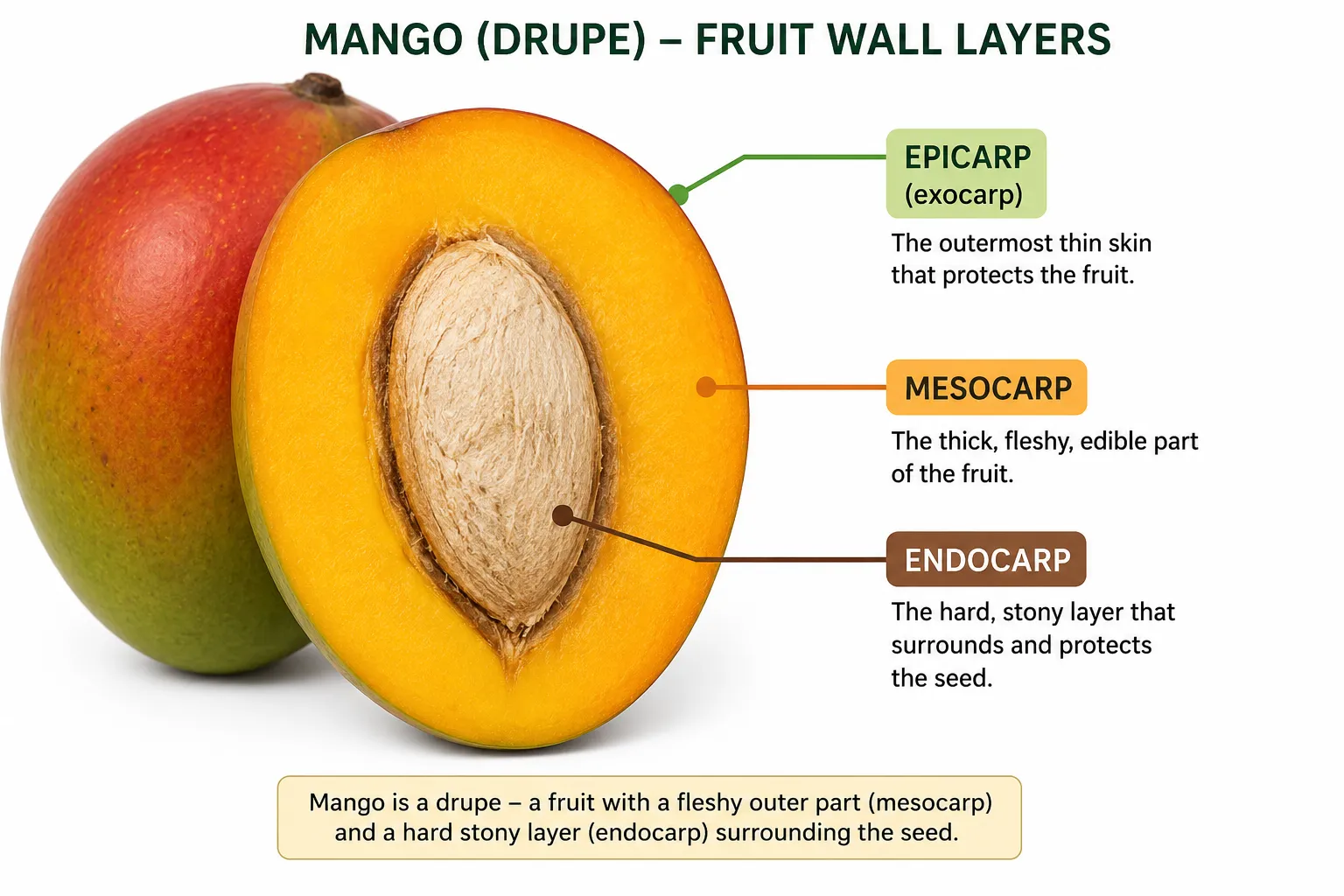
Step 4: Fruit formation. Ovary: Develops into a fruit. Ovary wall: Develops into the pericarp (fruit wall).
Question 16: What is a bisexual flower? Collect five bisexual flowers from your neighbourhood and with the help of your teacher find out their common and scientific names.
Step 1: Definition. A flower that contains both male (stamens) and female (pistil) reproductive organs is called a bisexual flower.
Step 2: Examples.
1. China rose (Hibiscus rosa-sinensis)
2. Mustard (Brassica campestris)
3. Pea (Pisum sativum)
4. Tomato (Solanum lycopersicum)
5. Onion (Allium cepa)
Question 17: Examine a few flowers of any cucurbit plant and try to identify the staminate and pistillate flowers. Do you know any other plant that bears unisexual flowers?
Step 1: Cucurbits identification. Cucurbits (like pumpkin, cucumber) have unisexual flowers.
Step 2: Staminate flowers. Male flowers bearing only stamens (no ovary at the base).
Step 3: Pistillate flowers. Female flowers bearing only pistils (a small swollen ovary is visible below the petals).
Step 4: Other examples. Other plants with unisexual flowers: Papaya, Watermelon, Date palm.
Question 18: Why are offspring of oviparous animals at a greater risk as compared to offspring of viviparous animals?
Step 1: Oviparous Risk. Oviparous animals lay eggs in the external environment (e.g., birds, reptiles). Unke eggs predators, harsh weather, aur environmental stress ka direct shikar ban sakte hain.
Step 2: Viviparous Advantage. In viviparous animals (like mammals), the embryo develops inside the mother's protected body, ensuring much higher chances of survival and proper nourishment before birth.
Extra Important Questions (Board Style)
Yahan kuch handpicked questions hain jo CBSE Board Exams 2026 ke liye bohot important hain.
Multiple Choice Questions (MCQs)
1. Which of the following is a post-fertilization event in flowering plants?
(a) Transfer of pollen grains
(b) Embryo development
(c) Formation of flower
(d) Formation of pollen grains
Step 1: Logic. (b) Embryo development. (It occurs after the zygote is formed post-fertilization).
2. The term 'clone' cannot be applied to offspring formed by sexual reproduction because:
(a) Offspring do not possess exact copies of parental DNA
(b) DNA of only one parent is copied and passed on to the offspring
(c) Offspring are formed at different times
(d) DNA of parent and offspring are completely different
Step 1: Logic. (a) Offspring do not possess exact copies of parental DNA. (Due to genetic recombination).
Short Answer Questions (2-3 Marks)
3. Differentiate between Oestrus cycle and Menstrual cycle.
Step 1: Oestrus cycle. Occurs in non-primate mammals (cows, dogs). Females show strong sexual urge only during a specific "heat" period. No bleeding occurs.
Step 2: Menstrual cycle. Occurs in primates (monkeys, apes, humans). Continuous cycle with shedding of the uterine lining (bleeding/menstruation).
4. What is the significance of the pericarp?
Step 1: Function. The pericarp is the protective wall of the fruit developed from the ovary wall. It protects the seeds inside and often helps in seed dispersal.
5. Define Hermaphrodite with an example.
Step 1: Definition. Organisms that possess both male and female reproductive organs in the same individual are called hermaphrodites.
Step 2: Example. Earthworm, Leech.
Long Answer Questions (5 Marks)
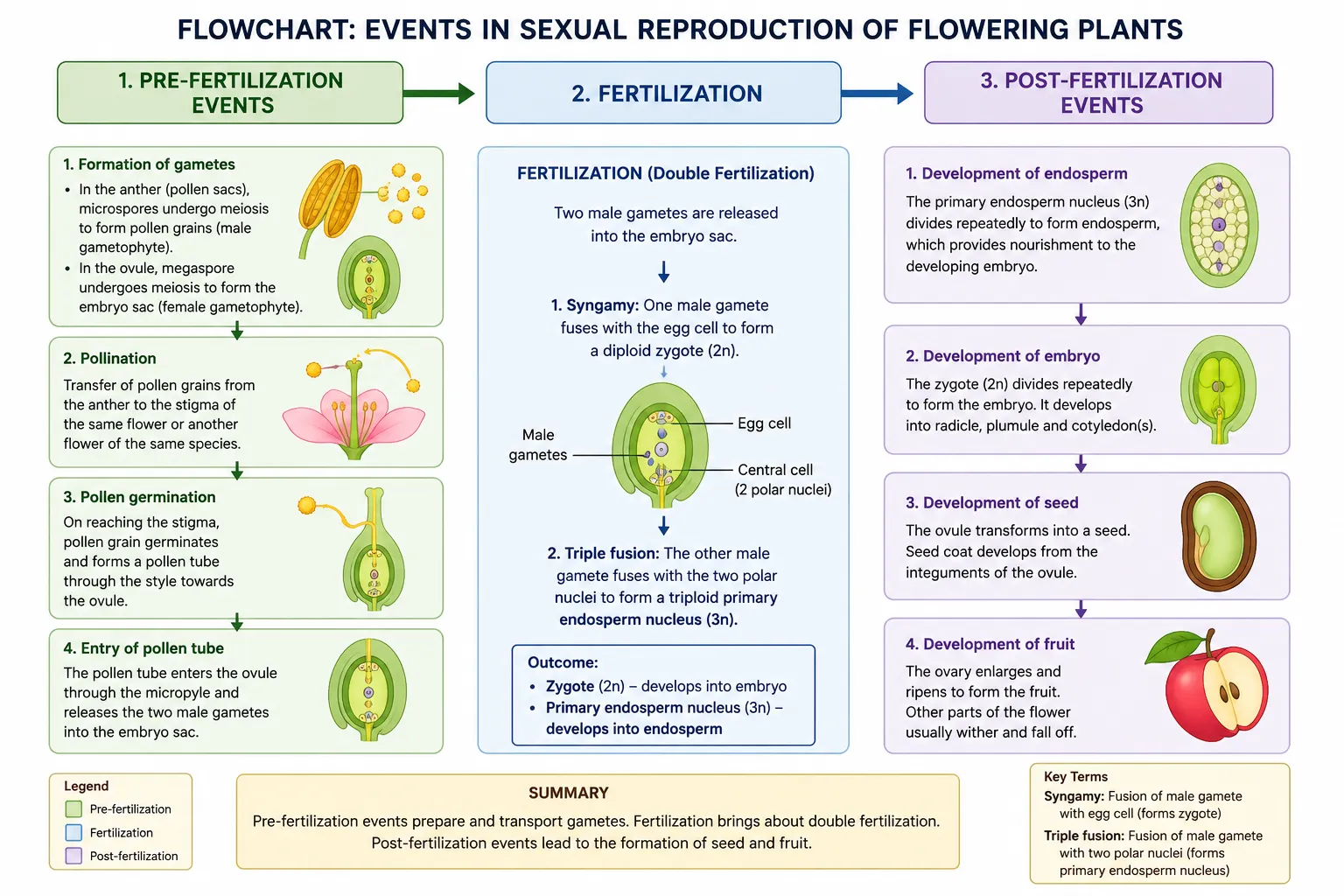
6. Describe the three major events in sexual reproduction.
Step 1: Pre-fertilization events. Includes Gametogenesis (formation of male and female haploid gametes) and Gamete Transfer (e.g., pollination in plants or physical mating in animals).
Step 2: Fertilization (Syngamy). The fusion of male and female gametes to form a diploid zygote. It can be internal or external.
Step 3: Post-fertilization events. The formation of the zygote and Embryogenesis (development of the embryo from the zygote through cell division and differentiation).
7. Water is essential for the reproduction of bryophytes and pteridophytes. Explain why.
Step 1: Nature of gametes. In lower plants like algae, bryophytes, and pteridophytes, the male gametes are motile and flagellated.
Step 2: Requirement for medium. They require a medium to swim and reach the stationary female gamete (egg) inside the archegonium. Without water, gamete transfer fails, and fertilization cannot occur.
Case-Based / Passage-Based Question
Read the passage and answer the questions (8-10):
In an orchard, a farmer notices that his apple trees produce fruits only when bees are highly active during the spring season. However, in his potato field, new potato plants grow abundantly from the old tubers planted in the soil without any insect activity.
8. Which type of reproduction is occurring in the potato field?
Step 1: Identification. Vegetative propagation (a type of asexual reproduction).
9. Why do apple trees depend on bees?
Step 1: Mechanism. Apple trees undergo sexual reproduction and rely on bees for pollination (gamete transfer)—carrying pollen from the anther to the stigma.
10. Which crop will have a better chance of surviving a sudden new viral disease and why?
Step 1: Crop Selection. The apple trees.
Step 2: Reason. Sexual reproduction in apples introduces genetic variation, meaning some trees might naturally possess resistance. Potatoes are clones; if a virus affects one, it can wipe out the entire genetically identical crop.
Assertion-Reason Questions
Options:
(A) Both A and R are true and R is the correct explanation of A.
(B) Both A and R are true but R is not the correct explanation of A.
(C) A is true but R is false.
(D) A is false but R is true.
11. Assertion (A): Amoeba reproduces by binary fission.
Reason (R): All single-celled organisms reproduce sexually.
Step 1: Verification. (C) A is true but R is false. (Single-celled organisms primarily reproduce asexually).
12. Assertion (A): Viviparous animals give better protection to their embryos.
Reason (R): The zygote develops inside the female body.
Step 1: Verification. (A) Both A and R are true, and R correctly explains A.
Miscellaneous Short Questions
13. Mention the exact site of fertilization in human females.
Step 1: Location. Fallopian tube (Ampullary region).
14. What are vegetative propagules? Give the propagule for Agave.
Step 1: Definition. Vegetative propagules are plant structures capable of giving rise to new plants.
Step 2: Agave example. For Agave, it is the Bulbil.
15. Why do algae produce a massive number of gametes?
Step 1: Mechanism. Algae undergo external fertilization in water.
Step 2: Reason for massive numbers. A huge number of gametes are produced to compensate for the massive loss of gametes to water currents and predators, ensuring that at least some fertilization occurs.
Common Mistakes Students Make
- Clone vs Offspring: Never use the word "clone" for babies born through sexual reproduction. Clones strictly belong to asexual reproduction.
- Zoospore vs Zygote: Students mix these up. Memory trick: Zygote is the Zero phase of a new life (after fertilization = 2n). Zoospores are just wandering spores (asexual).
- Embryogenesis cell division: Students often write "meiosis occurs during embryogenesis." Wrong! Embryogenesis relies strictly on mitosis (growth). Meiosis only happens during gametogenesis.
- Internal vs External Fertilization Examples: Don't write 'frog' for internal. Frogs do external fertilization; they release gametes in water.
Exam Preparation Tips
- Revision Trick: Don't read paragraphs. Make a comparative table for Asexual vs Sexual reproduction, and Oviparous vs Viviparous.
- Diagrams Matter: Always practice the diagrams of binary fission in Amoeba, budding in Yeast, and the types of vegetative propagules (ginger, potato, bryophyllum).
- Keywords: CBSE examiners look for specific words. Always underline words like Syngamy, Parthenogenesis, Clones, and Embryogenesis in your answers.
- Time Management: 1-mark questions should be answered in one sentence. Save your time for the 5-mark explanation questions!
Frequently Asked Questions (FAQs)
Is Reproduction in Organisms important for boards 2026?
Where can I download the NCERT PDF for Class 12 Biology?
Which questions are most important from Chapter 1?
What is the difference between syngamy and fertilization?
How to score full marks in Biology Class 12?
Conclusion:
Yaar Lucky, aur baaki sabhi students, Chapter 1 is all about understanding the circle of life. Make sure you memorize those key terms and differences perfectly! Revise regularly, write down the definitions to build muscle memory, and practice PYQs to get a feel of the board exam pattern. Bookmark this page, download your notes, and face the 2026 boards with absolute confidence. You've got this!