Biotechnology and its Applications Complete Solutions
Mastering Class 12 Biology Chapter 12 is vital for scoring high in your CBSE board exams and competitive tests like NEET. This chapter covers how genetic engineering transforms agriculture, medicine, and industries. Our updated NCERT solutions and important questions for 2026 provide clear, step-by-step explanations. Dive into concepts like Bt cotton, humulin production, and gene therapy to secure your full marks with confidence.
Learning Objectives
After completing this chapter, students will be able to:
- Explain how biotechnology provides pest-resistant and climate-resilient crops.
- Describe the production process of genetically engineered human insulin.
- Understand the clinical mechanism of gene therapy using the ADA deficiency model.
- Differentiate between various molecular diagnostic tools like PCR, ELISA, and autoradiography.
- Evaluate the ethical issues, patent protocols, and real-world impacts of biopiracy.
Key Concepts & Definitions
- Genetically Modified Organisms (GMOs): Plants, bacteria, fungi, and animals whose genes have been altered by artificial manipulation.
- Bt Toxin: An insecticidal protein produced by the bacterium Bacillus thuringiensis, toxic to specific insect orders like lepidopterans, coleopterans, and dipterans.
- RNA Interference (RNAi): A cellular defense mechanism in all eukaryotic organisms involving the silencing of specific mRNA due to a complementary double-stranded RNA (dsRNA) molecule.
- Humulin: The commercial name for chemically synthesized recombinant human insulin produced using E. coli plasmids.
- Gene Therapy: A collection of methods that allows the correction of a gene defect diagnosed in a human embryo or child.
- Biopiracy: The unauthorized commercial exploitation of bioresources and traditional knowledge native to a particular country without proper authorization or compensation.
Full NCERT Solutions (Step-by-Step)
Here are the complete, step-by-step textbook solutions for Class 12 Biology Chapter 12, written precisely to match CBSE board presentation standards.
Question 1: Crystals of Bt toxin produced by some bacteria do not kill the bacteria themselves because:
1. Bacteria are resistant to the toxin.
2. Toxin is immature.
3. Toxin is an inactive protoxin.
4. Bacteria encloses toxin in a special sac.
Step 1: Production State. The bacterium Bacillus thuringiensis produces insecticidal crystal proteins during a specific phase of its growth. However, these proteins exist as inactive protoxins inside the bacterial cell, rendering them completely harmless to the host bacterium itself.
Step 2: Solubilization Mechanism. Once an insect ingests this protoxin, the highly alkaline pH of the insect's midgut solubilizes the crystals. This alkaline environment converts the inactive protoxin into its active, toxic form.
Step 3: Pathological Effect. The activated toxin binds to the epithelial surface of the midgut, creating pores that cause cell swelling and lysis, ultimately leading to the death of the pest.
Question 2: What are transgenic bacteria? Illustrate using any one example.
Step 1: Definition. Transgenic Bacteria are bacteria whose genetic material has been artificially altered by inserting a foreign gene (transgene) from another species using recombinant DNA technology. This modification forces the bacteria to synthesize a desired protein of commercial or therapeutic value.
Step 2: Example Framework. Recombinant Human Insulin (Humulin) Production: In 1983, an American company named Eli Lilly successfully prepared transgenic bacteria to produce human insulin.
Step 3: Gene Synthesis & Insertion. They chemically synthesized two DNA sequences corresponding to Chain A and Chain B of human insulin. These sequences were inserted into plasmids of the bacterium Escherichia coli (E. coli) next to the promoter region.
Step 4: Expression & Assembly. The transgenic E. coli strains were cultured separately to produce individual peptide chains. Finally, Chains A and B were extracted, purified, and joined together via disulfide bonds in a laboratory setting to create fully functional human insulin.
Question 3: Compare and contrast the advantages and disadvantages of production of genetically modified crops.
Step 1: Assessment of Advantages.
- Enhanced Pest Resistance: Crops like Bt Cotton contain built-in resistance to targeted pests, significantly reducing dependence on harmful chemical pesticides.
- Abiotic Stress Tolerance: Genes can be transferred to make crops highly resilient to harsh environmental conditions such as extreme drought, cold, salinity, and heat waves.
- Improved Nutritional Value: Food crops can be biofortified. A classic example is Golden Rice, which is genetically enriched with Vitamin A (beta-carotene) to prevent nutritional blindness.
- Reduced Post-Harvest Losses: Genetic tweaks help slow down the ripening and degradation processes, boosting shelf life during transit.
- Increased Efficiency of Mineral Usage: GM plants optimize soil nutrient absorption, preventing early exhaustion of soil fertility.
- Ecological Risk & Gene Flow: There is a persistent concern that transgenes might escape into wild relatives via cross-pollination, leading to the creation of herbicide-resistant "superweeds".
- Impact on Non-Target Organisms: The widespread expression of insecticidal toxins might inadvertently harm beneficial insects like honeybees and butterflies.
- Human Allergies and Health Concerns: Introducing novel foreign proteins into standard dietary items poses a risk of triggering unexpected allergic reactions in humans.
- Economic Monopolies: High costs for patented GM seeds make small-scale farmers heavily dependent on massive multinational biotechnology corporations.
Question 4: What are Cry proteins? Name an organism that produces it. How has man exploited this protein to his benefit?
Step 1: Definition. Cry proteins (crystal proteins) are specialized insecticidal proteins encoded by the cry genes that form crystalline structures during the sporulation phase of certain bacteria.
Step 2: Source Organism. These proteins are natively produced by the soil bacterium Bacillus thuringiensis.
Step 3: Human Exploitation via Targeted Control. Biotechnologists have successfully isolated various cry genes from this bacterium and integrated them into commercial crop plants to provide target-specific insect resistance. Different Cry proteins target specific insect groups. For instance, the genes cryIAc and cryIIAb produce toxins that effectively control the cotton bollworm pest, while the cryIAb gene is used to control the corn borer.
Step 4: Development of Bt Cotton. By introducing these genes directly into the plant genome, the crop manufactures its own protection. When an insect attempts to feed on the plant tissue, it ingests the toxin and dies, eliminating the need for periodic external chemical pesticide sprays.
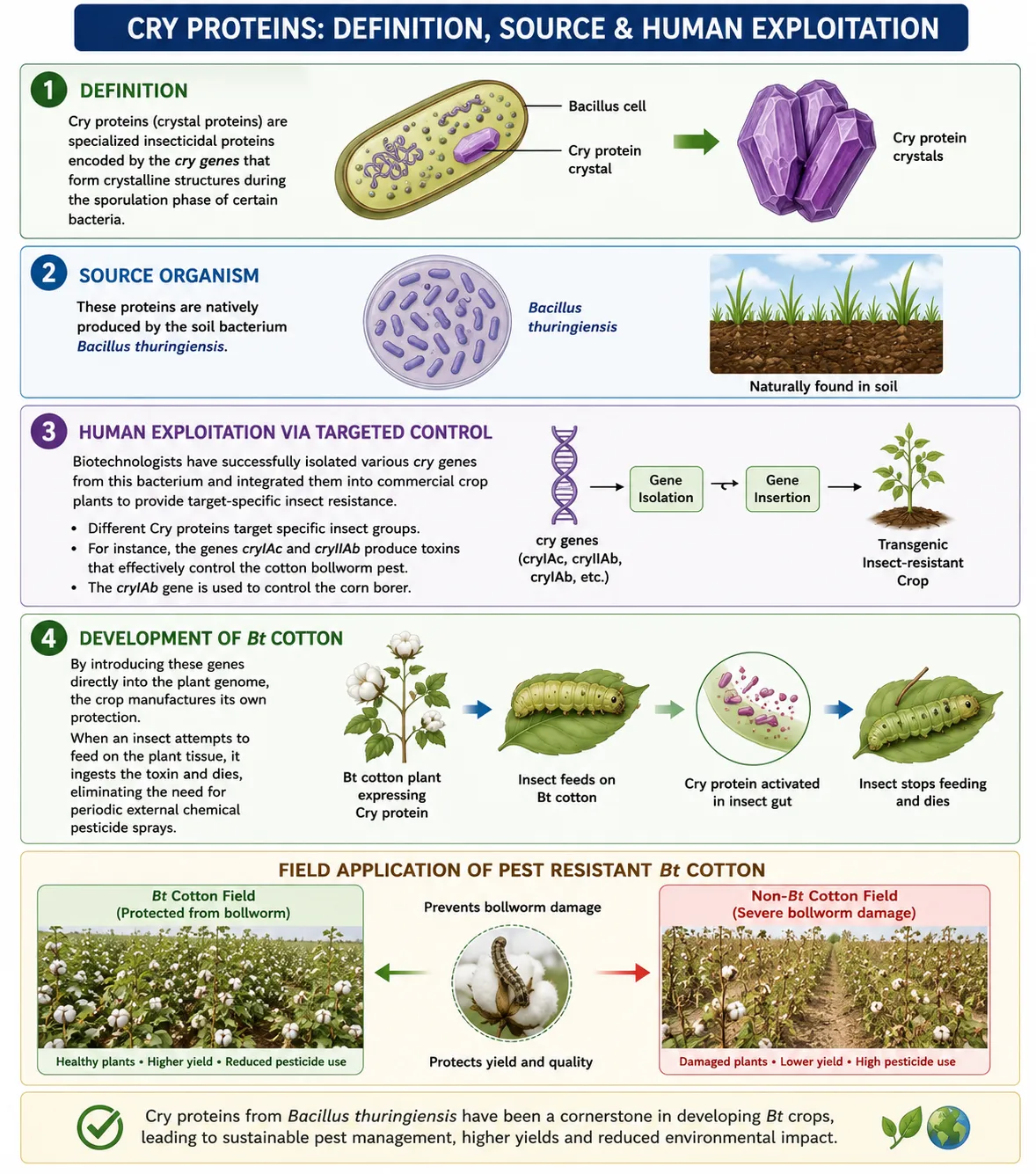
Field Application of Pest Resistant Bt Cotton.
Question 5: What is gene therapy? Illustrate using the example of adenosine deaminase (ADA) deficiency.
Step 1: Definition. Gene Therapy is an advanced therapeutic approach that involves introducing functional, healthy genes into an individual's cells or tissues to replace, repair, or compensate for a defective, disease-causing mutant allele.
Step 2: Case Study Context. ADA deficiency is a rare genetic disorder caused by the deletion of the gene responsible for synthesizing the enzyme adenosine deaminase. This enzyme is absolutely critical for the survival and maturation of infection-fighting T and B lymphocytes. Without it, the patient develops SCID (Severe Combined Immunodeficiency).
Step 3: Recombinant Procedure Steps. The first clinical trial was conducted in 1990 on a four-year-old girl using these steps:
- Lymphocyte Isolation: Lymphocytes are carefully harvested from the peripheral blood of the ADA-deficient patient and cultured in nutrient media inside a laboratory environment.
- Gene Integration: A functional, healthy human ADA cDNA sequence is engineered into a modified, harmless retroviral vector. This vector transfers the healthy gene into the cultured patient lymphocytes.
- Reinfusion: The genetically modified, functional lymphocytes are injected back into the patient's bloodstream, where they produce active ADA enzymes.
Question 6: What is RNA interference (RNAi)? How does it function?
Step 1: Definition. RNA Interference (RNAi) is a natural biological process occurring in all eukaryotic organisms as a highly conserved method of cellular defense against viral infections and transposon migrations.
Step 2: Functional Mechanism. The process acts as a sequence-specific post-transcriptional gene silencing system working as follows:
- Introduction of dsRNA: The process is triggered whenever a complementary double-stranded RNA molecule enters a cell.
- Dicer Cleavage: An enzyme named Dicer cuts this long dsRNA into short fragments called small interfering RNAs (siRNAs).
- RISC Activation: These fragments assemble into a multi-protein complex known as the RNA-Induced Silencing Complex (RISC).
- Target Binding & Cleavage: The single-stranded RNA guide bound within RISC pairs with its matching complementary host mRNA sequence and slices it, preventing translation.
Question 7: Name the first transgenic cow and explain how its milk was enriched.
Step 1: Identification. The world's first transgenic cow was named Rosie, produced in 1997.
Step 2: Processing Logic. Natural cow milk contains proteins that can be difficult for human infants to digest comfortably. Biotechnologists modified Rosie's genome to express the human gene for alpha-lactalbumin.
Step 3: Enrichment Outcome. As a result, Rosie produced milk containing \(2.4\text{ grams}\) of human alpha-lactalbumin per liter. This transgenic milk was far more balanced nutritionally for human babies than normal bovine milk, offering a superior alternative for infant formula.
Question 8: What is biopiracy? Explain with an example of an Indian crop.
Step 1: Definition. Biopiracy is the unauthorized practice where multinational corporations or wealthy organizations exploit indigenous biological resources or traditional knowledge native to a particular nation without obtaining formal legal consent or providing fair financial compensation.
Step 2: Case Context. Basmati Rice Patent Controversy: Basmati rice is an ancient, deeply cherished aromatic grain variety that has been cultivated across the Indian subcontinent by indigenous farmers for centuries.
Step 3: Exploitation Breakdown. In 1997, an American corporation managed to secure a patent for "Basmati rice lines and grains" through the US Patent and Trademark Office. This patent allowed the US company to market a new variety of Basmati, which they derived by cross-breeding traditional Indian Basmati varieties with semi-dwarf semi-exotic strains.
Step 4: Legal Conflict & Resolution. This legal patent effectively restricted Indian farmers from exporting authentic Basmati rice varieties globally under their historical name. Following intense legal challenges and protests by the Indian government, several claims of the patent were successfully reversed.
Question 9: What are the primary ethical concerns surrounding Genetically Modified Organisms (GMOs)?
Step 1: Ecological Disruption. Unpredictable Ecological Balance: Introducing foreign genes into natural ecosystems might yield unpredictable phenotypic impacts, potentially disrupting native food chains and local biodiversity.
Step 2: Violation of Evolutionary Barriers. Violating Species Barriers: Relocating complex genetic sequences across completely unrelated species boundaries is viewed by many communities as an unnatural interference with evolutionary biology.
Step 3: Socio-Economic Inequity. Exploitation of Developing Nations: Corporations from developed nations often patent indigenous genetic resources from developing countries without sharing the economic rewards.
Step 4: Institutional Supervision. To address these concerns, governments establish regulatory councils. In India, the GEAC (Genetic Engineering Appraisal Committee) evaluates the biosafety and ethical validity of approving any scale of GM research or environmental release.
Question 10: Explain how Eli Lilly produced human insulin using recombinant DNA technology.
Step 1: Structural Challenge. Human insulin is synthesized naturally as a prohormone containing three distinct polypeptide chains: Chain A, Chain B, and an extra C-peptide. This C-peptide must be cleaved and removed to turn the inactive prohormone into its mature, active configuration.

Recombinant Production Workflow for Recombinant Human Insulin. Dimensions: \(2.5\ \mu\text{m}\)
Step 2: Independent Synthesis. In 1983, Eli Lilly solved the engineering hurdle by skipping the processing problem entirely; they synthesized separate artificial DNA sequences for Chain A and Chain B.
Step 3: Plasmid Cloning. They cloned these individual sequences into separate expression plasmids of the laboratory bacterium Escherichia coli.
Step 4: Batch Expression & Assembly. The two distinct transgenic bacterial batches produced Chain A and Chain B peptides independently. Technicians extracted and purified these individual protein strands, combining them using disulfide bridges to yield authentic, active human insulin (Humulin).
Extra Important Questions (Board Style)
Yahan ExamSpark ke students ke liye exclusive, high-probability practice questions diye gaye hain.
Section A: Multiple Choice Questions (MCQs)
Q1: Which of the following genes encodes proteins that effectively control the cotton bollworm infestation?
A. cryIAb
B. cryIAc and cryIIAb
C. ampR
D. RNAi plasmid
Step 1: Logic. The genes cryIAc and cryIIAb specialize in stopping cotton bollworm, whereas cryIAb is adapted to target the corn borer pest.
(Difficulty Level: Easy)
Q2: The specific site of action of activated Bt toxin within an infected insect pest is:
A. Malpighian tubules
B. Midgut epithelial cells
C. Central nervous system cells
D. Salivary glands
Step 1: Logic. The active toxin targets midgut epithelial cells, creating microscopic pores that cause cell lysis and lethal starvation.
(Difficulty Level: Easy)
Q3: Which molecular diagnostic tool relies directly on the detection of antigen-antibody interactions?
A. PCR
B. Gel Electrophoresis
C. ELISA
D. Autoradiography
Step 1: Logic. ELISA (Enzyme-Linked Immunosorbent Assay) is built on the principle of antigen-antibody specificity.
(Difficulty Level: Easy)
Section B: Assertion-Reason Questions
Directions: Option A (Both true, R is explanation), Option B (Both true, R not explanation), Option C (A true, R false), Option D (A false, R true).
Q4: Assertion (A): The clinical administration of gene therapy for ADA deficiency using patient lymphocytes requires recurring infusion sessions.
Reason (R): Genetically engineered lymphocytes isolated from human blood are not immortal cells.
Step 1: Logic. Since lymphocytes naturally die off over time, the patient must receive regular infusions of modified cells to maintain protection.
(Difficulty Level: Medium)
Q5: Assertion (A): Tobacco plants engineered with sense and antisense nematode genes survive pest infestations.
Reason (R): Double-stranded RNA (dsRNA) initiates the RNA interference path, silencing vital nematode mRNA.
Step 1: Logic. Co-expressing both strands forms a dsRNA structure that activates the host's internal RNAi machinery, destroying target nematode mRNA when the pest feeds.
(Difficulty Level: Hard)
Q6: Assertion (A): Mature human insulin lacks the C-peptide chain.
Reason (R): The C-peptide chain is added during the final extraction stage of commercial Humulin synthesis.
Step 1: Logic. Mature active insulin naturally sheds the C-peptide. In commercial recombinant synthesis, the C-peptide sequence is completely omitted from the start rather than being added later.
(Difficulty Level: Medium)
Section C: Short Answer Questions (SAQs)
Q7: Explain the core function of the Genetic Engineering Appraisal Committee (GEAC).
Step 1: Mandate. The GEAC is a statutory regulatory body under the Ministry of Environment, Forest and Climate Change in India.
Step 2: Responsibilities. Its critical roles are:
- Evaluating the safety and ethical validity of large-scale genetic engineering research projects.
- Assessing potential biohazards before approving the commercial release of GM crops into public farming ecosystems.
Q8: Why is standard PCR preferred over traditional diagnostic methods for detecting pathogens in early stages of infection?
Step 1: Traditional Limit. Traditional methods like serum analysis or cell cultures only detect a pathogen after its concentration has multiplied enough to cause visible symptoms.
Step 2: PCR Advantage. In contrast, PCR (Polymerase Chain Reaction) exponentially amplifies even tiny, trace amounts of pathogen DNA or RNA, allowing accurate detection long before clinical symptoms manifest.
Q9: What are transgenic animals? List two main reasons why they are produced.
Step 1: Definition. Transgenic animals are animals whose genomes have been modified to carry and express an active foreign gene.
Step 2: Primary Reasons. They are engineered to:
- Study Normal Physiology: Investigating how specific genes are regulated and how they affect the body's overall development.
- Chemical Safety Testing: Testing the toxicity of drugs or biological vaccines on animals engineered to be highly sensitive to those chemicals.
Q10: How does a single-stranded DNA or RNA probe help identify a mutant gene in a group of cells using autoradiography?
Step 1: Probe Labeling. A single-stranded DNA or RNA molecule is tagged with a radioactive isotope to act as a diagnostic probe.
Step 2: Hybridization. It is allowed to hybridize with its complementary DNA strand in a collection of target cells.
Step 3: Detection. When exposed to photographic film, the normal gene binds and shows up clearly, while the mutated gene fails to appear because its altered sequence cannot pair with the radioactive probe.
Section D: Long Answer Questions (LAQs)
Q11: Detail the production process of recombinant human insulin. Highlight the primary structural differences between mature insulin and proinsulin.
Step 1: Structural Differences. Proinsulin is an inactive precursor molecule made of three distinct polypeptide chains: Chain A, Chain B, and a connecting C-peptide sequence. During maturation, the C-peptide is cleaved and removed. Mature functional insulin contains only Chain A and Chain B, linked together by strong covalent disulfide bridges.
Step 2: Manufacturing Breakdown. For a step-by-step processing breakdown of how Eli Lilly bypassed this obstacle using independent E. coli plasmid strains to synthesize Chains A and B separately, refer directly to the detailed technical logs in NCERT Solution Question 10.
Q12: What is RNA interference (RNAi)? Provide a detailed breakdown of how this mechanism protects tobacco plants from nematode infections.
Step 1: Core Definition. RNAi is a sequence-specific post-transcriptional gene silencing mechanism triggered inside host cells by double-stranded RNA molecules.
Step 2: Complete Pipeline. Review the step-by-step molecular description provided in NCERT Solution Question 6. Ensure you chart the transition from Agrobacterium vector transformation to dsRNA formation, Dicer enzyme processing, and RISC-mediated mRNA destruction to guarantee maximum marks.
Section E: Case-Based Questions
Case Study Context: Alpha-1-antitrypsin is a human protein produced by the liver that protects lung tissues from damage caused by inflammation. A deficiency in this protein leads to severe emphysema, a chronic respiratory condition where the lung's air sacs are progressively destroyed. Traditional treatments require expensive weekly infusions of proteins extracted from human blood plasma. To make treatment more accessible, scientists introduced the human alpha-1-antitrypsin gene into livestock embryos to express it in the milk of transgenic sheep like 'Tracy'.
Q13: Based on the case text, what specific medical condition is treated using the human protein alpha-1-antitrypsin?
Step 1: Identification. The protein is used to treat emphysema, a severe chronic respiratory disease characterized by the breakdown of alveolar walls.
Q14: Why is extracting therapeutic proteins from transgenic animal milk preferred over traditional extraction from human blood plasma?
Step 1: Operational Efficiency. Producing therapeutic proteins in the milk of transgenic animals offers a much higher production scale and lowers manufacturing costs.
Step 2: Safety Check. It minimizes the structural risk of transmitting unexpected blood-borne pathogens found in human plasma samples.
Common Mistakes Students Make
Exam mein marks lose hone se bachne ke liye in common galti yon par dhyan dein:
- Confusing the Cry Gene with the Cry Protein: Remember that cry (written in lowercase italics) refers strictly to the gene sequence, while Cry (capitalized, regular text) refers to the active insecticidal protein product.
- Misunderstanding the Active State of Bt Toxin: Students often write that the toxin kills the bacteria. Clarify in your answers that it remains an inactive protoxin inside the bacterium and only becomes toxic in the alkaline pH of an insect's gut.
- C-Peptide Inclusion in Insulin: Avoid stating that E. coli synthesizes whole proinsulin. Eli Lilly produced Chain A and Chain B separately, bypassing the C-peptide step entirely.
- Embryonic vs. Somatic Gene Therapy: Many forget to note that modifying adult lymphocytes is a temporary fix. For a permanent cure, the therapeutic gene must be introduced during early embryonic development.
Exam Preparation Tips
Lucky bhaiya ki taraf se kuch solid tips:
- Practice Core Diagrams: Be ready to draw the processing of proinsulin into mature insulin and the RNAi gene-silencing pathway.
- Memorize Specific Nomenclature: Keep your gene labels clear, such as cryIAc, cryIIAb, and cryIAb, along with their specific insect targets.
- Keep Descriptions Concise: Focus on using key biological phrases like alkaline pH solubilization, post-transcriptional gene silencing, and complementary cDNA sequencing.
- Review Regulatory Frameworks: Be prepared for short questions on the role of the GEAC and the details of the Basmati rice biopiracy case.
Frequently Asked Questions (FAQs)
Is Chapter 12 'Biotechnology and its Applications' important for NEET?
Why does the Bt toxin not harm the human digestive system?
What was the first clinical application of gene therapy?
How does Agrobacterium tumefaciens assist in RNA interference?
What is the difference between bioprospecting and biopiracy?
Conclusion: To master Biotechnology and its Applications, focus on understanding the core mechanisms rather than just memorizing definitions. Practice drawing key diagrams, review past year board questions, and test yourself on the specific terms highlighted in this guide. Regular revision is the key to mastering Biology. Solve PYQs, download our free PDF notes, and step into that examination hall with full confidence. All the best for your 2026 exams! You've got this!