Principles of Inheritance and Variation Complete Solutions
Welcome to examspark.in! Main Lucky hoon, aur aaj hum CBSE Class 12 Biology Chapter 5, Principles of Inheritance and Variation ko detail mein cover karenge. Students will learn Mendel's laws, dominance, recessive traits, crosses, sex determination, mutations, and genetic disorders. This chapter carries a massive 18-20 marks weightage for your 2026 Board Exams and is essential for NEET. Let's master these concepts together!
Note: According to the latest CBSE Syllabus, this chapter may be renumbered as Chapter 4 in some curriculums, but core NCERT textbooks still label it as Chapter 5.
Learning Objectives
After completing this chapter, students will be able to:
- Explain Mendel's three laws of inheritance with concrete examples.
- Differentiate between homozygous/heterozygous states, dominance/recessiveness, and crosses.
- Construct and analyze Punnett squares and perform pedigree analysis.
- Understand non-Mendelian inheritance like co-dominance, incomplete dominance, and pleiotropy.
- Identify causes and symptoms of point mutations, chromosomal mutations, and genetic disorders.
Key Concepts & Definitions
- Inheritance: The process by which characters pass from parent to progeny.
- Allele: Alternative form of a gene located at a specific chromosome position.
- Test Cross: Cross between an F₁ individual showing dominant phenotype and its homozygous recessive parent to decipher its genotype.
- Linkage: The physical co-existence and inheritance of two or more genes located on the same chromosome.
- Point Mutation: A genetic mutation that involves a change in a single base pair of DNA (e.g., Sickle Cell Anaemia).
Key Formulas & Ratios
- Number of gametes produced = $2^n$ (where $n$ = number of heterozygous loci).
- Monohybrid cross F₂ phenotypic ratio = 3:1 (dominant:recessive).
- Dihybrid cross F₂ phenotypic ratio = 9:3:3:1.
- Test cross ratio = 1:1 (for single heterozygous locus).
Full NCERT Solutions (Step-by-Step)
Question 1: Mention the advantages of selecting a pea plant for the experiment by Mendel.
Gregor Mendel selected the garden pea (Pisum sativum) for his genetic research due to the following structural and biological benefits:
Step 1: Visible Contrasting Features. Peas exhibit distinct, highly observable alternative traits (e.g., Tall/Dwarf plants, Round/Wrinkled seeds, Yellow/Green pods).
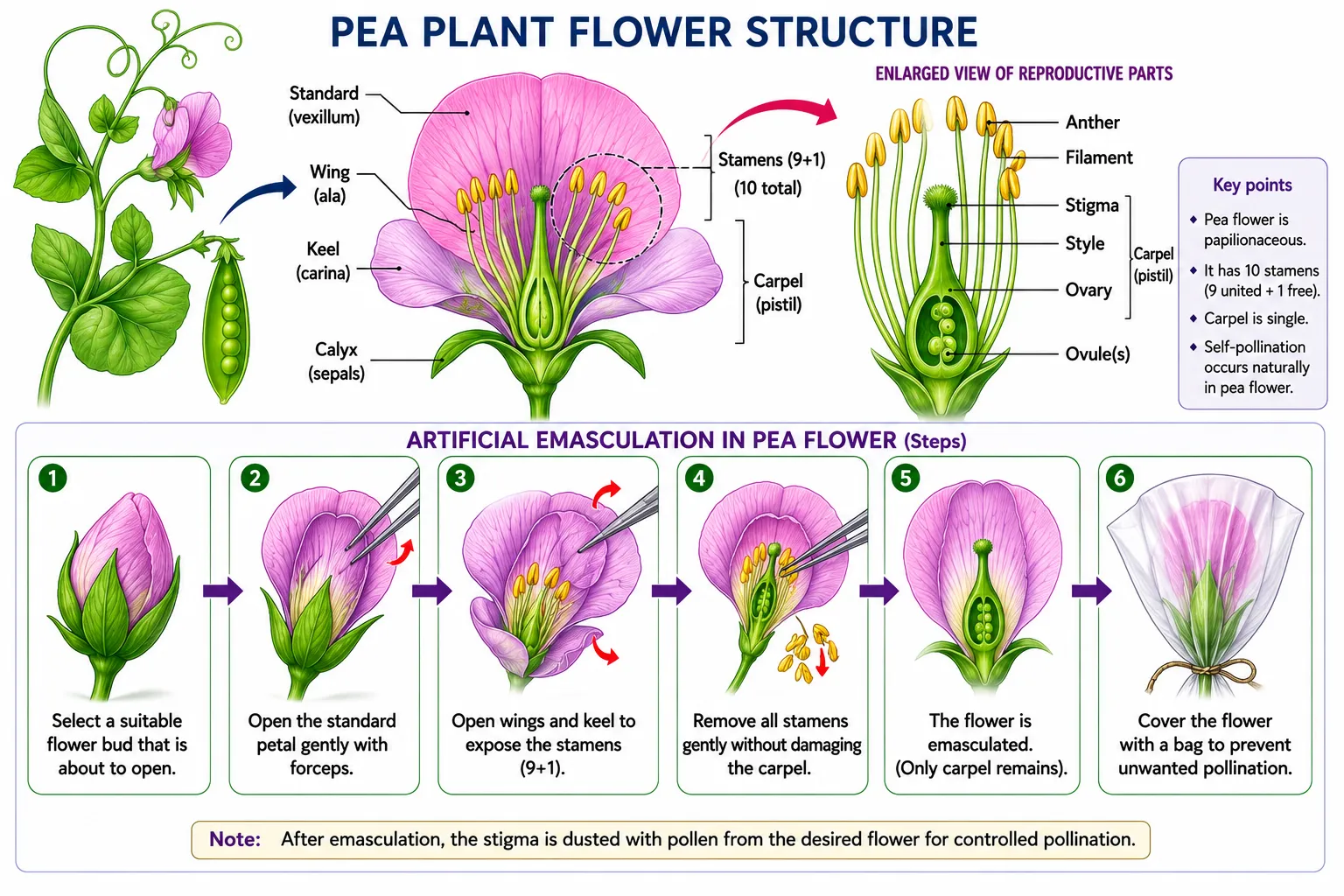
Step 2: Bisexual Flowers & Self-Pollination. Their natural flower structures support self-pollination, making it straightforward to maintain pure lines over successive generations.
Step 3: Easy Cross-Pollination. Artificial hybridization can be managed manually by removing stamens (emasculation) without disturbing the pistil structure.
Step 4: Short Life Span. Pea plants exhibit short life cycles and yield plenty of offspring seeds within a single generation, facilitating quick statistical data collection.
Question 2: Differentiate between the following:
(a) Dominance and Recessive
(b) Homozygous and Heterozygous
(c) Monohybrid and Dihybrid
(a) Dominance and Recessive
| Dominance | Recessive |
|---|---|
| An allele that expresses its phenotypic trait in both homozygous and heterozygous conditions. | An allele that can only express its structural phenotype under homozygous conditions. |
| Example: Round seeds, violet flowers. | Example: Wrinkled seeds, white flowers. |
| Homozygous | Heterozygous |
|---|---|
| An individual possessing two identical alleles for a specific gene trait (e.g., TT or tt). | An individual possessing two contrasting, different alleles for a specific gene trait (e.g., Tt). |
| Produces only one uniform type of gamete. | Produces two distinct types of gametes. |
| Monohybrid | Dihybrid |
|---|---|
| A genetic cross focused on tracking the inheritance of a single pair of contrasting features. | A genetic cross tracking the inheritance patterns of two distinct pairs of contrasting features simultaneously. |
| Example: Tall plant × Dwarf plant. | Example: Yellow Round seed × Green Wrinkled seed. |
Question 3: A diploid organism is heterozygous for 4 loci; how many types of gametes can be produced?
Step 1: Understand Loci & Heterozygosity. A locus refers to the exact coordinates or location of a gene on a chromosome. Heterozygous loci contain contrasting alleles (e.g., Aa, Bb, Cc, Dm).
Step 2: Mathematical Formulation. Assuming the genetic loci are entirely unlinked and undergo independent assortment during meiosis, we apply the gametic variety formula:
$$\text{Number of gametes} = 2^n$$ Given that the organism is heterozygous at four locations ($n = 4$):
$$2^4 = 2 \times 2 \times 2 \times 2 = 16$$ Final Answer: The organism can produce 16 types of genetically distinct gametes if the loci are unlinked. If structural chromosomal linkage exists, the number of distinct gametes drops to 8 (due to parental co-inheritance).
Question 4: Explain the Law of Dominance using a monohybrid cross.
Mendel's Law of Dominance outlines that in a cross between contrasting pure-line parents, the trait that expresses itself in the F₁ generation is dominant, while the hidden trait is recessive.
Step-by-Step Monohybrid Cross Breakdown:
* Parents: Pure Round Seeds (RR) × Pure Wrinkled Seeds (rr)
* F₁ Generation: All offspring develop as Rr (Phenotypically Round). The 'r' allele is entirely masked by 'R'.
* F₂ Generation (Selfing F₁): When Rr plants self-fertilize, the hidden wrinkled trait resurfaces in a structured statistical ratio.
| Generation | Genotypic Distribution | Phenotypic Outcome |
|---|---|---|
| Parents | RR × rr | Round × Wrinkled |
| F₁ | Rr | 100% Round (Dominant trait expressed) |
| F₂ | 1 RR : 2 Rr : 1 rr | 3 Round : 1 Wrinkled |
Question 5: Define and design a test cross.
Definition: A test cross is an experimental cross where an organism showing a dominant phenotype is mated with a known homozygous recessive parent.
Significance: It safely uncovers whether the dominant individual's genotype is homozygous dominant (e.g., TT) or heterozygous dominant (e.g., Tt).
Test Cross Design Example (Tall F₁ Plant):
Cross an unknown Tall plant (Tt) with a pure dwarf parent (tt):
| T | t | |
|---|---|---|
| t | Tt (Tall) | tt (Dwarf) |
| t | Tt (Tall) | tt (Dwarf) |
Question 6: Using a Punnett Square, work out the distribution of phenotypic features in the first filial generation after a cross between a homozygous female and a heterozygous male for a single locus.
Let's model coat coloration in guinea pigs where Black coat color (B) is dominant over White coat color (b).
* Homozygous Female (White coat): bb
* Heterozygous Male (Black coat): Bb
Punnett Square Analysis:
| Male \ Female | b | b |
|---|---|---|
| B | Bb (Black Coat) | Bb (Black Coat) |
| b | bb (White Coat) | bb (White Coat) |
* Genotypic Ratio: 1 Bb : 1 bb (or 1:1)
* Phenotypic Ratio: 50% Black Coat, 50% White Coat (or 1:1 ratio in F₁).
Question 7: When a cross is made between a tall plant with yellow seeds (TtYy) and a tall plant with green seeds (Ttyy), what proportions of phenotype in the offspring could be expected to be:
(a) tall and green
(b) dwarf and green
Cross Mapping: TtYy (Tall, Yellow) × Ttyy (Tall, Green)
* Gametes from TtYy: TY, Ty, tY, ty
* Gametes from Ttyy: Ty, ty
Dihybrid Distribution Chart:
| Gametes | Ty | ty |
|---|---|---|
| TY | TT Yy (Tall, Yellow) | Tt Yy (Tall, Yellow) |
| Ty | TT yy (Tall, Green) | Tt yy (Tall, Green) |
| tY | Tt Yy (Tall, Yellow) | tt Yy (Dwarf, Yellow) |
| ty | Tt yy (Tall, Green) | tt yy (Dwarf, Green) |
Phenotypic Class Summaries out of 8 total combinations:
* Tall and Yellow: 3/8
* Tall and Green: 3/8
* Dwarf and Yellow: 1/8
* Dwarf and Green: 1/8
Final Answer:
(a) Proportion of tall and green offspring = 3/8
(b) Proportion of dwarf and green offspring = 1/8
Question 8: Two heterozygous parents are crossed. If the two loci are linked, what would be the distribution of phenotypic features in the F₂ generation for a dihybrid cross?
Step 1: Understand Linkage. Linkage refers to genes residing closely together on the same physical chromosome. Because they travel together during meiotic assortment, they do not follow Mendel's Law of Independent Assortment.
Step 2: Complete Linkage Scenario. If the two loci display absolute linkage, zero crossing over occurs. The F₂ generation will mirror the original parental combinations completely, leading to a modified dihybrid phenotypic ratio of 3:1 instead of the classic 9:3:3:1.
Step 3: Incomplete Linkage Scenario. If the loci undergo partial recombination, parental traits will still present at a significantly higher proportion (much higher than 9:3:3:1), while newly mixed recombinant variants appear at low statistical frequencies.
Conclusion: Linked genes keep parental combinations significantly higher than recombinant phenotypes in the resulting generations.
Question 9: Briefly mention the contribution of T.H. Morgan to genetics.
Thomas Hunt Morgan advanced modern transmission genetics using experiments on fruit flies (Drosophila melanogaster):
* Experimental Evidence for Chromosomes: Provided tangible proof validating the Chromosomal Theory of Inheritance.
* Discovery of Linkage: Noticed that specific gene pairs did not assort independently but stayed bundled together during inheritance.
* Sex-Linked Traits: Tracked eye color mutations in Drosophila to discover sex-linked traits located on the X chromosome.
* Gene Mapping foundations: Established that the recombination frequency between distinct linked genes is directly proportional to the physical distances separating them on a chromosome.
Question 10: What is pedigree analysis? Suggest how such an analysis can be useful.
Definition: Pedigree analysis is a graphic chart mapping the transmission pattern of specific genetic traits, physiological anomalies, or clinical conditions across several generations of a family line.
Applications & Usefulness:
* Traces Inheritance: Acts as a powerful clinical diagnostic method to determine whether an inherited mutation is autosomal dominant, autosomal recessive, or sex-linked.
* Genetic Counselling: Enables medical professionals to calculate precise statistical probabilities of inherited mutations showing up in future children.
* Identifies Carriers: Tracks latent recessive disease carriers within an extended family ecosystem.
* Inbreeding Dangers: Visually illustrates why marriages between close biological relatives increase risks for deleterious recessive abnormalities.
Question 11: How is sex determined in human beings?
Humans employ an XX-XY chromosomal sex determination mechanism:
Step 1: Genomic Breakdown. Every somatic human cell contains 23 pairs (46 total) of chromosomes. 22 pairs are matching Autosomes, while the 23rd pair contains the sex chromosomes.
Step 2: Female Homogamety. Females carry a matching XX pair. They produce uniform, homogametic ova containing a $(22 + X)$ chromosome setup.
Step 3: Male Heterogamety. Males possess a contrasting XY pair. They produce two distinct, heterogametic sperms: 50% carry $(22 + X)$ and 50% carry $(22 + Y)$.
Fertilization Dynamics Table:
| Paternal Sperm Contribution | Maternal Ovum Contribution | Zygotic Karyotype | Resulting Sex |
|---|---|---|---|
| Sperm with X $(22+X)$ | Ovum with X $(22+X)$ | 44 + XX | Female Offspring |
| Sperm with Y $(22+Y)$ | Ovum with X $(22+X)$ | 44 + XY | Male Offspring |
Conclusion: The genetic sex ratio is strictly 1:1. The biological sex of a child is determined entirely by the paternal sperm type that fertilizes the maternal ovum.
Question 12: A child has blood group O. If the father has blood group A and the mother's blood group is B, work out the genotypes of the parents and the possible genotypes of the other offspring.
Step 1: Deduce Allelic Properties. Human ABO blood grouping is regulated by three distinct alleles: $I^A$, $I^B$, and $i$. Alleles $I^A$ and $I^B$ show co-dominance, while allele $i$ is recessive.
Step 2: Determine Child's Genotype. A child with blood group O must possess a homozygous recessive genotype ($ii$). This means the child received one recessive $i$ allele from the father and one from the mother.
Step 3: Deduce Parent Genotypes. For the parents to express blood groups A and B while passing on an $i$ allele, they must be heterozygous:
* Father's Genotype (Group A): $I^A i$
* Mother's Genotype (Group B): $I^B i$
Cross Punnett Square ($I^A i \times I^B i$):
| Father \ Mother | $I^B$ | $i$ |
|---|---|---|
| $I^A$ | $I^A I^B$ (AB Group) | $I^A i$ (A Group) |
| $i$ | $I^B i$ (B Group) | $ii$ (O Group) |
Final Summary:
* Father Genotype: $I^A i$; Mother Genotype: $I^B i$
* Other Offspring Genotypes: $I^A I^B$ (Blood group AB), $I^A i$ (Blood group A), and $I^B i$ (Blood group B).
Question 13: Explain the following terms with an example.
(a) Co-dominance
(b) Incomplete dominance
(a) Co-dominance: A genetic condition where both alleles in a heterozygous environment express their phenotypes independently and equally. Neither allele masks or blends with the other.
* Example: Human ABO Blood Grouping. Individuals with the $I^A I^B$ genotype present both A and B complex sugar polymers simultaneously on their red blood cell surfaces, producing blood group AB.
(b) Incomplete Dominance: A condition where neither allele is fully dominant over the other. The heterozygous F₁ phenotype presents as an intermediate blend between the two homozygous parental traits.
* Example: Flower coloration in the Snapdragon or Four O'Clock plant (Mirabilis jalapa). Mating a homozygous dominant Red flower plant (RR) with a homozygous recessive White flower plant (rr) yields entirely Pink flower offspring (Rr) in the F₁ generation.
Question 14: What is point mutation? Give one example.
Definition: A point mutation is a genetic alteration caused by a substitution, inversion, or deletion of a single nucleotide base pair within a specific DNA sequence.
Example - Sickle Cell Anaemia:
* Molecular Cause: A single base substitution mutation alters the triplet codon on the $\beta$-globin gene from GAG to GUG.
* Amino Acid Shift: This single nucleotide change swaps the sixth amino acid of the hemoglobin $\beta$-chain from Glutamic acid to Valine.
* Phenotypic Effect: Under low oxygen conditions, the mutant hemoglobin undergoes polymerization, warping flexible biconcave red blood cells into rigid, elongated sickle shapes that block blood capillaries.
Question 15: Who proposed the chromosomal theory of inheritance?
The Chromosomal Theory of Inheritance was formulated independently in 1902 by Theodore Boveri and Walter Sutton.
Core Concept: They paired cytological observations of chromosome segregation during meiosis with Mendel's mathematical inheritance principles, concluding that genes are located on chromosomes.
Question 16: Mention any two autosomal genetic disorders with their symptoms.
Autosomal disorders stem from structural mutations or numerical changes on non-sex chromosomes (autosomes):
1. Down's Syndrome (Trisomy of Chromosome 21)
* Symptoms: Short stature, broad forehead, a characteristically furrowed tongue with a partially open mouth, flat hands with a distinct palmar crease, and delayed psychomotor/mental development.
2. Phenylketonuria (Inborn Error of Metabolism)
* Symptoms: Caused by a mutation in an autosomal recessive gene, leading to a deficiency in the liver enzyme phenylalanine hydroxylase. Phenylalanine builds up in the body and converts into phenylpyruvic acid, causing mental retardation and skin pigmentation changes.
Extra Important Questions (Board Style)
Multiple Choice Questions (1 Mark Each)
Q1. If a hybrid expresses a specific character over another, it is known as:
A) Epistatic
B) Dominant
C) Co-dominant
D) Recessive
Q2. A plant presenting the genotype AABBCC will produce how many distinct kinds of gametes?
A) 1
B) 4
C) 8
D) 2
Explanation: Every single locus is completely homozygous. Using $2^n$ where $n = 0$, we get $2^0 = 1$ type of gamete (ABC). (Difficulty: Medium)
Q3. Human color blindness is inherited as a structural:
A) Y-linked trait
B) Autosomal dominant trait
C) X-linked recessive trait
D) Autosomal recessive trait
Short Answer Questions (2-3 Marks Each)
Q4. State Mendel's Law of Segregation using an explanatory cross example.
Q5. List the definitive karyotype and key clinical symptoms of Klinefelter's Syndrome.
* Karyotype: Trisomy of sex chromosomes, resulting in 47 chromosomes ($44 + XXY$).
* Symptoms: An affected individual develops an overall masculine frame alongside feminine traits like breast development (Gynecomastia), sparse body hair, and underdeveloped testes leading to sterility.
Case-Based Questions (4 Marks)
Q6. Case Analysis: A clinic reviews a family pedigree showing normal parents. Their first biological son presents with classic red-green color blindness, whereas their subsequent son and daughter show normal vision.
(a) Define the exact genetic inheritance pattern of this clinical condition.
(b) Deduce the exact genotypes of both biological parents.
(c) Calculate the exact probability of their next son inheriting color blindness.
(a) X-linked recessive inheritance pattern.
(b) The Father is normal ($X^Y$) and the Mother is a carrier ($X^C X^c$).
(c) The probability of their next son being affected is 50% (Sons inherit either the normal $X^C$ or mutated $X^c$ chromosome from the mother).
Assertion-Reason Questions
Options:
(A) Both Assertion and Reason are true, and Reason is the correct explanation.
(B) Both Assertion and Reason are true, but Reason is not the correct explanation.
(C) Assertion is true, but Reason is false.
(D) Both Assertion and Reason are false.
Q7. Assertion: Pink flowers present in the F₁ generation of an crossed Mirabilis jalapa plant.
Reason: This intermediate pink color shows epistatic suppression of white by red alleles.
Explanation: The appearance of intermediate pink colors stems from incomplete dominance, not epistatic interactions.
Common Mistakes to Avoid
| Frequent Mistake | Correct Concept | Exam Tip |
|---|---|---|
| Confusing Co-dominance with Incomplete Dominance. | Co-dominance shows both traits independently (AB blood group); Incomplete dominance creates a blend (Pink flowers). | Look for blended traits versus dual expression. |
| Calculating 16 gametes for 4 loci without checking for chromosome linkage. | Unlinked loci yield $2^4 = 16$, but linked genes remain bound together, reducing gametic varieties. | Always verify if the question mentions linked or unlinked states. |
| Mismatching standard pedigree symbols. | Squares denote males; circles denote females; filled shapes represent affected individuals. | Double-check your pedigree legend shapes. |
Exam Strategy & Time Management
- Always Draw Punnett Squares: Do not just write out ratios. Drawing a clear Punnett square ensures full marks on cross questions.
- Structure Long Answers: For 5-mark questions, introduce the law or condition, present your genetic cross diagrams clearly labeled with generations (Parents, F₁, F₂), and state the exact phenotypic and genotypic ratios.
- Time Benchmarks: Allocate 15 minutes for Section A, 40 minutes for Section B, and save 20 minutes specifically to verify genetic diagrams and crosses.
Frequently Asked Questions (FAQs)
Is Chapter 5 (Principles of Inheritance and Variation) important for CBSE Board 2026?
What is the main difference between a test cross and a back cross?
Why does the sex ratio of human births remain exactly 1:1?
Conclusion:
Practice your Punnett squares, memorize the criteria for genetic disorders, and avoid overcomplicating linked traits. You've got this! Good luck with your 2026 Board preparation.
Best regards,
Lucky (Founder, examspark.in)