Biotechnology: Principles and Processes Complete Solutions
Hey Lucky! Welcome to Chapter 11: Biotechnology: Principles and Processes. Is chapter mein hum genetic engineering aur recombinant DNA technology ke basics samjhenge. It's a high-scoring unit for your CBSE 2026 boards aur NEET ke liye super important hai. We have compiled the Updated NCERT Solutions and top practice questions to make your preparation smooth. Let's master these concepts together!
Learning Objectives
After completing this chapter, students will be able to:
- Understand the core principles behind genetic engineering.
- Identify the tools of recombinant DNA technology like restriction enzymes, ligases, and cloning vectors.
- Explain the step-by-step processes of creating recombinant DNA.
- Describe the working and applications of Polymerase Chain Reaction (PCR).
- Understand the use of bioreactors for the large-scale production of recombinant proteins and downstream processing.
Key Concepts & Definitions
- Biotechnology: The integration of natural science and organisms, cells, parts thereof, and molecular analogues for products and services.
- Genetic Engineering: The technique of altering the chemistry of genetic material (\(\text{DNA}\) and \(\text{RNA}\)) to introduce these into host organisms, thereby changing the host's phenotype.
- Restriction Endonucleases: Known as "molecular scissors." They cut \(\text{DNA}\) at specific palindromic recognition sequences (e.g., EcoRI).
- Plasmids: Autonomously replicating circular extra-chromosomal \(\text{DNA}\) present in bacteria. Used as vectors to transfer foreign \(\text{DNA}\).
- Recombinant DNA (rDNA): \(\text{DNA}\) formed by combining \(\text{DNA}\) from two different sources/organisms.
- PCR (Polymerase Chain Reaction): A technique used to synthesize multiple copies of a specific \(\text{DNA}\) sequence *in vitro*.
- Palindromic Sequence: A sequence of base pairs that reads the same on the two strands when the orientation of reading is kept the same (e.g., \(5^\prime\text{-GAATTC-}3^\prime\) and \(3^\prime\text{-CTTAAG-}5^\prime\)).
Full NCERT Solutions (Step-by-Step)
Question 1: Can you list 10 recombinant proteins which are used in medical practice? Find out where they are used as therapeutics.
- Human Insulin (Humulin): Used to treat Diabetes mellitus.
- Human Growth Hormone (hGH): Treats dwarfism and growth hormone deficiency.
- Interferons (\(\alpha, \beta, \gamma\)): Used in the treatment of viral infections and certain cancers.
- Erythropoietin: Treats anemia by stimulating RBC production.
- Tissue Plasminogen Activator (tPA): Dissolves blood clots in heart attack or stroke patients.
- Hepatitis B Vaccine: Used for immunization against the Hepatitis B virus.
- Blood Clotting Factor VIII: Treats Hemophilia A.
- Interleukin-2: Used to stimulate the immune system in cancer therapy.
- Platelet-derived Growth Factor (PDGF): Helps in wound healing.
- Streptokinase: Used as a clot-buster in myocardial infarction.
Question 2: Make a chart (with diagrammatic representation) showing a restriction enzyme, the substrate DNA on which it acts, the site at which it cuts DNA and the product it produces.
- Restriction Enzyme: EcoRI
- Substrate DNA: Any double-stranded \(\text{DNA}\) containing the specific recognition sequence.
- Recognition Site: \(5^\prime\text{ - GAATTC - }3^\prime\) and \(3^\prime\text{ - CTTAAG - }5^\prime\)
- Cutting Site: Between \(\text{'G'}\) and \(\text{'A'}\) on both strands.
- Product: \(\text{DNA}\) fragments with sticky ends.
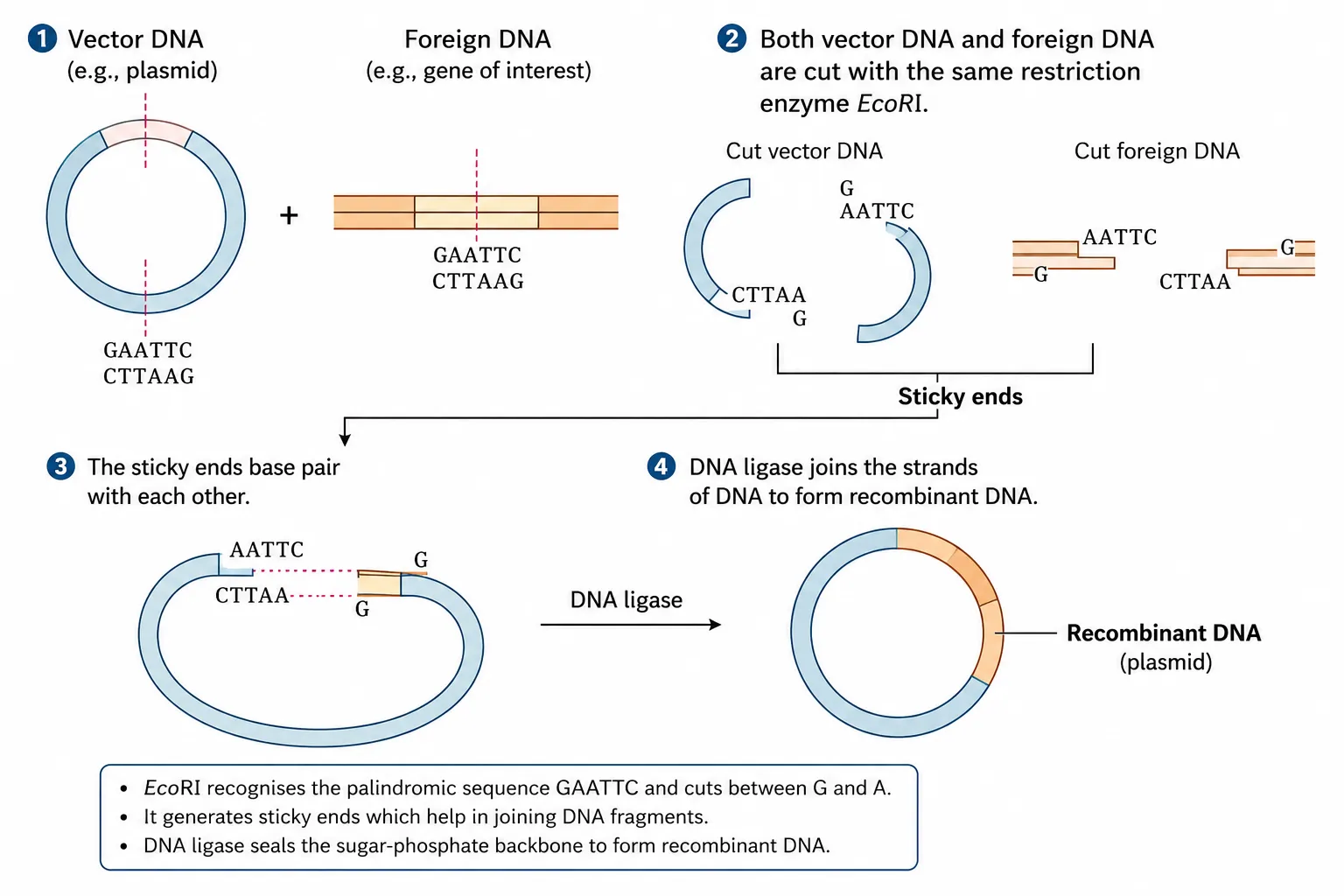
Exam Tip: You must draw the standard NCERT diagram showing the vector \(\text{DNA}\) and foreign \(\text{DNA}\) being cut by EcoRI, forming sticky ends, and then joining via \(\text{DNA}\) ligase to form recombinant \(\text{DNA}\).
Question 3: From what you have learnt, can you tell whether enzymes are bigger or DNA is bigger in molecular size? How did you know?
Explanation: \(\text{DNA}\) is a massive polymer containing millions of base pairs carrying genetic information for the entire organism. An enzyme is a protein, which is synthesized based on a very small segment of \(\text{DNA}\) (a single gene). Since a whole chromosome (\(\text{DNA}\)) contains thousands of genes, the entire \(\text{DNA}\) molecule is structurally much larger than a single enzyme molecule.
Question 4: What would be the molar concentration of human DNA in a human cell? Consult your teacher.
- A diploid human cell has \(6.6 \times 10^9\) base pairs.
- \(1\) mole contains \(6.023 \times 10^{23}\) molecules (Avogadro's number).
$$\text{Molar concentration} = \frac{\text{Number of DNA molecules}}{\text{Avogadro's number} \times \text{Volume of the cell}} \quad \text{}$$
Since there are \(46\) \(\text{DNA}\) molecules (chromosomes) per diploid cell, the molar concentration of \(\text{DNA}\) molecules is extremely low, roughly in the range of \(10^{-11}\text{ M}\) depending on the exact nuclear volume.
Question 5: Do eukaryotic cells have restriction endonucleases? Justify your answer.
Justification: Restriction endonucleases are a defense mechanism found in bacteria (prokaryotes) to protect themselves from bacteriophages (viruses). They cut foreign viral \(\text{DNA}\). If eukaryotic cells had these enzymes, they would risk cutting and destroying their own genomic \(\text{DNA}\), leading to cell death. Eukaryotes have other mechanisms (like methylation and chromatin packaging) to protect their \(\text{DNA}\).
Question 6: Besides better aeration and mixing properties, what other advantages do stirred tank bioreactors have over shake flasks?
- Temperature Control: They have built-in cooling/heating jackets to maintain optimum temperature.
- pH Control: They have sensors and automated systems to add acid/base to maintain the exact pH.
- Foam Control: Built-in foam breakers prevent the culture from overflowing.
- Sampling Ports: Small volumes of culture can be withdrawn periodically to check the quality and progression without contaminating the whole batch.
- Large Volumes: They can process \(100\) to \(1000\text{ liters}\) of culture, which isn't possible in flasks.
Question 7: Collect 5 examples of palindromic DNA sequences by consulting your teacher. Better try to create a palindromic sequence by following base-pair rules.
- EcoRI recognition site:
\(5^\prime\text{-GAATTC-}3^\prime\)
\(3^\prime\text{-CTTAAG-}5^\prime\) - BamHI recognition site:
\(5^\prime\text{-GGATCC-}3^\prime\)
\(3^\prime\text{-CCTAGG-}5^\prime\) - HindIII recognition site:
\(5^\prime\text{-AAGCTT-}3^\prime\)
\(3^\prime\text{-TTCGAA-}5^\prime\) - SalI recognition site:
\(5^\prime\text{-GTCGAC-}3^\prime\)
\(3^\prime\text{-CAGCTG-}5^\prime\) - SmaI recognition site:
\(5^\prime\text{-CCCGGG-}3^\prime\)
\(3^\prime\text{-GGGCCC-}5^\prime\)
Question 8: Can you recall meiosis and indicate at what stage a recombinant DNA is made?
Question 9: Can you think and answer how a reporter enzyme can be used to monitor transformation of host cells by foreign DNA in addition to a selectable marker?
Example: The \(lacZ\) gene produces the enzyme \(\beta\)-galactosidase. When grown on a chromogenic substrate (\(\text{X-gal}\)), non-recombinant colonies produce a blue color. If we insert our foreign \(\text{DNA}\) into the \(lacZ\) gene, the gene becomes inactivated (insertional inactivation). The enzyme is not produced, and these recombinant colonies appear white. This makes it incredibly easy to just look at the petri dish and identify recombinants.
Question 10: Describe briefly the following: (a) Origin of replication (b) Bioreactors (c) Downstream processing.
- (a) Origin of replication (ori): It is a specific sequence of \(\text{DNA}\) where replication initiates. Any piece of foreign \(\text{DNA}\) linked to this sequence can be made to replicate within the host cell. It also controls the copy number of the linked \(\text{DNA}\).
- (b) Bioreactors: These are large cylindrical vessels (\(100\text{–}1000\text{ liters}\)) in which raw materials are biologically converted into specific products, individual enzymes, etc., using microbial, plant, animal, or human cells. They provide optimal conditions for growth (temperature, pH, oxygen, etc.).
- (c) Downstream processing: The series of processes that a product is subjected to after the biosynthetic stage is complete, before it is ready for marketing. It primarily includes separation and purification of the desired product, followed by formulation with suitable preservatives.
Question 11: Explain briefly (a) PCR (b) Restriction enzymes and DNA (c) Chitinase
- (a) PCR (Polymerase Chain Reaction): A technique to amplify a specific gene segment. It involves three steps:
- Denaturation: Heating \(\text{DNA}\) to \(94^\circ\text{C}\) to separate strands.
- Annealing: Adding primers that bind to the \(\text{DNA}\) strands at \(\sim 54^\circ\text{C}\).
- Extension: Taq polymerase adds nucleotides to synthesize new strands at \(72^\circ\text{C}\). Millions of copies are made in a few hours.
- (b) Restriction enzymes and DNA: These are endonucleases that inspect the length of a \(\text{DNA}\) molecule, recognize a specific palindromic sequence, and cut the sugar-phosphate backbone of both strands. This is the foundational step for creating recombinant \(\text{DNA}\).
- (c) Chitinase: It is an enzyme used to break down the cell wall of fungi (which is made of chitin). This is done during \(\text{DNA}\) isolation to release the genetic material from fungal cells.
Question 12: Discuss with your teacher and find out how to distinguish between (a) Plasmid DNA and Chromosomal DNA (b) RNA and DNA (c) Exonuclease and Endonuclease.
| Category | Feature A | Feature B |
|---|---|---|
| (a) Plasmid vs Chromosomal | Plasmid DNA: Extra-chromosomal, circular, smaller, contains non-essential but beneficial genes (like antibiotic resistance). | Chromosomal DNA: Main genomic \(\text{DNA}\), linear (in eukaryotes) or circular (in bacteria), very large, carries essential genes for survival. |
| (b) RNA vs DNA | RNA: Single-stranded, contains Ribose sugar, uses Uracil (\(\text{U}\)) instead of Thymine. | DNA: Double-stranded, contains Deoxyribose sugar, uses Thymine (\(\text{T}\)). |
| (c) Exonuclease vs Endonuclease | Exonuclease: Removes nucleotides from the ends of a \(\text{DNA}\) molecule. | Endonuclease: Makes cuts at specific positions within the \(\text{DNA}\) molecule. |
Extra Important Questions (Board Style)
Yahan 15 important questions hain jo 2026 Board aur competitive exams ke liye bohot zaroori hain.
Multiple Choice Questions (MCQs)
Q1. DNA fragments generated by the restriction endonucleases in a chemical reaction can be separated by:
A) Polymerase chain reaction
B) Electrophoresis
C) Restriction mapping
D) Centrifugation
Explanation: Gel electrophoresis separates \(\text{DNA}\) fragments based on their size under an electric field.
Difficulty Level: Easy
Q2. Which of the following is a plasmid?
A) EcoRI
B) pBR322
C) Taq polymerase
D) HindIII
Explanation: pBR322 is one of the most widely used *E. coli* cloning vectors. The others are enzymes.
Difficulty Level: Easy
Q3. During PCR, the enzyme Taq polymerase is used because it:
A) Helps in denaturation
B) Is a restriction enzyme
C) Is thermostable and remains active at high temperatures
D) Synthesizes RNA primers
Explanation: Derived from Thermus aquaticus, it doesn't denature during the high heat (\(94^\circ\text{C}\)) step of PCR.
Difficulty Level: Medium
Short Answer Questions (2-3 Marks)
Q4. Why is DNA considered a hydrophilic molecule? How is it introduced into a host bacterium?
Q5. State the principle underlying gel electrophoresis.
Q6. What is insertional inactivation?
Q7. Why do we need a 'selectable marker' in a cloning vector?
Long Answer Questions (5 Marks)
Q8. Draw a schematic labeled diagram of the cloning vector pBR322 and explain its features.
- ori (Origin of replication): Sequence where replication starts.
- Selectable markers: \(amp^\text{R}\) (ampicillin resistance) and \(tet^\text{R}\) (tetracycline resistance) genes.
- Cloning sites: Unique recognition sites for restriction enzymes. E.g., BamHI and SalI within the \(tet^\text{R}\) gene, and PvuI and PstI within the \(amp^\text{R}\) gene.
- rop: Codes for the proteins involved in the replication of the plasmid.
Q9. Explain the steps involved in the process of Polymerase Chain Reaction (PCR).
- 1. Denaturation: The double-stranded \(\text{DNA}\) template is heated to around \(94^\circ\text{C}\). The hydrogen bonds break, resulting in single-stranded \(\text{DNA}\).
- 2. Annealing: The temperature is lowered to around \(54^\circ\text{C}\). Two sets of oligonucleotide primers bind (anneal) to the complementary regions on the single-stranded \(\text{DNA}\) templates.
- 3. Extension: The temperature is raised to \(72^\circ\text{C}\). The thermostable enzyme Taq DNA polymerase extends the primers by adding nucleotides complementary to the template.
This cycle is repeated \(30\) times to get \(\sim 1\text{ billion}\) copies.
Q10. Describe the process of isolation of genetic material (DNA) from a plant cell.
- 1. Cell Wall Breakdown: Treat plant tissues with enzymes like Cellulase and Pectinase to break the cell wall.
- 2. Cell Membrane Lysis: Use detergents to dissolve the lipid membrane and release cellular contents.
- 3. Removal of RNA and Proteins: Treat the extract with Ribonuclease (to digest \(\text{RNA}\)) and Proteases (to digest proteins).
- 4. Precipitation: Add chilled ethanol to the purified mixture. This causes the \(\text{DNA}\) to precipitate out as fine threads in the suspension.
- 5. Spooling: The precipitated \(\text{DNA}\) threads can be removed by spooling using a glass rod.
Case-Based Question (4 Marks)
Q11. Case Analysis: A scientist wants to amplify a gene of interest using PCR. She mixes the DNA template, primers, normal DNA polymerase, and nucleotides in a tube and runs the thermal cycler. However, after 30 cycles, she observes no amplification on the agarose gel.
Answer: She used a "normal DNA polymerase" instead of a thermostable polymerase like Taq polymerase.
(b) Why did her mistake lead to no amplification? (2 Marks)
Answer: The first step of PCR involves heating the mixture to \(94^\circ\text{C}\) for denaturation. At this high temperature, normal \(\text{DNA}\) polymerase denatures (gets destroyed) and loses its catalytic activity. Hence, no extension occurred.
(c) Name the source organism of the correct enzyme required for this process. (1 Mark)
Answer: The bacterium Thermus aquaticus.
Assertion-Reason Questions
Options:
(A) Both A and R are true and R is the correct explanation of A.
(B) Both A and R are true but R is not the correct explanation of A.
(C) A is true but R is false.
(D) A is false but R is true.
Q12. Assertion (A): Agrobacterium tumefaciens is known as a natural genetic engineer of plants.
Reason (R): It can deliver a piece of DNA known as 'T-DNA' to transform normal plant cells into a tumor and direct these tumor cells to produce the chemicals required by the pathogen.
Difficulty Level: Medium
Q13. Assertion (A): In gel electrophoresis, DNA fragments move towards the cathode.
Reason (R): DNA fragments are negatively charged molecules.
Difficulty Level: Easy
Q14. Assertion (A): Restriction endonucleases cut the DNA strand a little away from the centre of the palindrome sites.
Reason (R): This leaves single-stranded overhanging stretches at the ends called sticky ends.
Difficulty Level: Medium
Q15. Assertion (A): Downstream processing is not required for products intended for human consumption.
Reason (R): Bioreactors provide a completely sterile environment, so the product is already pure.
Difficulty Level: Hard
Common Mistakes Students Make
Exam likhte time in choti mistakes se bacho:
- Confusing Endonuclease vs Exonuclease: Endo means 'inside' (cuts within \(\text{DNA}\)), whereas Exo means outer edges (removes nucleotides from ends).
- Highlight Key Terms: When writing answers, underline terms like Palindromic sequence, Taq polymerase, Elution, and Downstream processing. It makes checking easier for the examiner.
- Time Management: For 5-mark questions, always draw a diagram even if it's not explicitly asked. It saves you from writing huge paragraphs and secures full marks faster.
Frequently Asked Questions (FAQs)
Is Chapter 11 Biotechnology Principles and Processes important for boards?
Where can I download the Class 12 Biology NCERT PDF?
Which questions are most important in this chapter?
Why is Taq polymerase used in PCR instead of normal DNA polymerase?
What is a restriction endonuclease?
Internal Learning Links:
● Check out the continuation in Class 12 Biology Chapter 12: Biotechnology and its Applications.
● Review upstream DNA structure in Molecular Basis of Inheritance.
● Download the Top Scoring Diagrams for Class 12 Biology Boards 2026.