Reproductive Health Complete Solutions
Welcome to examspark.in! Main Lucky hoon, aur aaj hum CBSE Class 12 Biology Chapter 4, Reproductive Health ko detail mein cover karenge. This chapter is super scoring for your 2026 Board Exams and NEET. Concept samajhna bahut aasan hai, so let's dive in and secure those crucial marks! Is post mein, aapko Updated NCERT Solutions aur board-focused important questions milenge.
Learning Objectives
After completing this chapter, students will be able to:
- Understand the significance of reproductive health and the strategies implemented in India (like RCH programs).
- Analyze the reasons behind the population explosion and the methods of birth control.
- Explain Medical Termination of Pregnancy (MTP) and its legal/ethical aspects.
- Identify common Sexually Transmitted Infections (STIs) and their preventive measures.
- Describe various Assisted Reproductive Technologies (ART) used to treat infertility.
Key Concepts & Definitions
- Reproductive Health: According to WHO, it means a total well-being in all aspects of reproduction (physical, emotional, behavioral, and social).
- RCH (Reproductive and Child Health Care): Programs initiated at the national level to create awareness about reproduction-related aspects.
- Amniocentesis: A fetal sex determination and chromosomal abnormality test based on the chromosomal pattern in the amniotic fluid surrounding the developing embryo.
- Contraceptives: Methods or devices used to prevent unwanted pregnancies. Examples: IUDs, condoms, oral pills.
- MTP (Medical Termination of Pregnancy): Intentional or voluntary termination of pregnancy before full term.
- STIs (Sexually Transmitted Infections): Infections or diseases transmitted through sexual intercourse (e.g., HIV, Syphilis, Gonorrhoea).
- ART (Assisted Reproductive Technologies): Special techniques to help infertile couples have children. Examples include:
- IVF: In Vitro Fertilization (fertilization outside the body).
- ZIFT: Zygote Intra Fallopian Transfer.
- GIFT: Gamete Intra Fallopian Transfer.
- ICSI: Intra Cytoplasmic Sperm Injection.
Full NCERT Solutions (Step-by-Step)
Here are the complete, step-by-step CBSE Class 12 Biology Chapter 4 solutions.
Question 1: What do you think is the significance of reproductive health in a society?
Step 1: Safe Sexual Life. It ensures that individuals have safe and healthy sexual lives without the fear of contracting Sexually Transmitted Infections (STIs).
Step 2: Reduced Mortality. It helps in reducing maternal and infant mortality rates through proper pre-natal and post-natal care.
Step 3: Population Control. It promotes awareness about birth control, which helps check the population explosion.
Step 4: Social Well-being. It builds a socially responsible and healthy society by preventing sex abuse and sex-related crimes.
Question 2: Suggest the aspects of reproductive health which need to be given special attention in the present scenario.
Step 1: Contraceptive Awareness. Creating widespread awareness about available contraceptive methods to control population growth.
Step 2: Medical Assistance. Providing medical assistance and care for pregnancy, delivery, and post-natal health.
Step 3: STI Education. Spreading awareness about the prevention, symptoms, and cure of Sexually Transmitted Infections (STIs).
Step 4: Stop Female Feticide. Educating people about the dangers of female feticide and enforcing strict bans on sex determination techniques like amniocentesis.
Step 5: Infertility Treatments. Providing specialized treatments (ART) for infertile couples.
Question 3: Is sex education necessary in schools? Why?
Step 1: Scientific Accuracy. Yes, sex education is strictly necessary because it provides accurate and scientific information about reproductive organs, adolescence, and related bodily changes.
Step 2: Dispelling Myths. It saves students from myths and misconceptions regarding sex-related topics.
Step 3: Safe Practices. It creates awareness about safe and hygienic sexual practices and STDs/AIDS.
Step 4: Protection. It helps teenagers lead a healthy reproductive life and protects them from sexual abuse.
Question 4: Do you think that reproductive health in our country has improved in the past 50 years? If yes, mention some such areas of improvement.
Step 1: Confirmation. Yes, reproductive health in India has shown massive improvement in the past 50 years.
Step 2: Decreased Mortality. There has been a massive decline in Maternal Mortality Rate (MMR) and Infant Mortality Rate (IMR).
Step 3: Better Family Planning. Better awareness and increased usage of contraceptives, leading to better family planning.
Step 4: Medical Deliveries & STDs. Increased number of medically assisted deliveries ensuring mother and child safety, and better detection and cure of STDs.
Step 5: ART Availability. Widespread availability of Assisted Reproductive Technologies (ART) for infertile couples.
Question 5: What are the suggested reasons for population explosion?
Step 1: Death Rate. A rapid decline in the overall Death Rate.
Step 2: MMR and IMR. A significant decline in the Maternal Mortality Rate (MMR) and Infant Mortality Rate (IMR).
Step 3: Reproducible Age. An increase in the number of people reaching reproducible age.
Step 4: Health Care. Better public health care and medical facilities leading to a higher lifespan.
Question 6: Is the use of contraceptives justified? Give reasons.
Step 1: Population Control. Yes, it is completely justified because they are essential to control the rapid population growth (population explosion).
Step 2: Child Spacing. They help in spacing out children, which is vital for the physical and mental health of the mother.
Step 3: Dual Protection. Some contraceptives (like condoms) offer dual protection by also preventing the spread of STIs and HIV/AIDS.
Question 7: Removal of gonads cannot be considered as a contraceptive option. Why?
Step 1: Primary Function. Gonads (testes in males, ovaries in females) are primary sex organs. Their removal (castration) stops the production of gametes.
Step 2: Hormonal Loss. It also completely halts the secretion of essential sex hormones (testosterone, estrogen).
Step 3: Severe Imbalance. This leads to severe physiological and psychological imbalances and loss of sexual desire.
Step 4: Contraceptive Definition. A contraceptive is meant to prevent pregnancy without interfering with a person's normal sexual drive or overall health. Hence, removing gonads is surgical sterilization/mutilation, not a practical contraceptive option.
Question 8: Amniocentesis for sex determination is banned in our country. Is this ban necessary? Comment.
Step 1: Medical Purpose. Yes, this ban is absolutely necessary. Amniocentesis is a medical procedure meant to detect chromosomal abnormalities or genetic disorders in the fetus.
Step 2: Misuse in India. However, it was widely misused in India to determine the sex of the unborn child.
Step 3: Female Feticide. If the fetus was found to be female, it often led to illegal female feticide.
Step 4: Maintaining Sex Ratio. To maintain a healthy male-female sex ratio and stop this unethical practice, the statutory ban on amniocentesis for sex determination is crucial.
Question 9: Suggest some methods to assist infertile couples to have children.
Step 1: IVF (In Vitro Fertilization). Fertilization occurs outside the body in laboratory conditions, followed by embryo transfer (ET).
Step 2: ZIFT (Zygote Intra Fallopian Transfer). Transfer of zygote or early embryo (up to 8 blastomeres) into the fallopian tube.
Step 3: GIFT (Gamete Intra Fallopian Transfer). Transfer of an ovum collected from a donor into the fallopian tube of another female who cannot produce one.
Step 4: ICSI (Intra Cytoplasmic Sperm Injection). A single sperm is directly injected into the ovum in the lab.
Step 5: AI (Artificial Insemination). Semen from the husband or a healthy donor is artificially introduced into the vagina or uterus (IUI) of the female.
Question 10: What are the measures one has to take to prevent from contracting STDs?
Step 1: Partner Selection. Avoid sex with unknown partners or multiple partners.
Step 2: Barrier Protection. Always use condoms during coitus.
Step 3: Medical Consultation. In case of any doubt or symptom (itching, fluid discharge, slight pain), immediately consult a qualified doctor for early detection and complete treatment.
Question 11: State True/False with explanation.
(a) Abortions could happen spontaneously too.
(b) Infertility is defined as the inability to produce a viable offspring and is always due to abnormalities/defects in the female partner.
(c) Complete lactation could help as a natural method of contraception.
(d) Creating awareness about sex related aspects is an effective method to improve reproductive health of the people.
Step 1 (a): True. Miscarriages or spontaneous abortions can happen naturally due to internal genetic or physiological factors.
Step 2 (b): False. Infertility can be due to physical, congenital, or psychological defects in either the male or the female partner. It is wrong to always blame the female.
Step 3 (c): True. Intense lactation (Lactational amenorrhea) following delivery delays the return of menstruation and ovulation, acting as a natural contraceptive (effective up to ~6 months).
Step 4 (d): True. Awareness eliminates myths, encourages proper hygiene, and promotes the use of contraceptives and medical help, directly improving reproductive health.
Question 12: Correct the following statements:
(a) Surgical methods of contraception prevent gamete formation.
(b) All sexually transmitted diseases are completely curable.
(c) Oral pills are very popular contraceptives among the rural women.
(d) In E.T. techniques, embryos are always transferred into the uterus.
Step 1 (a): Corrected Statement: Surgical methods of contraception (vasectomy/tubectomy) prevent gamete transport (not gamete formation).
Step 2 (b): Corrected Statement: Except for Hepatitis-B, Genital Herpes, and HIV infections, other sexually transmitted diseases are completely curable if detected early and treated properly.
Step 3 (c): Corrected Statement: Oral pills are very popular contraceptives among urban women.
Step 4 (d): Corrected Statement: In E.T. techniques, embryos with up to 8 blastomeres are transferred into the Fallopian tube (ZIFT), and embryos with more than 8 blastomeres are transferred into the uterus (IUT).
Extra Important Questions (Board Style)
Practice makes perfect! Here are 15 highly expected Board Exam Questions 2026 to help you score big.
Multiple Choice Questions (1 Mark)
1. The contraceptive pill 'Saheli' was developed at:
A) AIIMS, New Delhi
B) CDRI, Lucknow
C) IISc, Bangalore
D) WHO, Geneva
Step 1: Selection. B) CDRI, Lucknow. (Difficulty: Easy)
2. CuT, Cu7, and Multiload 375 are examples of:
A) Non-medicated IUDs
B) Hormone-releasing IUDs
C) Copper-releasing IUDs
D) Barrier methods
Step 1: Selection. C) Copper-releasing IUDs. (Difficulty: Easy)
3. Which of the following ART involves the in vivo fertilization?
A) ZIFT
B) GIFT
C) ICSI
D) IVF
Step 1: Selection. B) GIFT (Gamete Intra Fallopian Transfer).
Step 2: Reason. Fertilization happens inside the female's fallopian tube, making it in vivo. (Difficulty: Medium)
Short Answer Questions (2-3 Marks)
4. What makes 'Saheli' different from other oral contraceptive pills?
Step 1: Non-Steroidal Nature. Saheli is a non-steroidal, once-a-week pill with very few side effects and high contraceptive value.
Step 2: Comparison. In contrast, regular pills contain steroid hormones (progestogens/estrogens) and must be taken daily. (Difficulty: Medium)
5. Mention any two conditions under which Medical Termination of Pregnancy (MTP) is legally advised.
Step 1: Condition 1. When pregnancy poses a severe risk to the physical or mental health of the mother.
Step 2: Condition 2. In cases of pregnancies arising from rape, or if there is a substantial risk that the child would be born with serious physical or mental abnormalities. (Difficulty: Medium)
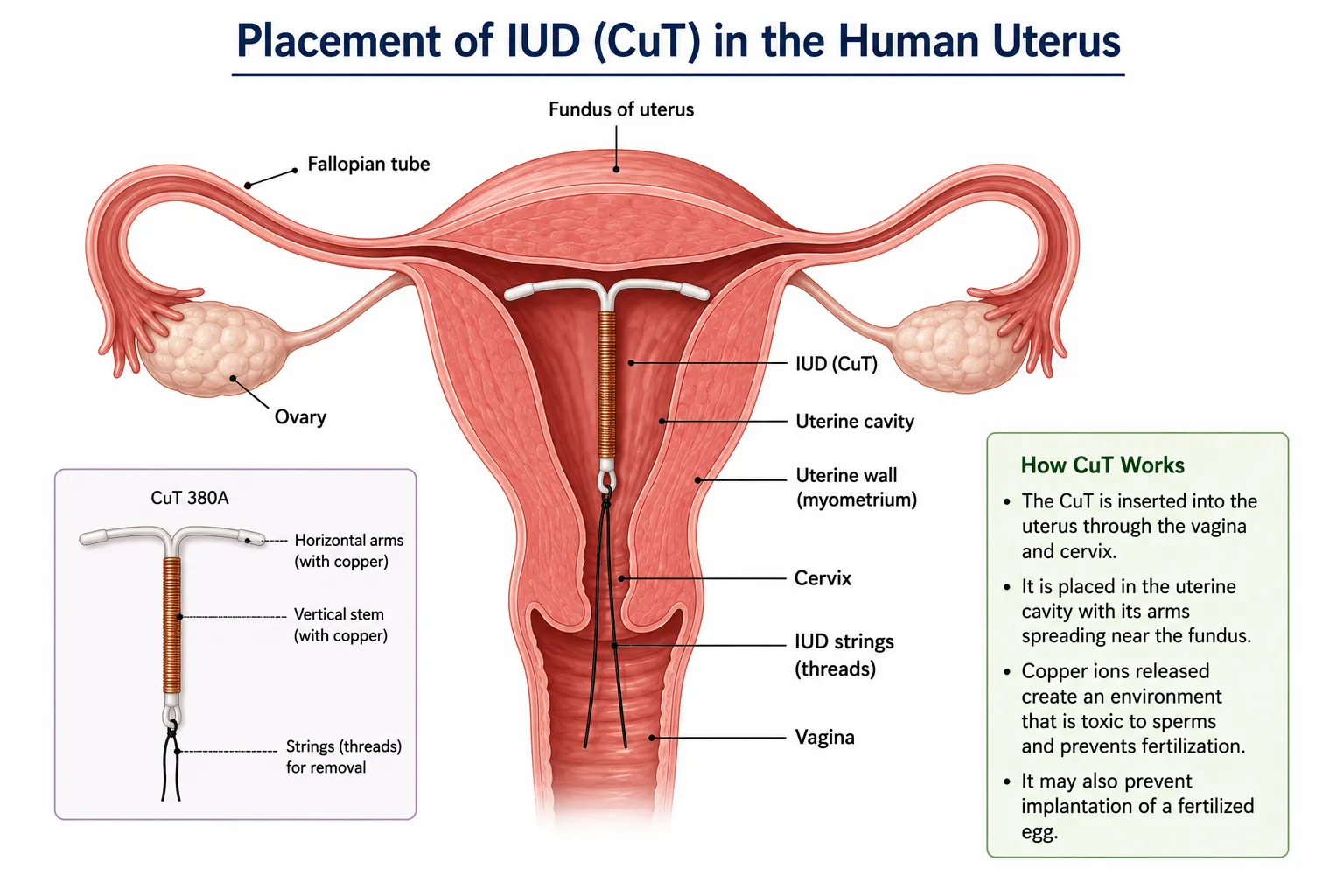
6. Explain the mechanism of action of Copper-releasing IUDs.
Step 1: Sperm Motility. The copper ions released by IUDs suppress the motility of the sperms and reduce their fertilizing capacity within the female reproductive tract.
Step 2: Phagocytosis. They also increase the phagocytosis of sperms within the uterus. (Difficulty: Easy)
Long Answer Questions (4-5 Marks)
7. Explain the various natural methods of contraception.
Step 1: Principle. Natural methods work on the principle of avoiding the meeting of sperm and ovum. They have no side effects but high failure chances.
Step 2: Periodic Abstinence. Couples avoid coitus from days 10 to 17 of the menstrual cycle when ovulation is highly expected (fertile period).
Step 3: Withdrawal or Coitus Interruptus. The male partner withdraws his penis from the vagina just before ejaculation to avoid insemination.
Step 4: Lactational Amenorrhea. Absence of menstruation during the intense lactation period after parturition. It is effective only up to 6 months post-delivery. (Difficulty: Medium)
8. Classify IUDs into different categories with examples. How do hormone-releasing IUDs work?
Step 1: Classification. Intra Uterine Devices (IUDs) are classified into three main categories.
Step 2: Non-medicated IUDs. Example: Lippes loop.
Step 3: Copper-releasing IUDs. Examples: CuT, Cu7, Multiload 375.
Step 4: Hormone-releasing IUDs. Examples: Progestasert, LNG-20.
Step 5: Mechanism of Hormone-releasing IUDs. They make the uterus unsuitable for implantation and the cervix hostile to the sperms by thickening the cervical mucus. (Difficulty: Hard)
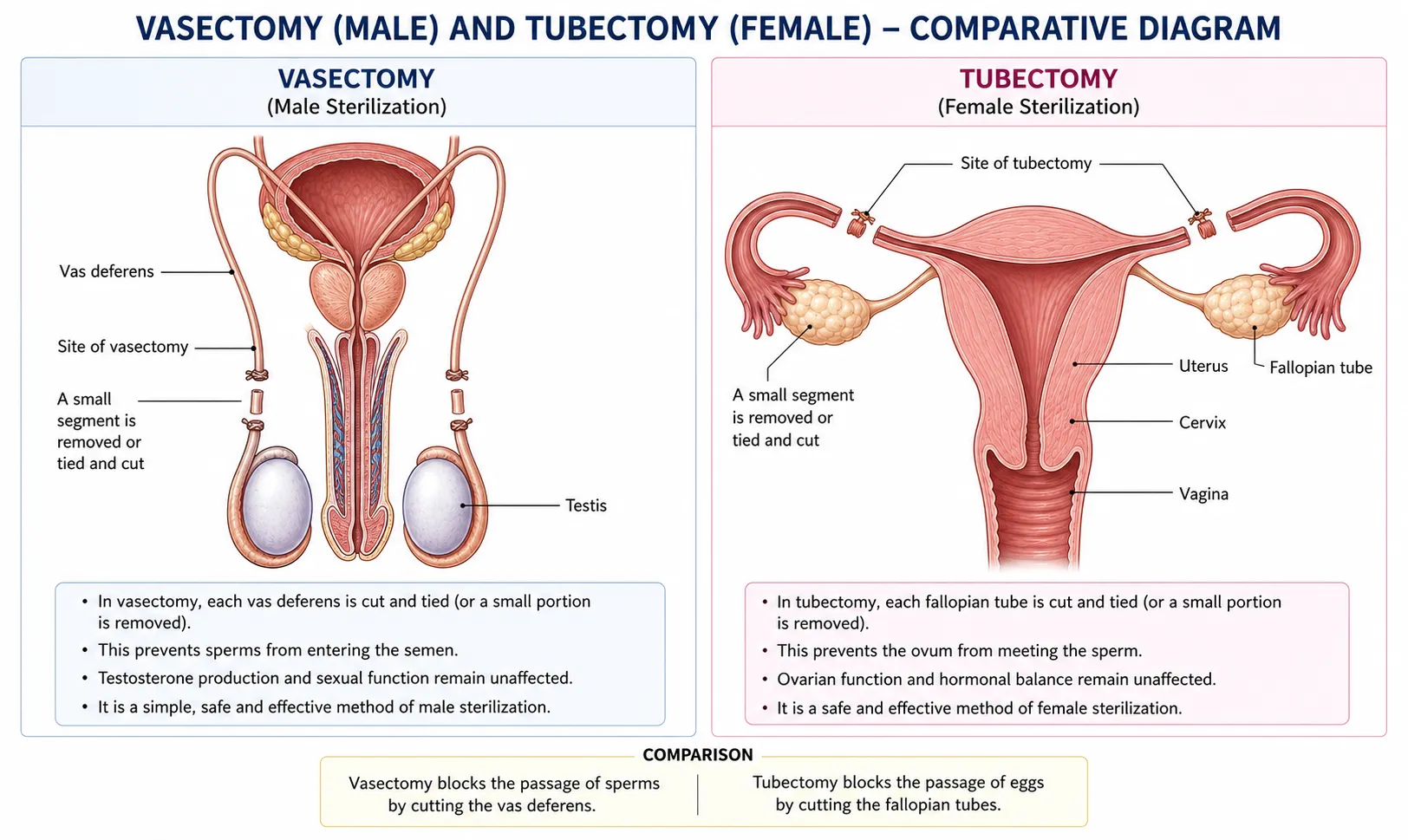
9. Differentiate between Vasectomy and Tubectomy.
Step 1: Differences Table.
| Vasectomy | Tubectomy |
|---|---|
| Surgical sterilization method in males. | Surgical sterilization method in females. |
| A small part of the vas deferens is removed or tied up. | A small part of the fallopian tube is removed or tied up. |
| Prevents the transport of sperms in semen. | Prevents the ovum from reaching the uterus/sperm. |
Case-Based Questions (4 Marks)
10. Read the scenario and answer the questions:
A couple has been trying to conceive for 3 years without success. Medical tests reveal that the male partner has a very low sperm count (oligospermia), but the female partner is completely normal.
(a) Which Assisted Reproductive Technology (ART) would be most suitable for this couple?
(b) Define the suggested technique.
(c) Name another technique where a single sperm is injected directly into the ovum.
Step 1 (a): Artificial Insemination (AI) or Intra-Uterine Insemination (IUI).
Step 2 (b): In AI/IUI, the semen collected from the husband is concentrated and artificially introduced directly into the uterus of the female.
Step 3 (c): Intra Cytoplasmic Sperm Injection (ICSI). (Difficulty: Hard)
11. Read the scenario and answer the questions:
A 25-year-old female visits a clinic complaining of pelvic pain, slight discharge, and itching in the genital area. The doctor diagnoses her with a bacterial Sexually Transmitted Infection.
(a) Name two common bacterial STIs.
(b) Are bacterial STIs completely curable?
(c) If left untreated, what severe complications can STIs lead to in females?
Step 1 (a): Gonorrhoea and Syphilis (or Chlamydiasis).
Step 2 (b): Yes, bacterial STIs are completely curable if detected early and treated with appropriate antibiotics.
Step 3 (c): Pelvic Inflammatory Diseases (PID), ectopic pregnancies, infertility, or even cancer of the reproductive tract. (Difficulty: Medium)
12. Read the scenario and answer the questions:
Government hospitals widely distribute 'Nirodh'. It is a popular contraceptive barrier method among males in India.
(a) What is the common name for Nirodh?
(b) What is it made of?
(c) What are the dual benefits of using this method?
Step 1 (a): Condom.
Step 2 (b): It is made of thin rubber/latex sheath.
Step 3 (c): It prevents pregnancy (by avoiding sperm-ovum meeting) AND protects the user from contracting STIs and AIDS. (Difficulty: Easy)
Assertion-Reason Questions (1 Mark Each)
Directions: Choose the correct option.
A) Both Assertion and Reason are true, and Reason is the correct explanation of Assertion.
B) Both Assertion and Reason are true, but Reason is NOT the correct explanation.
C) Assertion is true, but Reason is false.
D) Assertion is false, but Reason is true.
13. Assertion (A): Amniocentesis is legally banned for sex determination in India.
Reason (R): It was being misused to abort normal female fetuses, leading to a skewed male-female ratio.
Step 1: Evaluation. A) Both Assertion and Reason are true, and Reason is the correct explanation. (Difficulty: Easy)
14. Assertion (A): In ZIFT, the embryo with more than 8 blastomeres is transferred into the fallopian tube.
Reason (R): Zygote Intra Fallopian Transfer requires early-stage embryos.
Step 1: Evaluation. D) Assertion is false, but Reason is true.
Step 2: Reason. In ZIFT, embryos with up to 8 blastomeres are transferred to the fallopian tube. More than 8 go to the uterus - IUT. (Difficulty: Hard)
15. Assertion (A): Lactational amenorrhea is a natural method of contraception.
Reason (R): Ovulation does not occur during intense lactation.
Step 1: Evaluation. A) Both Assertion and Reason are true, and Reason is the correct explanation. (Difficulty: Medium)
Exam Preparation Tips
- Learn the Abbreviations: Is chapter mein se 1 mark ka full-form question pakka aata hai (RCH, IUD, MMR, IMR, ZIFT, GIFT, ICSI). Make a list on a sticky note.
- Expanding Abbreviations: Writing half-correct full forms causes mark loss. E.g., ICSI is Intra Cytoplasmic Sperm Injection (not insertion).
- Tables are Your Best Friend: Differentiate concepts using tables (e.g., Vasectomy vs. Tubectomy, Cu-IUDs vs. Hormone-releasing IUDs). Examiners love structured answers.
- Answer to the Point: Biology answers don't need unnecessary stories. Use bullet points and highlight the keywords in black pen.
- Last-Minute Revision: Go through the NCERT summary and the 'Extra Important Questions' provided above just before your pre-boards.
Frequently Asked Questions (FAQs)
Is Reproductive Health a high-weightage chapter for CBSE Class 12?
Which are the most important questions from this chapter?
What is the safest period for Medical Termination of Pregnancy (MTP)?
Conclusion:
Apne notes banayein, diagrams practice karein, aur overthink mat karein. You have plenty of time for the 2026 boards. Download these notes, keep revising, and confidently prepare for your exams. All the best!
Signing off,
Lucky (Founder, examspark.in)