Ecosystem Complete Solutions
Welcome to your ultimate study guide for Class 12 Biology Chapter 14: Ecosystem! In this post, we provide Updated NCERT Solutions, key concepts, and top Board Exam Questions 2026. This chapter is highly scoring for CBSE boards and forms the foundation for NEET ecology. Mastering topics like energy flow, decomposition, and ecological pyramids will boost your confidence and grades. Let's make biology simple!
Learning Objectives
After completing this chapter, students will be able to:
- Understand the structure and function of an ecosystem.
- Calculate and differentiate between Gross Primary Productivity (GPP) and Net Primary Productivity (NPP).
- Explain the sequential steps of decomposition.
- Trace the unidirectional flow of energy through various trophic levels.
- Draw and analyze ecological pyramids of number, biomass, and energy.
Key Concepts, Definitions & Formulas
Before diving into the CBSE Class 12 Biology Chapter 14 solutions, let's brush up on the core concepts:
- Ecosystem: A functional unit of nature where living organisms interact among themselves and with their physical environment.
- Stratification: The vertical distribution of different species occupying different levels (e.g., trees at the top, shrubs in the middle, grasses at the bottom).
- Primary Productivity: The amount of biomass or organic matter produced per unit area over a time period by plants during photosynthesis.
- Formulas for Productivity:
$$NPP = GPP - R$$
(Where NPP = Net Primary Productivity, GPP = Gross Primary Productivity, and \(R =\) Respiration losses) - Decomposition: The physical and chemical breakdown of complex organic matter into simple inorganic substances like carbon dioxide, water, and nutrients.
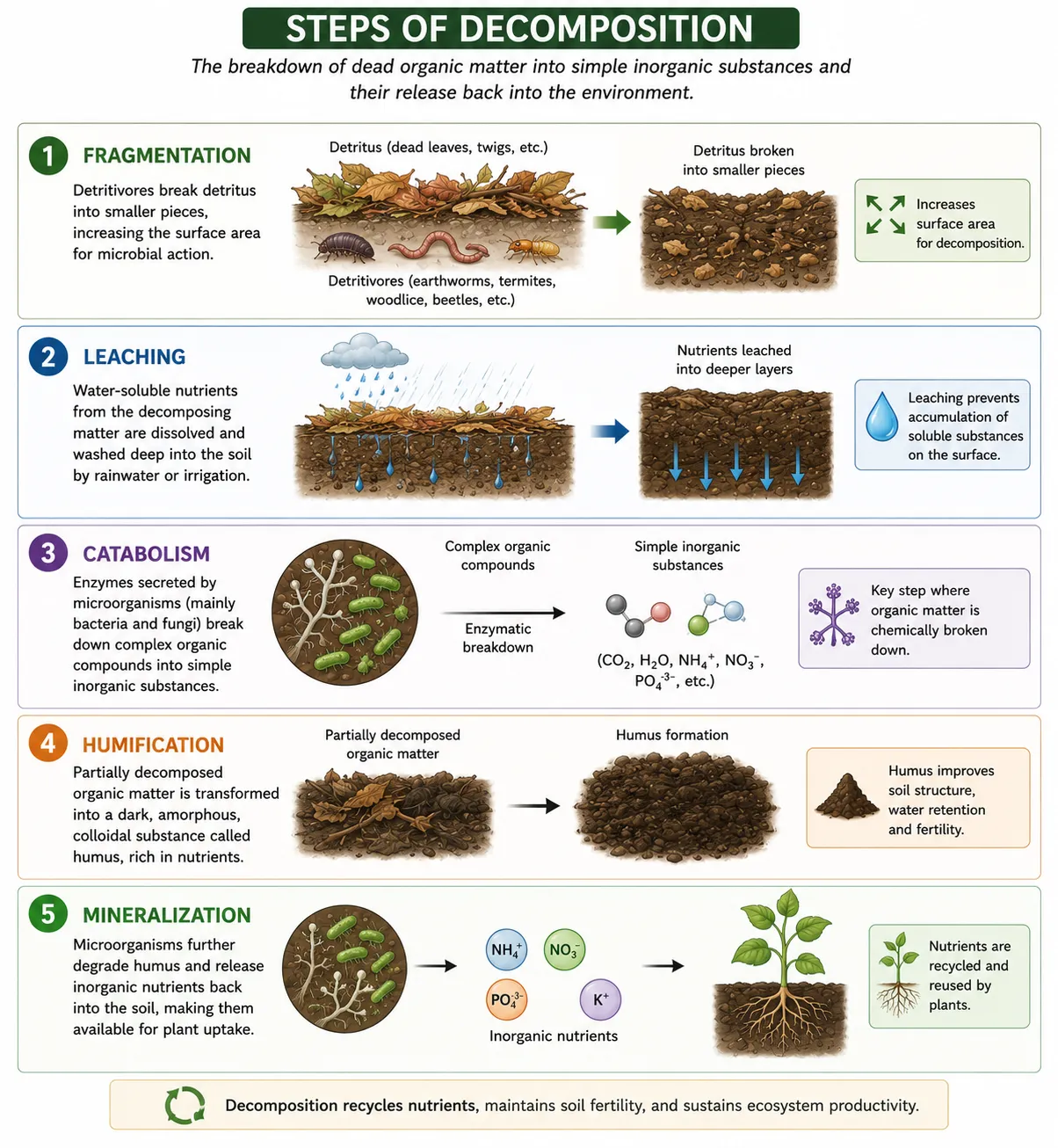
Key steps: Fragmentation \(\rightarrow\) Leaching \(\rightarrow\) Catabolism \(\rightarrow\) Humification \(\rightarrow\) Mineralization. - 10% Law of Energy Flow: Proposed by Lindeman, it states that only 10% of the energy is transferred from one trophic level to the next higher trophic level.
- Ecological Pyramids: Graphical representations of the trophic structure of an ecosystem. The pyramid of energy is always upright.
Full NCERT Solutions (Step-by-Step)
Here are the detailed, step-by-step NCERT Solutions for Class 12 Biology Chapter 14. Make sure to practice these for your board exams!
Question 1: Fill in the blanks.
(a) Plants are called as _______ because they fix carbon dioxide.
(b) In an ecosystem dominated by trees, the pyramid (of numbers) is _______ type.
(c) In aquatic ecosystems, the limiting factor for the productivity is _______
(d) Common detritivores in our ecosystem are _______
(e) The major reservoir of carbon on earth is _______
Step 1: (a) Autotrophs / Producers
Step 2: (b) Inverted
Step 3: (c) Light
Step 4: (d) Earthworms
Step 5: (e) Oceans
Question 2: Which one of the following has the largest population in a food chain?
(a) Producers
(b) Primary consumers
(c) Secondary consumers
(d) Decomposers
Step 1: Explanation. Decomposers (like bacteria and fungi) exist in billions in the soil and have the largest population in any food chain, as they feed on dead and decaying matter from all trophic levels.
Question 3: The second trophic level in a lake is:
(a) Phytoplankton
(b) Zooplankton
(c) Benthos
(d) Fishes
Step 1: Explanation. Phytoplanktons act as producers (first trophic level). Zooplanktons feed on phytoplanktons, making them primary consumers at the second trophic level.
Question 4: Secondary productivity is the rate of formation of new organic matter by:
(a) Parasite
(b) Consumer
(c) Decomposer
(d) Producer
Step 1: Explanation. Primary productivity is done by producers. When consumers (herbivores/carnivores) assimilate this food and create new biomass, it is called secondary productivity.
Question 5: What is the percentage of photosynthetically active radiation (PAR) in the incident solar radiation?
Step 1: Total Incident Radiation. Of the total incident solar radiation, less than 50% is Photosynthetically Active Radiation (PAR).
Step 2: Plant Capture Rate. Plants capture only 2-10% of this PAR to sustain the entire living world.
Question 6: Distinguish between: (a) Grazing food chain and detritus food chain (b) Production and decomposition (c) Upright and inverted pyramid
Step 1: (a) Grazing Food Chain (GFC) vs. Detritus Food Chain (DFC)
| Grazing Food Chain (GFC) | Detritus Food Chain (DFC) |
|---|---|
| Starts with living green plants (producers). | Starts with dead organic matter (detritus). |
| Energy comes directly from the sun. | Energy comes from organic remains. |
| Major conduit of energy flow in aquatic ecosystems. | Major conduit of energy flow in terrestrial ecosystems. |
Step 2: (b) Production vs. Decomposition
| Production | Decomposition |
|---|---|
| Process of synthesizing organic matter from inorganic substances. | Process of breaking down complex organic matter into simple inorganic substances. |
| Requires energy (sunlight). | Releases energy. |
| Carried out by autotrophs (plants). | Carried out by decomposers (bacteria, fungi). |
Step 3: (c) Upright vs. Inverted Pyramid
| Upright Pyramid | Inverted Pyramid |
|---|---|
| Base is broad and narrows towards the top. | Base is narrow and broadens towards the top. |
| Example: Pyramid of energy in all ecosystems. | Example: Pyramid of numbers in a single-tree ecosystem. |
Question 7: Describe the components of an ecosystem.
Step 1: Abiotic Components (Non-living). These include physical factors (temperature, light, wind, soil) and chemical factors (water, oxygen, carbon, nitrogen). They determine the survival of organisms in a given area.
Step 2: Biotic Components (Living). These include all living organisms, categorized as:
- Producers: Autotrophs (plants) that make their own food.
- Consumers: Heterotrophs (animals) that depend on plants or other animals for food.
- Decomposers: Saprotrophs (fungi, bacteria) that break down dead matter.
Question 8: Define ecological pyramids and describe with examples, pyramids of number and biomass.
Step 1: Definition. Ecological Pyramid: It is a graphical representation of the trophic structure and function of an ecosystem, starting with producers at the base and top carnivores at the apex.
Step 2: Pyramid of Number. Represents the number of individuals at each trophic level. Example: In a grassland ecosystem, it is upright because grasses (producers) are maximum in number, followed by fewer herbivores, and even fewer top carnivores.
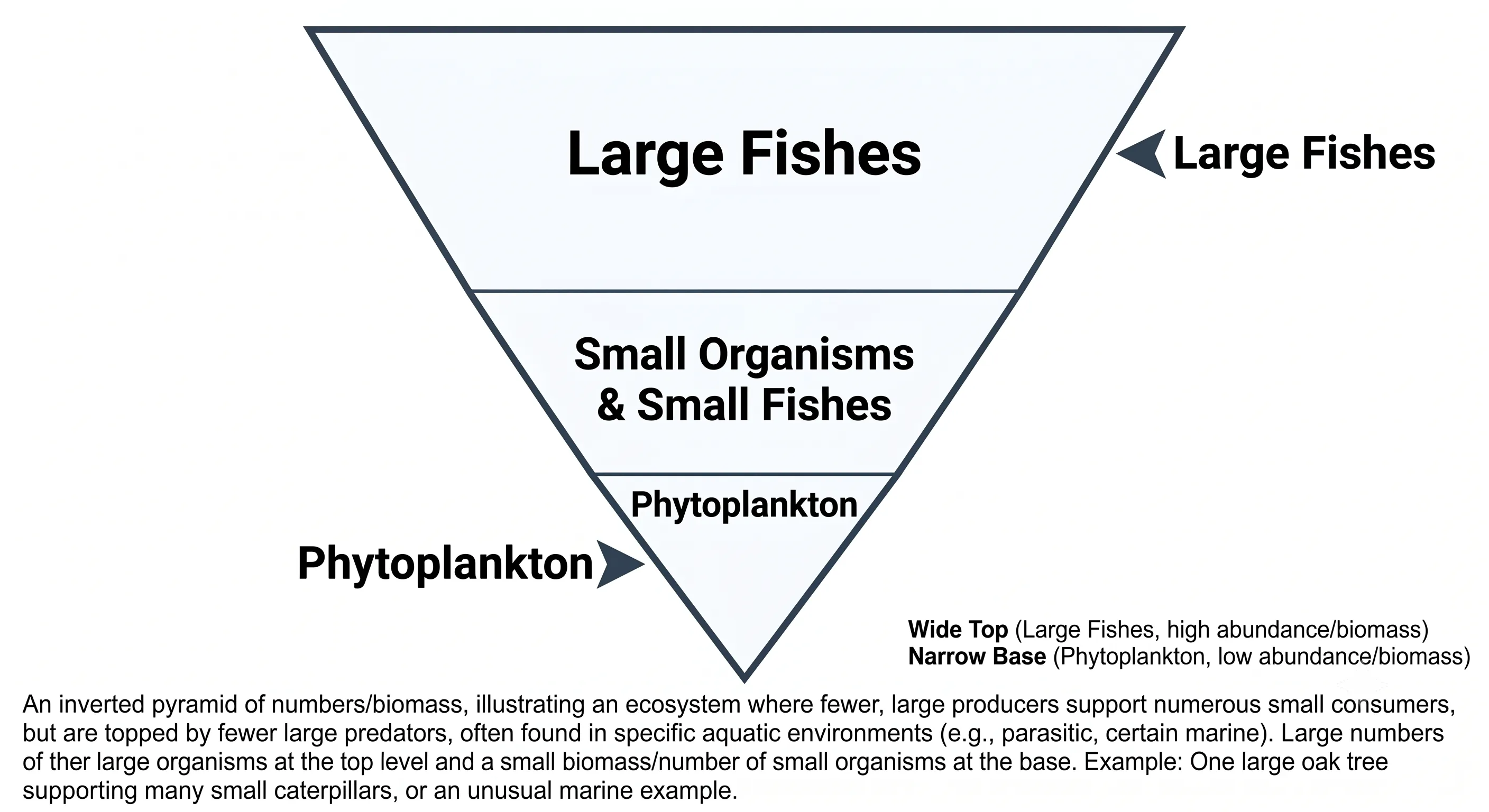
Step 3: Pyramid of Biomass. Represents the total dry weight of living matter at each trophic level. Example: In a forest ecosystem, it is upright. However, in a marine ecosystem, it is inverted because the biomass of fishes (consumers) far exceeds the biomass of phytoplankton (producers).
Question 9: What is primary productivity? Give brief description of factors that affect primary productivity.
Step 1: Definition. Primary Productivity is defined as the amount of biomass or organic matter produced per unit area over a time period by plants during photosynthesis.
Step 2: Factors affecting primary productivity.
- Plant species: It depends on the type of plant species inhabiting a particular area (e.g., \(C_4\) plants are more productive than \(C_3\) plants).
- Environmental factors: Sunlight availability, temperature, and moisture play a crucial role.
- Nutrient availability: The presence of essential minerals like nitrogen and phosphorus in the soil.
- Photosynthetic capacity: The inherent efficiency of the plants to trap solar energy.
Question 10: Define decomposition and describe the processes and products of decomposition.
Step 1: Definition. Decomposition is the process by which decomposers break down complex organic matter into inorganic substances like carbon dioxide, water, and nutrients.
Step 2: Processes of Decomposition.
- Fragmentation: Detritivores (like earthworms) break down detritus into smaller pieces, increasing the surface area.
- Leaching: Water-soluble inorganic nutrients seep down into the soil horizon and get precipitated.
- Catabolism: Bacterial and fungal enzymes degrade detritus into simpler inorganic substances.
- Humification: Leads to the formation of a dark-colored amorphous substance called humus, which is highly resistant to microbial action.
- Mineralization: Further degradation of humus by microbes to release inorganic nutrients.
Question 11: Give an account of energy flow in an ecosystem.
Step 1: Solar Input. The sun is the only source of energy for all ecosystems. Plants capture only 2-10% of the Photosynthetically Active Radiation (PAR).
Step 2: Producers. Plants convert solar energy into chemical energy via photosynthesis.
Step 3: Food Chain transfer. Energy is passed on to primary consumers (herbivores), then to secondary consumers (carnivores).
Step 4: 10% Law. According to Lindeman's 10% law, only 10% of the energy is transferred to the next trophic level. The remaining 90% is lost as heat during respiration and metabolic activities.
Step 5: Trophic Limitation. Due to this massive energy loss, food chains usually do not go beyond 4-5 trophic levels.
(Note: Questions 12 and 13 regarding Nutrient Cycling are largely omitted from the rationalized CBSE 2023-24 syllabus onwards, but are excellent for competitive exam knowledge.)
Extra Important Questions (Board Style)
Prepare for the Board Exam Questions 2026 with these highly probable practice questions!
Multiple Choice Questions (MCQs)
1. The rate of biomass production by consumers is called:
A) Gross primary productivity
B) Net primary productivity
C) Secondary productivity
D) Net community productivity
Step 1: Explanation. Consumers only reshape and store energy derived from producers, hence it's secondary. (Difficulty: Easy)
2. Which ecosystem has the maximum gross primary productivity?
A) Desert
B) Coral Reefs
C) Grassland
D) Deep ocean
Step 1: Explanation. High sunlight and nutrient recycling make coral reefs highly productive. (Tropical rainforests also share top spots). (Difficulty: Medium)
3. In a grazing food chain, carnivores represent:
A) Primary producers
B) Primary consumers
C) Secondary consumers
D) Decomposers
Step 1: Explanation. Producers \(\rightarrow\) Herbivores (Primary Consumers) \(\rightarrow\) Carnivores (Secondary Consumers). (Difficulty: Easy)
Short Answer Questions (SAQs)
4. Why is the pyramid of energy always upright?
Step 1: Thermodynamic Logic. The pyramid of energy can never be inverted because energy flow is strictly unidirectional according to the laws of thermodynamics.
Step 2: Heat Loss. As energy flows from one trophic level to the next, about 90% is lost as heat, meaning successive levels always have less energy. (Difficulty: Medium)
5. Distinguish between GPP and NPP.
Step 1: Gross Primary Productivity (GPP). The total rate of photosynthesis by producers.
Step 2: Net Primary Productivity (NPP). The remaining biomass after subtracting respiratory losses (R) from GPP. \((NPP = GPP - R)\). (Difficulty: Easy)
6. State Lindeman's 10% law with a simple example.
Step 1: The Law. It states that only 10% of the energy from one trophic level transfers to the next.
Step 2: Example. If plants have 1000 Joules of energy, herbivores will receive only 100 Joules, and primary carnivores will receive just 10 Joules. (Difficulty: Medium)
7. Why are earthworms referred to as "farmer's friends"?
Step 1: Role in Detritus. Earthworms help in the fragmentation of dead organic matter (detritus).
Step 2: Soil Benefits. By burrowing, they also loosen and aerate the soil, which accelerates decomposition and nutrient recycling, boosting soil fertility. (Difficulty: Easy)
8. Name the factors that make decomposition faster.
Step 1: Chemical Factors. Decomposition is faster if detritus is rich in nitrogen and water-soluble substances like sugars.
Step 2: Environmental Factors. Warm and moist environmental conditions also highly favor rapid decomposition. (Difficulty: Medium)
Long Answer Questions (LAQs)
9. Explain the steps of decomposition in detail.
Step 1: Fragmentation. Detritivores break detritus into smaller pieces, increasing the surface area.
Step 2: Leaching. Water-soluble nutrients wash deep into the soil.
Step 3: Catabolism. Enzymes from fungi and bacteria break down complex organics into simple inorganics.
Step 4: Humification. Leads to the formation of a dark, nutrient-rich layer called humus.
Step 5: Mineralization. Microbes degrade humus to finally release inorganic nutrients back into the soil for plants.
10. "The pyramid of biomass in sea is generally inverted." Justify this statement.
Step 1: Producer characteristics. In aquatic or marine ecosystems, the producers are tiny phytoplanktons. Their individual weight is very low, and they have a rapid turnover rate (they multiply and are eaten quickly).
Step 2: Consumer characteristics. However, the consumers (zooplanktons and fishes) are larger, live longer, and accumulate much more body mass.
Step 3: Conclusion. Thus, the total biomass of fishes at any given time is much higher than the phytoplankton they depend on, creating an inverted pyramid.
Assertion-Reason Questions
11. Assertion (A): The number of trophic levels in a food chain is restricted to four or five.
Reason (R): Only 10% of energy is transferred to the next trophic level, leaving negligible energy for top predators.
Step 1: Verification. Both A and R are true, and R is the correct explanation of A. (Difficulty: Medium)
12. Assertion (A): Humus is highly susceptible to microbial action and degrades very fast.
Reason (R): Humification is the final step of decomposition.
Step 1: Verification. Both A and R are false.
Step 2: Explanation. Humus is highly resistant to microbial action and degrades very slowly. Humification is the second-last step, followed by mineralization. (Difficulty: Hard)
Case-Based Questions
13. Read the passage and answer: In a certain ecosystem, tree leaves fall to the ground and are slowly broken down by bacteria and fungi. A student observed that the rate of this breakdown was much slower in winter than during the monsoon season.
(a) Which specific food chain is operating here?
(b) Why is the process slower in winter?
Step 1: (a) Detritus Food Chain (DFC).
Step 2: (b) Low temperature and dry conditions in winter inhibit microbial activity, slowing down decomposition. Monsoons provide warmth and moisture, which favor faster microbial action. (Difficulty: Medium)
14. A grasshopper eats a plant, a frog eats the grasshopper, a snake eats the frog, and an eagle eats the snake.
(a) What trophic level does the snake occupy?
(b) If the plant produces 10,000 J of energy, how much energy will reach the eagle?
Step 1: (a) The snake is a tertiary consumer occupying the 4th trophic level (Plant \(\rightarrow\) Grasshopper \(\rightarrow\) Frog \(\rightarrow\) Snake).
Step 2: (b) Plant (\(10,000\text{ J}\)) \(\rightarrow\) Grasshopper (\(1000\text{ J}\)) \(\rightarrow\) Frog (\(100\text{ J}\)) \(\rightarrow\) Snake (\(10\text{ J}\)) \(\rightarrow\) Eagle (\(1\text{ J}\)). The eagle receives \(1\text{ Joule}\). (Difficulty: Hard)
15. Identify the missing links (A and B) in the given food web:
Grass \(\rightarrow\) Insect \(\rightarrow\) (A) \(\rightarrow\) Eagle
Grass \(\rightarrow\) Rabbit \(\rightarrow\) (B) \(\rightarrow\) Eagle
Step 1: (A) Frog or Lizard (secondary consumer eating insect).
Step 2: (B) Fox or Snake (carnivore eating rabbit). (Difficulty: Easy)
Common Mistakes Students Make
- Confusing GPP and NPP: Remember that Gross is the total income of the plant, while Net is the take-home income after paying the "tax" of respiration (\(NPP = GPP - R\)).
- Direction of the 10% Law: Students sometimes apply the 10% law backward. Always divide by 10 as you move up the food chain (Producers \(\rightarrow\) Consumers).
- Pyramid Shapes: Many students assume all pyramids can be inverted. Never invert the Pyramid of Energy! It is physically impossible because of heat loss.
- Mixing Grazing and Detritus Chains: Always start a GFC with a living plant and a DFC with dead organic matter.
Exam Preparation Tips
- Master the Terminology: Words like Catabolism, Humification, and Stratification carry marks in board exams. Highlight them in your answers.
- Practice Diagrams: Always support your answers about ecological pyramids or energy flow with neat, labeled pencil diagrams.
- Solve PYQs: The board repeats questions on GPP/NPP calculations and inverted pyramids almost every alternate year.
- Keep Answers Point-wise: Examiners prefer bullets over paragraphs, especially for "differentiate between" type questions.
Frequently Asked Questions (FAQs)
1. Is Chapter 14 Ecosystem important for Class 12 biology boards?
2. What is the difference between an upright and inverted pyramid?
3. What is the equation for Net Primary Productivity?
4. Where can I download the updated NCERT Biology PDF for Class 12?
5. Which questions are most important from the Ecosystem chapter?
Conclusion: Mastering the Ecosystem chapter isn't just about memorizing facts; it's about understanding how nature balances itself. By thoroughly practicing these Updated NCERT Solutions and the extra Board Exam Questions 2026, you are setting yourself up for success. Revise regularly, draw clear diagrams, and don't forget to practice past year papers. You've got this! Let us know in the comments if you need notes for the next chapter.