Evolution Complete Solutions
Hey Lucky! Welcome to the fascinating world of Chapter 7: Evolution. Yeh chapter life ke origin, species ke development, aur human history ke raaz kholta hai. This chapter is super important for your CBSE Board Exams 2026 and carries massive weightage for competitive exams like NEET. Let's dive right into these updated, easy-to-understand NCERT solutions so you can clear your concepts and score full marks!
Learning Objectives
After completing this chapter, students will be able to:
- Understand the scientific theories behind the origin of life (Oparin-Haldane, Miller-Urey).
- Analyze the biological evidences supporting evolution, such as fossils and comparative anatomy.
- Differentiate between homologous and analogous organs.
- Explain Charles Darwin's theory of Natural Selection.
- Apply the Hardy-Weinberg principle to understand genetic equilibrium.
- Trace the major evolutionary stages from early primates to modern humans.
Key Concepts, Definitions & Formulas
- Big Bang Theory: Explains the singular huge explosion that created the universe.
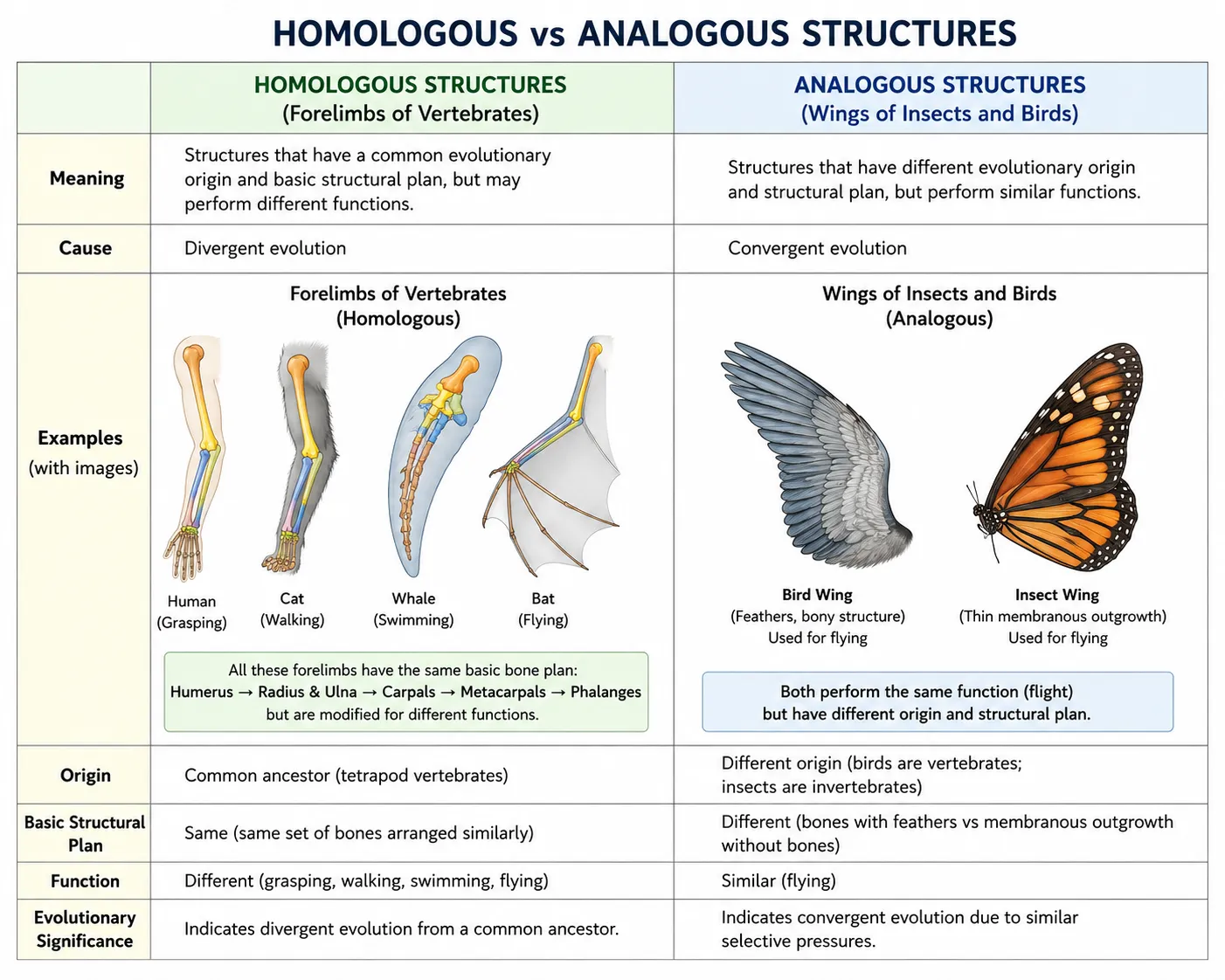
- Homologous Organs: Organs with the same basic structural design and origin but different functions. Indicates Divergent Evolution (e.g., Forelimbs of whales, bats, cheetahs, and humans).
- Analogous Organs: Organs with different anatomical structures but similar functions. Indicates Convergent Evolution (e.g., Wings of birds and butterflies).
- Adaptive Radiation: The evolutionary process where different species originate from a single common ancestor in a specific geographical area, adapting to different habitats (e.g., Darwin's Finches).
- Founder Effect: A type of genetic drift where a small group breaks off from a large population to form a new colony, and their allele frequency becomes the new norm.
- Hardy-Weinberg Principle: States that allele frequencies in a population are stable and constant from generation to generation in the absence of evolutionary influences.
Formula: $p^2 + 2pq + q^2 = 1$ (where $p$ and $q$ represent the frequencies of dominant and recessive alleles).
Full NCERT Solutions (Step-by-Step)
Here are the complete, step-by-step Updated NCERT Solutions for Class 12 Biology Chapter 7.
Question 1: Explain antibiotic resistance observed in bacteria in light of Darwinian selection theory.
Step 1: Natural Variation. According to Darwin's theory of natural selection, nature selects the fittest organisms. In a population of bacteria, natural genetic variations exist. Some bacteria naturally possess a mutation that makes them resistant to a specific antibiotic.
Step 2: Environmental Change. Jab hum antibiotic use karte hain, toh sensitive (non-resistant) bacteria mar jaate hain.
Step 3: Natural Selection. The resistant bacteria survive, multiply, and pass on their resistant genes to the next generation.
Step 4: Result. Over time, the entire population becomes resistant. This is a classic example of natural selection in action.
Question 2: Find out from newspapers and popular science articles any new fossil discoveries or controversies about evolution.
(Note: Students can mention recent discoveries.)
Step 1: The Discovery. A famous recent discovery is the fossil of Homo naledi found in the Rising Star Cave system in South Africa.
Step 2: The Controversy. It sparked controversy and excitement because it exhibited a mix of primitive features (like a small brain) and modern human-like features (like complex hands and feet), challenging the linear timeline of human evolution.
Question 3: Attempt giving a clear definition of the term species.
Step 1: Definition. A species is defined as a group of physically similar organisms that can interbreed freely in nature to produce fertile offspring, and are reproductively isolated from other such groups.
Question 4: Try to trace the various components of human evolution (hint: brain size and function, skeletal structure, dietary preference, etc.).
Human evolution is characterized by several key components:
Step 1: Bipedalism. Shift from walking on four limbs to walking erect on two legs (which freed the hands).
Step 2: Cranial Capacity (Brain Size). Gradual increase in brain size. (e.g., Australopithecus ~500 cc, Homo erectus ~900 cc, Homo sapiens ~1400 cc).
Step 3: Skeletal Structure. Development of an S-shaped spine, broader pelvis, and bowl-shaped jaw.
Step 4: Dietary Preference. Shift from a purely herbivorous diet (large teeth) to an omnivorous diet (smaller teeth, cooking food).
Step 5: Cultural Evolution. Tool making, use of fire, language, and community living.
Question 5: Find out through internet and popular science articles whether animals other than man have self-consciousness.
Step 1: The Mirror Test. Yes, several animals exhibit self-consciousness. The "Mirror Test" (putting a mark on an animal and seeing if they recognize it in a mirror) has been passed by several species.
Step 2: Examples. Animals that have passed include Chimpanzees, Orangutans, Dolphins, Elephants, and some species of birds like magpies.
Question 6: List 10 modern-day animals and using the internet resources link it to a corresponding ancient fossil. Name both.
Step 1: Horse → Eohippus (ancient)
Step 2: Elephant → Moeritherium (ancient)
Step 3: Humans → Ramapithecus (ancient)
Step 4: Dog → Leptocyon (ancient)
Step 5: Camel → Protylopus (ancient)
Step 6: Whale → Pakicetus (ancient)
Step 7: Giraffe → Samotherium (ancient)
Step 8: Crocodile → Deinosuchus (ancient)
Step 9: Bird → Archaeopteryx (ancient link between reptiles and birds)
Step 10: Shark → Cladoselache (ancient)
Question 7: Practice drawing various animals and plants.
(Self-practice question for students).
Exam Tip: Practice drawing the diagram of Homologous Organs (forelimbs of man, cheetah, whale, and bat) as it is frequently asked in the CBSE Board Exams.
Question 8: Describe one example of adaptive radiation.
Step 1: The Example. Darwin's Finches on the Galapagos Islands are the best example of adaptive radiation.
Step 2: The Process. Darwin observed that multiple species of finches existed on the islands, all sharing a common seed-eating ancestor from the South American mainland.
Step 3: The Adaptation. Depending on the type of food available on different islands (insects, fruits, tough seeds), their beaks evolved and adapted differently. From a single ancestor, multiple distinct species radiated out to fit various ecological niches.
Question 9: Can we call human evolution as adaptive radiation?
Step 1: Direct Answer. No, human evolution is not generally considered an example of adaptive radiation.
Step 2: Reasoning. Adaptive radiation involves a common ancestor rapidly diversifying into multiple species in a specific geographical area to fill different ecological niches (like finches eating different foods). Human evolution is more of a progressive, sequential evolution (anagenesis) over time, where one species gradually evolved into another (Australopithecus → Homo habilis → Homo erectus → Homo sapiens), accompanied by brain enlargement and tool use, rather than splitting into multiple co-existing species adapting to different localized diets.
Question 10: Using various resources such as your school library or the internet and discussions with your teacher, trace the evolutionary stages of any one animal, say horse.
Step 1: Overview. The evolution of the horse occurred over 50 million years, generally showing an increase in body size, lengthening of legs, and a reduction in the number of toes. The main stages are:
Step 2: Eohippus (Dawn horse). Small, dog-sized, with 4 toes on front feet and 3 on hind feet.
Step 3: Mesohippus. Slightly larger, 3 toes on all feet.
Step 4: Merychippus. Larger still, adaptation to running on hard ground (middle toe became larger).
Step 5: Pliohippus. The first one-toed horse.
Step 6: Equus (Modern horse). Large size, single solid hoof, complex teeth for grazing grass.
EXTRA IMPORTANT QUESTIONS (BOARD STYLE)
Yahan 15 highly important questions hain for your 2026 Board preparation!
Multiple Choice Questions (MCQs)
1. The wings of a bird and the wings of an insect are:
A) Homologous structures and represent divergent evolution
B) Analogous structures and represent convergent evolution
C) Phylogenetic structures and represent divergent evolution
D) Homologous structures and represent convergent evolution
Step 1: Logic. (B) Analogous structures and represent convergent evolution. (Difficulty Level: Easy)
2. Which of the following had the smallest brain capacity?
A) Homo neanderthalensis
B) Homo habilis
C) Homo erectus
D) Homo sapiens
Step 1: Logic. (B) Homo habilis (around 650-800 cc). (Difficulty Level: Medium)
3. The Hardy-Weinberg principle cannot operate if:
A) The population is very large
B) Mating is random
C) Frequent mutations occur
D) Free gene flow is absent
Step 1: Logic. (C) Frequent mutations occur (Mutations change allele frequencies). (Difficulty Level: Medium)
Short Answer Questions (2-3 Marks)
4. Explain the Miller-Urey experiment briefly.
Step 1: Setup. S.L. Miller created primitive earth conditions in a laboratory. He circulated a mixture of $CH_4$, $NH_3$, $H_2$, and water vapor in a closed flask at $800^\circ C$ and passed electric discharges (simulating lightning).
Step 2: Result. After a week, he observed the formation of organic molecules like amino acids, proving that life could originate from inorganic molecules.
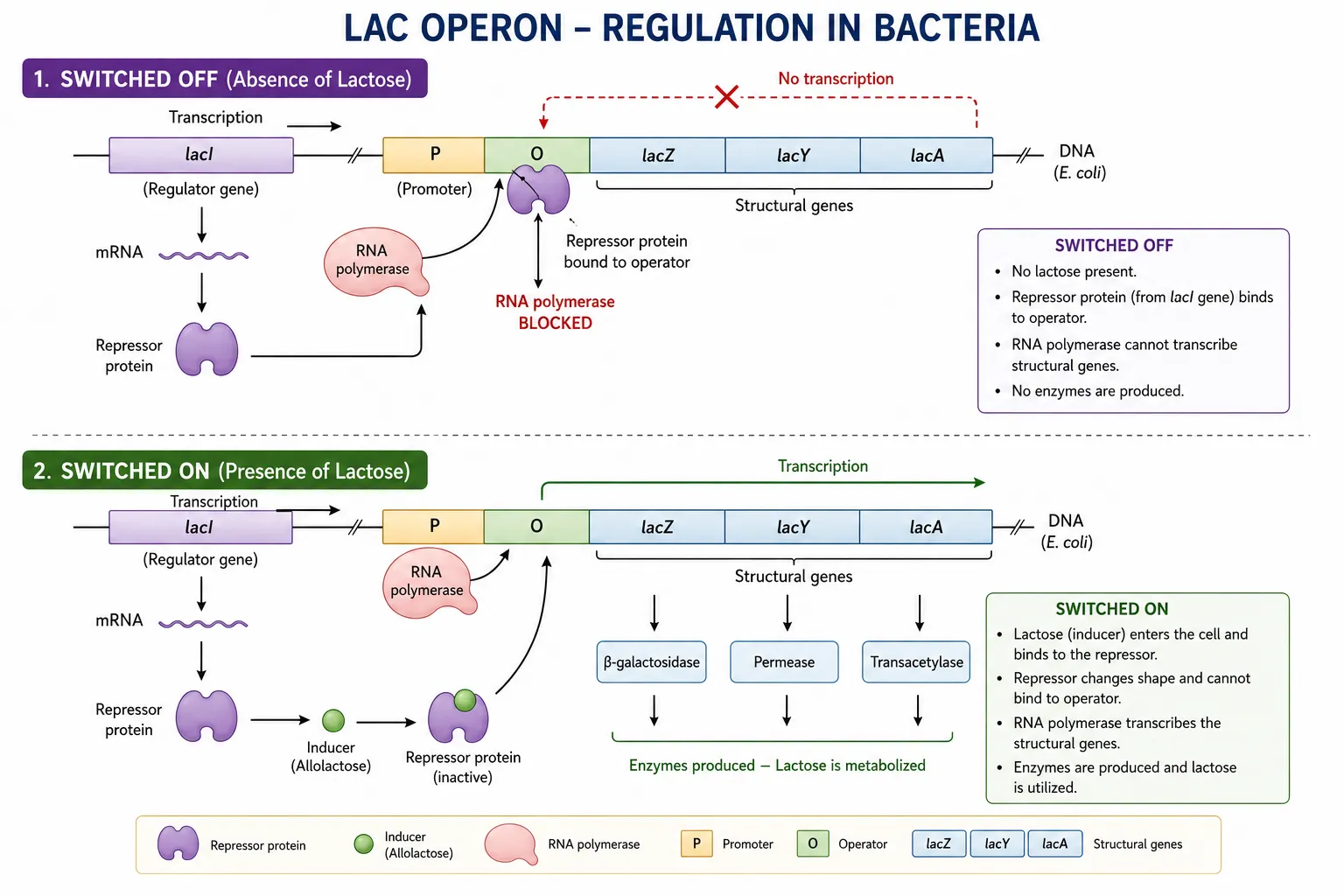
5. What is the difference between Genetic Drift and Gene Flow?
Step 1: Gene Flow. Gene Flow is the transfer of genetic material from one population to another due to migration.
Step 2: Genetic Drift. Genetic Drift is the random, chance change in allele frequencies in a small population, irrespective of natural selection (e.g., a natural disaster wiping out a specific trait).
6. Name the hominid that used hides to protect their body and buried their dead.
Step 1: Identification. Neanderthal man (Homo neanderthalensis).
7. "Industrial melanism in peppered moths is an excellent example of natural selection." Justify.
Step 1: Pre-industrialization. Before industrialization in England, white-winged moths were completely camouflaged against light-colored, lichen-covered tree trunks, while dark moths were eaten by birds.
Step 2: Post-industrialization. Post-industrialization, pollution killed lichens and darkened tree trunks with soot. Now, dark moths were hidden, and white moths were eaten.
Step 3: Conclusion. Nature "selected" the dark moths for survival in the changed environment.
Long Answer Questions (5 Marks)
8. Differentiate between Divergent and Convergent evolution with examples.
Step 1: Divergent Evolution. When a single ancestral species develops different traits to adapt to different environments. It leads to homologous organs.
Example: The forelimbs of mammals (whales for swimming, bats for flying, cheetahs for running) have the same basic bone structure (humerus, radius, ulna) but do different jobs.
Step 2: Convergent Evolution. When unrelated species evolve similar traits because they live in similar environments. It leads to analogous organs.
Example: Flippers of Penguins (birds) and Dolphins (mammals). They look similar and do the same job (swimming) but have different internal anatomy.
9. Explain the Hardy-Weinberg principle. What are the five factors that affect the Hardy-Weinberg equilibrium?
Step 1: The Principle. The Hardy-Weinberg principle states that allele frequencies in a population are stable and remain constant from generation to generation ($p^2 + 2pq + q^2 = 1$).
Step 2: The Five Factors. The genetic equilibrium is disturbed by five factors:
1. Gene migration (gene flow)
2. Genetic drift
3. Mutation
4. Genetic recombination during meiosis
5. Natural selection
10. Trace the evolutionary history of humans from dryopithecus to modern man, mentioning their cranial capacities.
Step 1: Dryopithecus / Ramapithecus. 15 million years ago. Ape-like and man-like.
Step 2: Australopithecus. 2 million years ago. Walked upright, brain capacity ~500 cc.
Step 3: Homo habilis. The first human-like hominid. Brain ~650-800 cc. Did not eat meat.
Step 4: Homo erectus. 1.5 million years ago. Brain ~900 cc. Ate meat.
Step 5: Homo neanderthalensis. Brain ~1400 cc. Used hides, buried dead.
Step 6: Homo sapiens. Arose during ice age. Brain ~1350-1400 cc. Developed agriculture and art.
Case-Based / Passage-Based Questions (4 Marks)
Read the passage and answer questions 11-13:
A group of scientists studied a remote island. They found 14 distinct species of birds that all looked similar but had completely different beak shapes. The mainland, 500 miles away, had only one species of this bird, which ate seeds. On the island, some birds ate insects, some ate cactus, and some ate seeds.
11. What evolutionary phenomenon does this passage describe?
Step 1: Identification. Adaptive Radiation. (Difficulty Level: Easy)
12. Who was the first scientist to document a similar observation, and where?
Step 1: Identification. Charles Darwin, on the Galapagos Islands. (Difficulty Level: Easy)
13. What forced the original seed-eating birds to change their beak shapes?
Step 1: Mechanism. Competition for food. To survive in different habitats on the islands with varying food sources, natural selection favored variations in beak shapes that allowed birds to utilize alternative food sources without competing. (Difficulty Level: Medium)
Assertion-Reason Questions
Directions:
(A) Both A and R are true and R is the correct explanation of A.
(B) Both A and R are true but R is not the correct explanation of A.
(C) A is true but R is false.
(D) A is false but R is true.
14. Assertion (A): The wings of a bat and the wings of a butterfly are homologous organs.
Reason (R): They perform the same function of flying but have different structural origins.
Step 1: Verification. (D) A is false but R is true. (They are analogous, not homologous). (Difficulty Level: Medium)
15. Assertion (A): Homo habilis is called the first tool-maker.
Reason (R): He had a cranial capacity of 900 cc and ate a lot of meat.
Step 1: Verification. (C) A is true but R is false. (Reason is false because Homo habilis had a cranial capacity of 650-800 cc and probably did NOT eat meat). (Difficulty Level: Hard)
Common Mistakes Students Make
- Mixing up Homologous and Analogous: Memory Trick: HD TV and AC. Homologous = Divergent. Analogous = Convergent.
- Hardy-Weinberg Confusion: Students often forget what $p$ and $q$ stand for. Remember, $p$ is the frequency of the dominant allele, $q$ is the frequency of the recessive allele. $2pq$ represents the heterozygous population.
- Human Evolution Order: Galti se Homo erectus ko Homo habilis ke pehle likh dete hain. Memory Trick: Remember Always, Humans Evolve Naturally Smart (Ramapithecus → Australopithecus → H. Habilis → H. Erectus → Neanderthal → H. Sapiens).
Exam Preparation Tips
- Focus on Flowcharts: Draw a clear flowchart for human evolution and stick it on your desk. You need to memorize the cranial capacities (cc) perfectly.
- Practice the Diagrams: The Miller-Urey experiment diagram is a classic 3-mark question. Practice labeling it neatly.
- Answer Writing Strategy: Whenever you write about Natural Selection, always use keywords like "Survival of the Fittest", "Reproductive Fitness", and "Adaptation". Examiners scan for these exact words.
- Time Management: Don't waste time writing huge essays for 2-mark questions on homologous/analogous organs. Make a quick table and give two examples. Done!
Frequently Asked Questions (FAQs)
Is Chapter 7 Evolution important for CBSE 2026?
Where can I find the updated NCERT Solutions for Class 12 Biology Evolution?
What is the Hardy-Weinberg principle?
What is the difference between homologous and analogous organs?
How to memorize the stages of human evolution?
Conclusion:
Yaar Lucky, aur baaki sabhi students, Evolution ek aisi kahani hai jo samajh aane ke baad bohot logical lagti hai. Don't try to cram everything; visualize how organisms adapted to survive. Revise regularly, make short notes of the human cranial capacities, and definitely practice PYQs (Previous Year Questions) to get a feel of the board's language. Download these notes, keep your basics crystal clear, and get ready to rock your CBSE 2026 Boards with confidence!