Sexual Reproduction in Flowering Plants Solutions
Welcome to examspark.in! Is post mein hum CBSE Class 12 Biology Chapter 2, Sexual Reproduction in Flowering Plants ko detail mein samjhenge. We will cover the Updated NCERT Solutions, important concepts, aur Board Exam Questions 2026 ke liye zaroori tips. Yeh chapter aapke board exams aur NEET dono ke liye super important hai. Concept ko samajhna aur practice karna key hai. Let's make learning simple!
Learning Objectives
After completing this chapter, students will be able to:
- Understand the morphology and reproductive structure of a typical angiosperm flower.
- Explain the detailed processes of microsporogenesis and megasporogenesis.
- Identify different types of pollination, pollinating agents, and outbreeding devices.
- Describe the unique event of double fertilization and its significance.
- Outline post-fertilization events including endosperm, embryo, seed, and fruit formation.
Key Concepts & Definitions
- Microsporogenesis: The process of formation of microspores from a pollen mother cell (PMC) through meiosis.
- Megasporogenesis: The process of formation of megaspores from the megaspore mother cell (MMC) in the ovule.
- Sporopollenin: One of the most resistant organic materials known; it makes up the hard outer layer (exine) of pollen grains.
- Pollination: The transfer of pollen grains from the anther to the stigma. It has three types: Autogamy (same flower), Geitonogamy (different flower, same plant), and Xenogamy (different plant).
- Double Fertilization: The fusion of one male gamete with the egg cell (Syngamy) and the other male gamete with two polar nuclei (Triple Fusion).
- Endosperm: A triploid (3n) tissue that develops from the Primary Endosperm Nucleus (PEN) and provides nutrition to the developing embryo.
- Parthenocarpy: The development of a fruit without fertilization (e.g., banana).
- Apomixis: A special mechanism to produce seeds without fertilization, mimicking sexual reproduction.
Full NCERT Solutions (Step-by-Step)
Here are the complete, step-by-step CBSE Class 12 Biology Chapter 2 solutions.
Question 1: Name the parts of an angiosperm flower in which development of male and female gametophyte take place.
Step 1: Male gametophyte. The male gametophyte (pollen grain) develops inside the microsporangium (pollen sac) of the anther.
Step 2: Female gametophyte. The female gametophyte (embryo sac) develops inside the megasporangium (ovule) of the ovary.
Question 2: Differentiate between microsporogenesis and megasporogenesis. Which type of cell division occurs during these events? Name the structures formed at the end of these two events.
Step 1: Differences Table.
| Microsporogenesis | Megasporogenesis |
|---|---|
| Formation of microspores from a Pollen Mother Cell (PMC). | Formation of megaspores from a Megaspore Mother Cell (MMC). |
| Occurs inside the microsporangium (anther). | Occurs inside the megasporangium (ovule). |
| All four microspores of a tetrad are usually functional. | Only one megaspore is functional; the other three degenerate. |
Step 2: Cell Division. Meiosis (reduction division) occurs during both events.
Step 3: Structures Formed. Microsporogenesis produces microspores (which develop into pollen grains). Megasporogenesis produces megaspores (the functional one develops into the embryo sac).
Question 3: Arrange the following terms in the correct developmental sequence: Pollen grain, sporogenous tissue, microspore tetrad, pollen mother cell, male gametes.
Step 1: Correct Sequence. Sporogenous tissue → Pollen mother cell (PMC) → Microspore tetrad → Pollen grain → Male gametes.
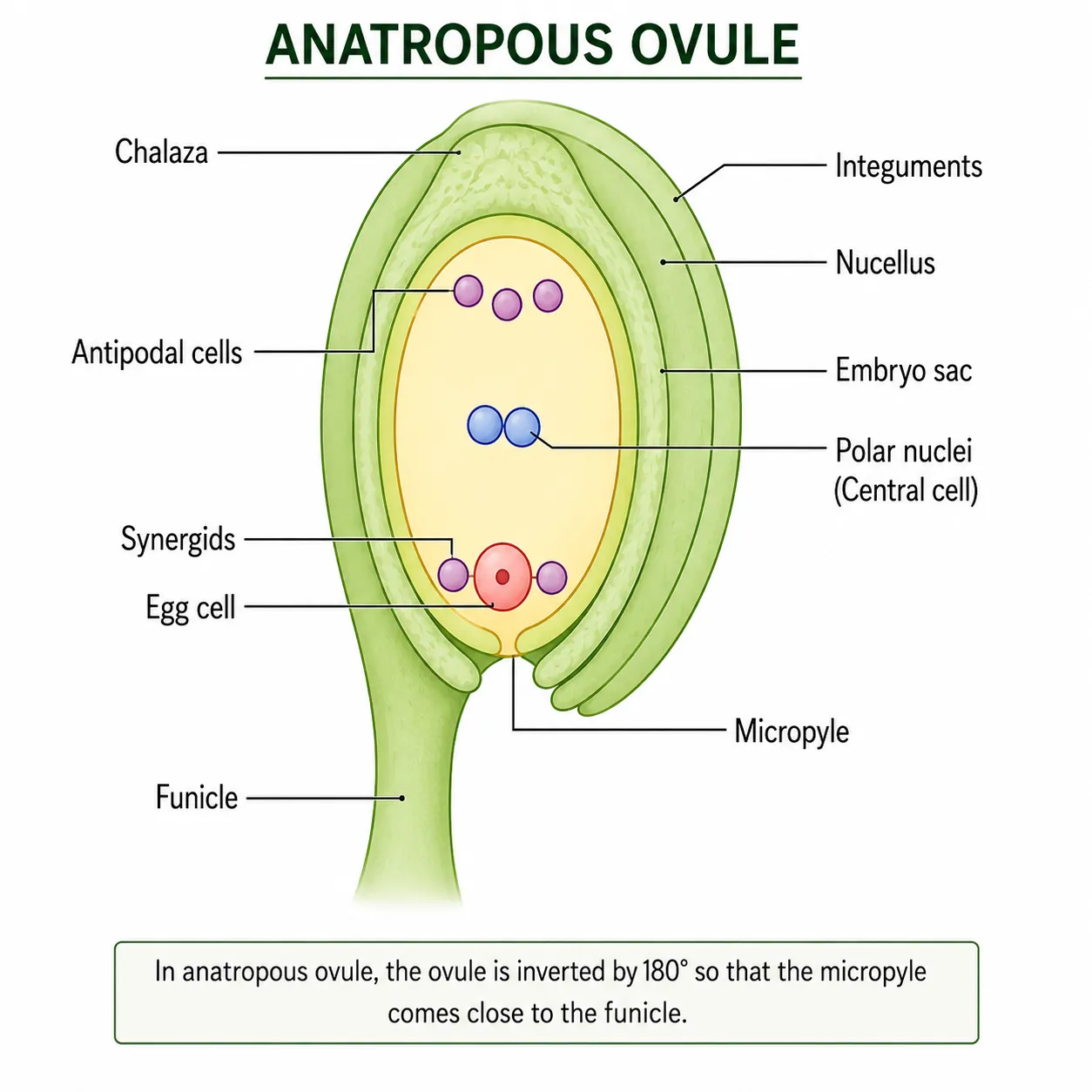
Question 4: With a neat, labelled diagram, describe the parts of a typical angiosperm ovule.
Step 1: Structural Parts. A typical angiosperm ovule (anatropous ovule) consists of the following parts:
- Funiculus: The stalk that attaches the ovule to the placenta.
- Hilum: The junction where the body of the ovule fuses with the funiculus.
- Integuments: Protective envelopes surrounding the ovule.
- Micropyle: A small opening at the tip where integuments are absent. Pollen tube usually enters through here.
- Chalaza: The basal part of the ovule opposite the micropyle.
- Nucellus: A mass of cells enclosed within the integuments, providing nourishment.
- Embryo Sac: The female gametophyte located inside the nucellus.
Question 5: What is meant by monosporic development of female gametophyte?
Step 1: Meiotic Division. During megasporogenesis, the Megaspore Mother Cell (MMC) divides meiotically to form four megaspores.
Step 2: Degeneration. Out of these, three degenerate, and only one remains functional.
Step 3: Definition. The method of embryo sac formation from this single functional megaspore is called monosporic development.
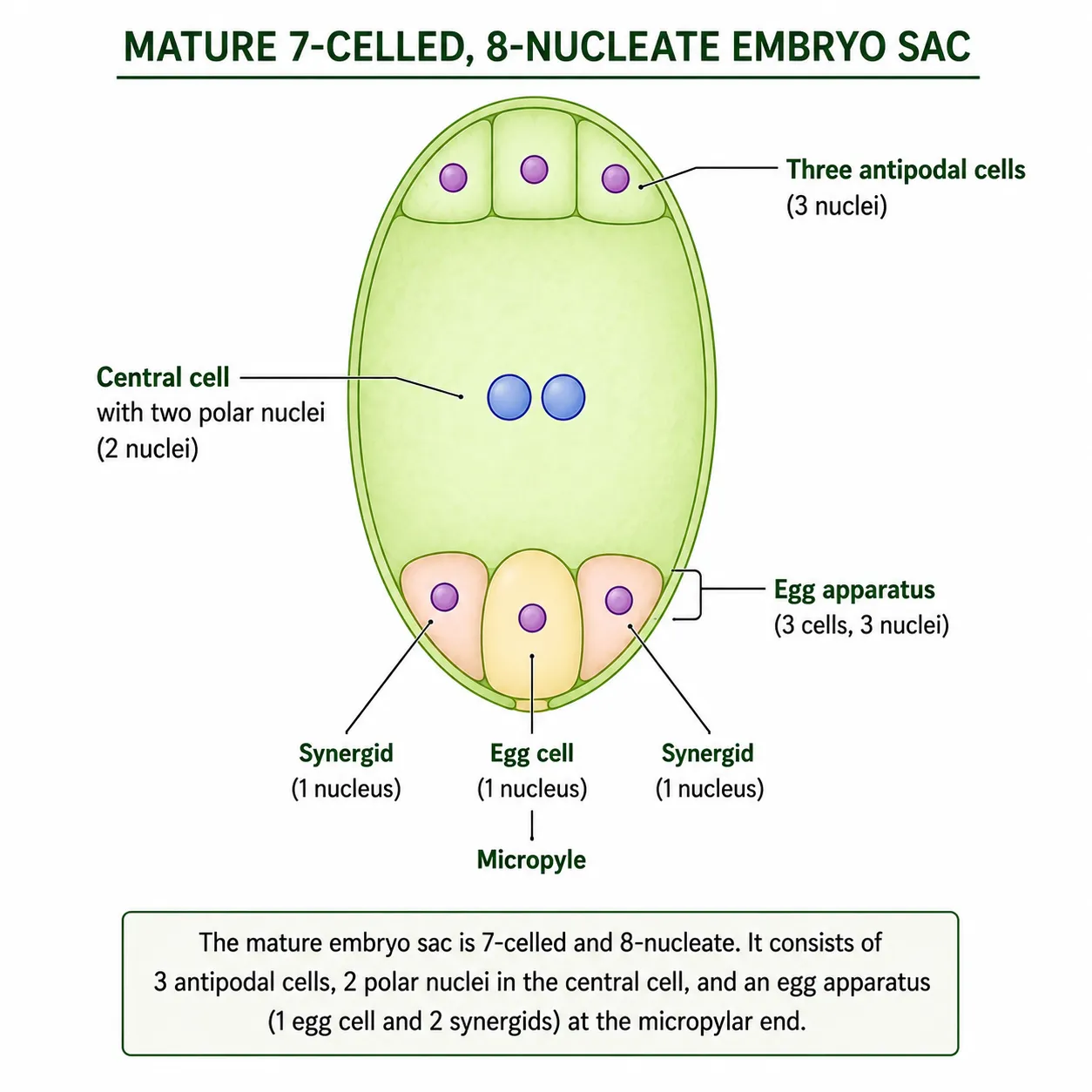
Question 6: With a neat diagram explain the 7-celled, 8-nucleate nature of the female gametophyte.
Step 1: Egg Apparatus. Located at the micropylar end, it consists of two synergids and one egg cell (3 cells, 3 nuclei).
Step 2: Antipodals. Located at the chalazal end, these are three cells that eventually degenerate (3 cells, 3 nuclei).
Step 3: Central Cell. The largest cell in the center containing two polar nuclei (1 cell, 2 nuclei).
Step 4: Total count. Total: 3 + 3 + 1 = 7 cells, but 3 + 3 + 2 = 8 nuclei.
Question 7: What are chasmogamous flowers? Can cross-pollination occur in cleistogamous flowers? Give reasons for your answer.
Step 1: Chasmogamous definition. Chasmogamous flowers are normal flowers with exposed anthers and stigmas. They open at maturity.
Step 2: Cross-pollination in cleistogamous? No, cross-pollination cannot occur in cleistogamous flowers.
Step 3: Reason. Cleistogamous flowers never open. The anther and stigma lie very close to each other. When pollen is released, it inevitably lands on the stigma of the same flower. Hence, they are strictly autogamous (self-pollinating) and there is no chance for cross-pollen to land on the stigma.
Question 8: Mention two strategies evolved to prevent self-pollination in flowers.
Step 1: Strategy 1 (Dichogamy). The pollen release and stigma receptivity are not synchronized (e.g., pollen is released before the stigma becomes receptive, or vice versa).
Step 2: Strategy 2 (Self-incompatibility). A genetic mechanism that prevents self-pollen from fertilizing the ovules by inhibiting pollen germination or pollen tube growth in the pistil.
Question 9: What is self-incompatibility? Why does self-pollination not lead to seed formation in self-incompatible species?
Step 1: Definition. Self-incompatibility is a genetically controlled mechanism in plants that prevents their own pollen (from the same flower or another flower of the same plant) from fertilizing the egg.
Step 2: Reason for no seeds. It does not lead to seed formation because the plant rejects the self-pollen, either by preventing it from germinating on the stigma or by blocking the growth of the pollen tube through the style.
Question 10: What is bagging technique? How is it useful in a plant breeding programme?
Step 1: Technique definition. The bagging technique involves covering the emasculated flower (or an intact bisexual flower before it opens) with a bag made of butter paper to prevent contamination of its stigma with unwanted pollen.
Step 2: Usefulness. It is crucial in artificial hybridization. Plant breeders use it to ensure that only the desired, selected pollen grains are used for pollination, helping to develop superior plant varieties.
Question 11: What is triple fusion? Where and how does it take place? Name the nuclei involved in triple fusion.
Step 1: Definition. Triple Fusion is the fusion of one male gamete with the two polar nuclei to form a triploid Primary Endosperm Nucleus (PEN).
Step 2: Location. It takes place inside the central cell of the embryo sac.
Step 3: Mechanism. The pollen tube releases two male gametes into the synergid. One gamete fuses with the egg (syngamy). The second male gamete moves to the central cell and fuses with the two polar nuclei.
Step 4: Nuclei involved. One male gamete nucleus + Two polar nuclei.
Question 12: Why do you think the zygote is dormant for sometime in a fertilized ovule?
Step 1: Assuring nutrition. The zygote remains dormant for some time to wait for the development of the endosperm.
Step 2: Embryo development. The embryo needs assured nutrition to develop properly. The endosperm provides this nourishment. Once a certain amount of endosperm is formed, the zygote begins dividing.
Question 13: Differentiate between: (a) hypocotyl and epicotyl; (b) coleoptile and coleorhiza; (c) integument and testa; (d) perisperm and pericarp.
Step 1: Hypocotyl vs Epicotyl.
- Hypocotyl: The portion of the embryonal axis below the level of cotyledons. It terminates in the radicle (root tip).
- Epicotyl: The portion of the embryonal axis above the level of cotyledons. It terminates in the plumule (shoot tip).
Step 2: Coleoptile vs Coleorhiza.
- Coleoptile: A hollow, protective foliar structure enclosing the plumule in monocots.
- Coleorhiza: An undifferentiated sheath enclosing the radicle and root cap in monocots.
Step 3: Integument vs Testa.
- Integument: The protective covering of the ovule before fertilization.
- Testa: The hard outer protective coat of the seed formed from the outer integument after fertilization.
Step 4: Perisperm vs Pericarp.
- Perisperm: The persistent, residual nucellus found in some seeds (e.g., black pepper).
- Pericarp: The fruit wall developed from the ovary wall after fertilization.
Question 14: Why is apple called a false fruit? Which part(s) of the flower forms the fruit?
Step 1: Reason for false fruit. An apple is called a false fruit because the floral parts other than the ovary contribute to fruit formation.
Step 2: Part forming the fruit. In apples, the fleshy edible part develops from the thalamus.
Question 15: What is meant by emasculation? When and why does a plant breeder employ this technique?
Step 1: Definition. Emasculation is the removal of anthers from the flower bud using forceps before the anther dehisces (opens).
Step 2: When and Why. Plant breeders employ this technique during artificial hybridization in bisexual flowers to prevent self-pollination. It ensures the stigma is pollinated only by pollen grains of the breeder's choice.
Question 16: If one can induce parthenocarpy through the application of growth substances, which fruits would you select to induce parthenocarpy and why?
Step 1: Selection. I would select fruits that contain many seeds and where seeds are a nuisance while eating, such as watermelons, oranges, lemons, and grapes.
Step 2: Reason. Parthenocarpic fruits are seedless. Inducing parthenocarpy in these fruits makes them more consumer-friendly and increases their commercial value.
Question 17: Explain the role of tapetum in the formation of pollen-grain wall.
Step 1: Location. The tapetum is the innermost layer of the microsporangium.
Step 2: Roles. Its roles include:
1. Providing nourishment to the developing pollen mother cells and pollen grains.
2. Secreting enzymes and hormones.
3. Producing Ubisch bodies, which are coated with sporopollenin. These help in the formation of the exine (the hard outer wall of the pollen grain).
Question 18: What is apomixis and what is its importance?
Step 1: Definition. Apomixis is a form of asexual reproduction that mimics sexual reproduction, resulting in the formation of seeds without fertilization.
Step 2: Importance. It is highly useful in agriculture. If hybrid seeds are made apomictic, the farmers can keep using the harvested seeds year after year to raise new crops. The hybrid characters do not segregate in the progeny, saving farmers the cost of buying expensive hybrid seeds every year.
EXTRA IMPORTANT QUESTIONS (BOARD STYLE)
ExamSpark par humari koshish rehti hai ki aapko complete practice mile. Here are 15 important questions (mix of formats) that are highly expected in the 2026 Board Exams!
Multiple Choice Questions (MCQs)
1. Sporopollenin is absent in which part of the pollen grain?
A) Exine
B) Intine
C) Germ pore
D) Vegetative cell
Step 1: Identify. C) Germ pore. (Difficulty: Easy)
2. Which of the following is an example of a water-pollinated plant?
A) Water lily
B) Water hyacinth
C) Vallisneria
D) Lotus
Step 1: Identify. C) Vallisneria. (Difficulty: Medium) Note: Water lily and water hyacinth are pollinated by insects/wind.
3. In angiosperms, a functional megaspore develops into:
A) Endosperm
B) Embryo sac
C) Ovule
D) Pollen sac
Step 1: Identify. B) Embryo sac. (Difficulty: Easy)
Short Answer Questions (2-3 Marks)
4. Differentiate between Geitonogamy and Xenogamy.
Step 1: Geitonogamy. It is the transfer of pollen grains to the stigma of another flower on the same plant. Genetically, it is similar to autogamy.
Step 2: Xenogamy. It is the transfer of pollen grains to the stigma of a different flower on a different plant. It brings genetic variation. (Difficulty: Medium)
5. What is a pollen bank? How is it useful?
Step 1: Definition. Pollen banks are centers where pollen grains of various species are stored in liquid nitrogen (-196°C).
Step 2: Usefulness. They are useful in crop breeding programs to preserve genetic diversity and make pollen available for artificial hybridization anytime. (Difficulty: Easy)
6. Mention the ploidy of the following: (a) Synergids (b) Nucellus (c) Endosperm (d) Zygote.
Step 1: (a) Synergids - Haploid (n)
Step 2: (b) Nucellus - Diploid (2n)
Step 3: (c) Endosperm - Triploid (3n)
Step 4: (d) Zygote - Diploid (2n). (Difficulty: Medium)
Long Answer Questions (5 Marks)
7. Describe the process of double fertilization in angiosperms with a suitable diagram.
Step 1: Syngamy. One male gamete (n) fuses with the egg cell (n) to form a diploid zygote (2n).
Step 2: Triple Fusion. The second male gamete (n) fuses with the two polar nuclei (n+n) in the central cell to form a triploid Primary Endosperm Nucleus (3n).
Step 3: Double Fertilization. Since two types of fusions occur in the same embryo sac, it is called double fertilization. (Difficulty: Hard)

8. Explain the post-fertilization events leading to the formation of a seed.
Step 1: Zygote development. The zygote develops into an embryo.
Step 2: Endosperm development. The PEN develops into the endosperm (providing nutrition).
Step 3: Degeneration. The synergids and antipodals degenerate.
Step 4: Seed formation. The ovule matures into a seed. The integuments harden to form seed coats (testa and tegmen). (Difficulty: Medium)
9. Explain the development of a dicot embryo from the zygote.
Step 1: Initial division. The zygote undergoes a transverse division to form a basal suspensor cell and a terminal embryonal cell.
Step 2: Suspensor formation. The suspensor cell divides to form a 6-10 celled suspensor, which pushes the embryo into the endosperm.
Step 3: Embryo stages. The embryonal cell undergoes divisions to form proembryo, followed by globular, heart-shaped, and mature embryo stages, containing two cotyledons and an embryonal axis. (Difficulty: Hard)
Case-Based Questions (4 Marks)
10. Read the passage and answer: Bees are the dominant biotic pollinating agents. Most insect-pollinated flowers are large, colourful, fragrant, and rich in nectar. When a flower is small, many flowers cluster into an inflorescence.
(a) Why do flowers produce nectar?
(b) What are floral rewards?
(c) Give an example of a plant that provides a safe place to lay eggs as a floral reward.
Step 1: (a) To attract and sustain insect pollinators.
Step 2: (b) Nectar and pollen grains are the usual floral rewards for pollinators.
Step 3: (c) Amorphophallus (or Yucca moth relationship). (Difficulty: Medium)
11. Read the passage and answer: Endosperm development precedes embryo development. The PEN undergoes successive nuclear divisions to give rise to free nuclei. This stage is free-nuclear endosperm.
(a) Why does endosperm development precede embryo development?
(b) Give an example of free-nuclear endosperm.
(c) Is the endosperm haploid, diploid, or triploid?
Step 1: (a) To ensure assured nutrition is ready for the developing embryo.
Step 2: (b) The water of tender coconut.
Step 3: (c) Triploid (3n). (Difficulty: Medium)
12. Read the passage and answer: Seeds offer several advantages to angiosperms. First, since reproductive processes such as pollination and fertilization are independent of water, seed formation is more dependable.
(a) What is dormancy?
(b) Name the two seed coats.
(c) Name the oldest viable seed discovered.
Step 1: (a) A state of metabolic inactivity in seeds to survive unfavorable conditions.
Step 2: (b) Testa (outer) and tegmen (inner).
Step 3: (c) Lupinus arcticus (Lupine) from Arctic Tundra (approx 10,000 years dormancy). (Difficulty: Hard)
Assertion-Reason Questions (1 Mark each)
Directions: (A) Both A and R are true and R is correct explanation of A. (B) Both are true but R is not the correct explanation. (C) A is true, R is false. (D) A is false, R is true.
13. Assertion (A): Exine of a pollen grain is made of sporopollenin.
Reason (R): Sporopollenin can withstand high temperatures and strong acids.
Step 1: Verification. (A) Both A and R are true and R is the correct explanation of A's evolutionary advantage. (Both are true, and the property is WHY it evolved to be the protective layer). (Difficulty: Medium)
14. Assertion (A): Cleistogamous flowers are invariably autogamous.
Reason (R): These flowers do not open at all.
Step 1: Verification. (A) Both are true and R is the correct explanation. (Difficulty: Easy)
15. Assertion (A): Apomixis is a type of sexual reproduction.
Reason (R): Apomixis involves the fusion of male and female gametes.
Step 1: Verification. (D) Both A and R are false. Apomixis is asexual and does not involve fusion. (Difficulty: Easy)
COMMON MISTAKES STUDENTS MAKE
- Confusing Syngamy and Triple Fusion: Yaad rakhein, Syngamy = Zygote (2n). Triple Fusion = PEN (3n). Dono ko mila kar Double Fertilization kehte hain.
- Ploidy Levels: Students aksar n, 2n, and 3n structures mix kar dete hain. Memory Trick: Endosperm is always 3n (in angiosperms), Zygote/Nucellus is 2n, and Gametes/Synergids are n.
- Forgetting to Label Diagrams: Biology without labels is like a car without an engine. Hamesha neat diagrams draw karein, especially for the 7-celled 8-nucleate embryo sac.
- True vs False Fruit: Always mention that in a false fruit, the thalamus contributes. Sirf "ovary is not involved" likhna incomplete hai.
EXAM PREPARATION TIPS
- NCERT Reading: Biology paper is 100% based on NCERT. Read between the lines!
- Practice PYQs: Previous Year Questions bahut repeat hote hain is chapter se, especially 3-mark and 5-mark questions.
- Key Diagrams: Practice the diagram of the Anatropous Ovule and T.S. of young anther daily.
- Answer Formatting: Use bullet points in exams. Examiner ko easily apka answer dikhna chahiye. Highlight important keywords like Sporopollenin, Tapetum, and Emasculation.
- Time Management: Long answer questions (5 marks) me flowcharts aur diagrams use karein to save time and score full marks.
FAQ SECTION
1. Is Chapter 2 Biology Class 12 important for board exams?
2. What are the most important topics in this chapter?
3. What is the role of tapetum?
4. Where can I find the updated NCERT syllabus solutions for 2026?
5. How to remember the ploidy levels easily?
CONCLUSION
Lucky here, reminding you that Biology is a highly scoring subject if you stick to the NCERT and clear your concepts. Sexual Reproduction in Flowering Plants sirf ek chapter nahi, botany ka base hai! I highly encourage you to revise regularly, practice diagrams rough notebook mein, and solve board exam PYQs. Bookmark examspark.in for more notes and future updates. Download our notes, stay focused, and confidently prepare for your 2026 Board Exams. You've got this!