Human Health and Disease Solutions
Welcome to ExamSpark! Let's conquer CBSE Class 12 Biology Chapter 8, Human Health and Disease. This chapter is highly scoring and crucial for both the 2026 board exams and NEET. Below, you will find easy-to-understand Updated NCERT Solutions, core concepts, and predicted board-level questions. Mastering these topics will build a rock-solid foundation for your exams. Let's dive in and make Biology simple!
Learning Objectives
- Identify various infectious and non-infectious diseases and their causative agents.
- Understand the life cycle of pathogens like Plasmodium (Malaria).
- Differentiate between innate and acquired immunity, and active and passive immunity.
- Explain the replication mechanism of HIV and the progression of AIDS.
- Understand the causes, detection, and treatment of Cancer.
- Recognize the dangers of drug and alcohol abuse and learn preventive measures.
Key Concepts, Definitions & Formulas
- Health: A state of complete physical, mental, and social well-being, not just the absence of disease.
- Pathogen: Disease-causing organisms (bacteria, viruses, fungi, protozoans, helminths).
- Innate Immunity: Non-specific defense present from birth (e.g., skin, stomach acid, WBCs).
- Acquired Immunity: Pathogen-specific defense developed during one's lifetime, characterized by memory.
- Antibody: Proteins produced by B-lymphocytes in response to antigens. Structure is represented as $H_2L_2$ (Two Heavy and Two Light chains).
- Interferons: Proteins secreted by virus-infected cells that protect non-infected cells from further viral infection.
- Metastasis: The most feared property of malignant tumors where cancer cells spread to distant organs via blood.
- Withdrawal Syndrome: Anxiety, shakiness, nausea, and sweating when a regular dose of drugs/alcohol is abruptly discontinued.
Full NCERT Solutions (Step-by-Step)
Here are the complete, step-by-step NCERT Solutions for Class 12 Biology Chapter 8, formatted perfectly for board exams!
Question 1: What are the various public health measures, which you would suggest as safeguard against infectious diseases?
Step 1: Proper Waste Disposal. Ensure the safe disposal of human excreta and daily waste.
Step 2: Clean Water. Provision of safe, treated, and contamination-free drinking water.
Step 3: Vector Control. Eradication of vectors (like mosquitoes) and their breeding places by avoiding water stagnation and using mosquito nets.
Step 4: Vaccination. Implement mass immunization programs for diseases like polio, tetanus, and diphtheria.
Step 5: Hygiene. Maintain personal hygiene and isolate infected individuals to prevent the spread of contagious diseases.
Question 2: In which way has the study of biology helped us to control infectious diseases?
Step 1: Understanding Pathogens. Biology helps us study the life cycle of pathogens and vectors, making it easier to disrupt their transmission.
Step 2: Vaccines & Immunization. Biological research led to the creation of vaccines, successfully eradicating diseases like Smallpox.
Step 3: Antibiotics & Drugs. The discovery of antibiotics (e.g., Penicillin) has cured many fatal bacterial diseases.
Step 4: Diagnostics. Advanced biological tools like ELISA and PCR allow for the early detection of lethal diseases like AIDS and cancer.
Question 3: How does the transmission of each of the following diseases take place? (a) Amoebiasis (b) Malaria (c) Ascariasis (d) Pneumonia
Step 1: Amoebiasis. Transmitted through contaminated food and water. Houseflies act as mechanical carriers, transferring the parasite (Entamoeba histolytica) from feces to food.
Step 2: Malaria. Transmitted via the bite of an infected female Anopheles mosquito, which transfers the Plasmodium sporozoites into the human bloodstream.
Step 3: Ascariasis. Transmitted through water, vegetables, and fruits contaminated with the eggs of the Ascaris parasite.
Step 4: Pneumonia. Transmitted by inhaling droplets/aerosols released by an infected person or by sharing infected utensils.
Question 4: What measure would you take to prevent water-borne diseases?
Step 1: Safe Water. Drink boiled, filtered, or chemically treated water.
Step 2: Clean Storage. Keep water reservoirs, tanks, and pools strictly clean.
Step 3: Proper Sanitation. Ensure proper sanitation and sewage disposal systems.
Step 4: Safe Eating Habits. Avoid eating street food exposed to flies and dust.
Question 5: Discuss with your teacher what does 'a suitable gene' means, in the context of DNA vaccines.
Step 1: Target Identification. In the context of DNA vaccines, a 'suitable gene' refers to a specific segment of DNA that codes for an antigenic protein of the pathogen.
Step 2: Host Expression. When this gene is injected into the host, the host cells express this protein.
Step 3: Immune Response. The immune system recognizes the expressed protein as foreign and produces antibodies against it, generating immunity without causing the actual disease.
Question 6: Name the primary and secondary lymphoid organs.
Step 1: Primary Lymphoid Organs. Bone marrow and Thymus. These are the sites where lymphocytes are formed and mature.
Step 2: Secondary Lymphoid Organs. Spleen, lymph nodes, tonsils, Peyer's patches of the small intestine, and appendix. These are the sites where lymphocytes interact with antigens.
Question 7: The following are some well-known abbreviations, which have been used in this chapter. Expand each one to its full form: (a) MALT (b) CMI (c) AIDS (d) NACO (e) HIV
Step 1: (a) MALT: Mucosa-Associated Lymphoid Tissue
Step 2: (b) CMI: Cell-Mediated Immunity
Step 3: (c) AIDS: Acquired Immuno Deficiency Syndrome
Step 4: (d) NACO: National AIDS Control Organisation
Step 5: (e) HIV: Human Immunodeficiency Virus
Question 8: Differentiate the following and give examples of each: (a) Innate and acquired immunity (b) Active and passive immunity
Step 1: Innate vs. Acquired Immunity.
| Innate Immunity | Acquired Immunity |
|---|---|
| Present right from birth. | Acquired during the lifetime of an individual. |
| It is non-specific defense. | It is pathogen-specific defense. |
| Has no memory. | Characterized by immunological memory. |
| Example: Skin, stomach acid, macrophages. | Example: Immunity developed after a measles infection or vaccination. |
Step 2: Active vs. Passive Immunity.
| Active Immunity | Passive Immunity |
|---|---|
| Host's own body produces antibodies when exposed to antigens. | Ready-made antibodies are directly injected into the body. |
| It is slow to act but long-lasting. | It provides immediate relief but lasts for a short time. |
| Example: Immunity after Polio vaccination. | Example: Colostrum (mother's milk) giving IgA to an infant; Anti-tetanus serum. |
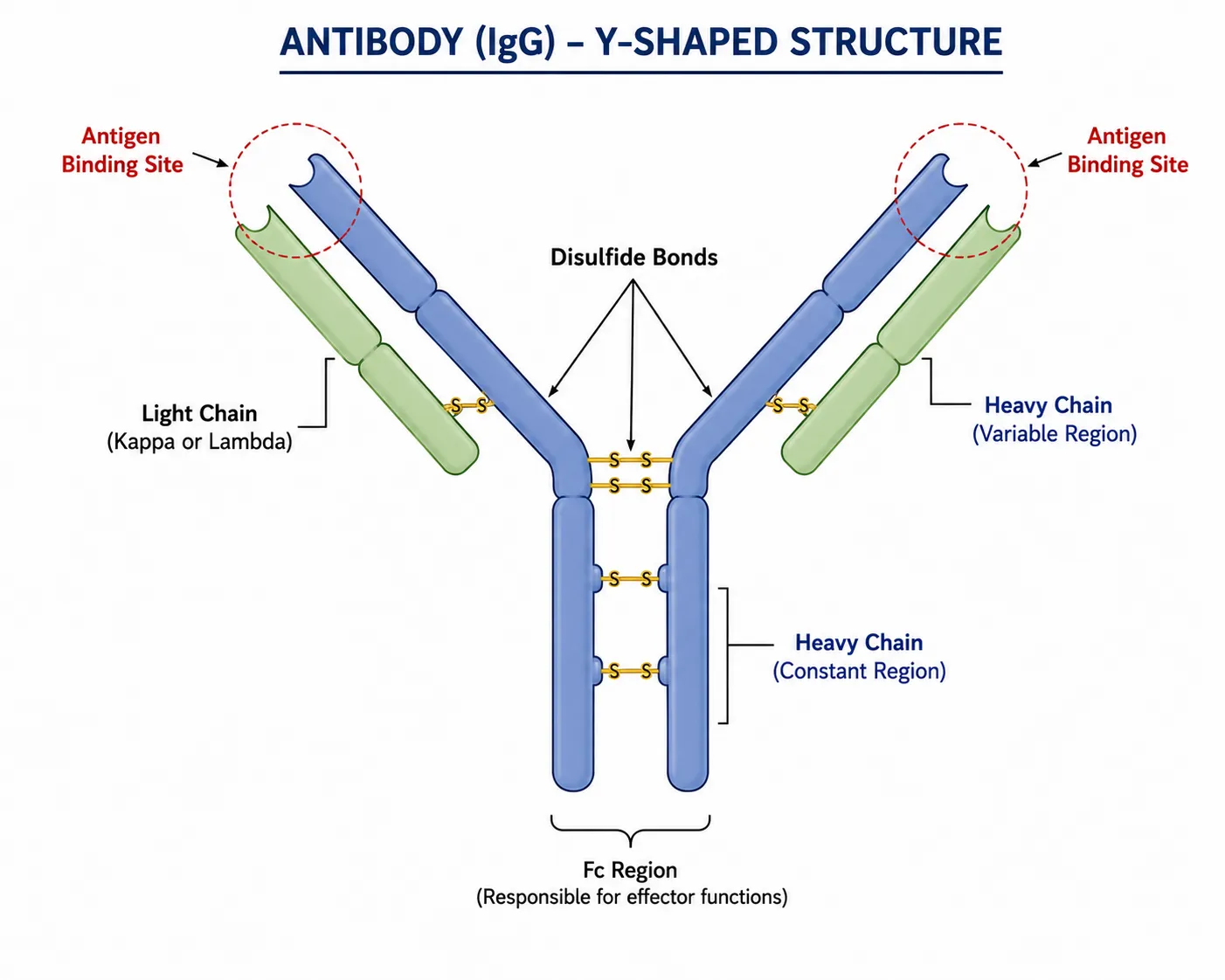
Question 9: Draw a well-labelled diagram of an antibody molecule.
Step 1: Structural Basics. An antibody molecule is Y-shaped and consists of 4 peptide chains: 2 light chains and 2 heavy chains (H2L2 structure).
Step 2: Bonds. These chains are held together by disulfide bonds.
Question 10: What are the various routes by which transmission of human immunodeficiency virus takes place?
Step 1: Sexual Contact. Unprotected sexual contact with an infected person.
Step 2: Blood Transfusion. Transfusion of contaminated blood or blood products.
Step 3: Needle Sharing. Sharing infected needles or syringes (common among intravenous drug users).
Step 4: Maternal Transmission. From an infected mother to her child through the placenta during pregnancy.
Question 11: What is the mechanism by which the AIDS virus causes deficiency of immune system of the infected person?
Step 1: Initial Infection. Once HIV enters the body, it targets Macrophages (which act as an HIV factory) and Helper T-lymphocytes (TH cells).
Step 2: Viral Replication. The viral RNA uses the enzyme reverse transcriptase to form viral DNA, which incorporates into the host cell's DNA.
Step 3: Multiplication. The infected cell produces multiple new viral particles.
Step 4: Spreading. These viruses burst out and infect other Helper T-cells.
Step 5: Immunodeficiency. This continuous cycle leads to a progressive and massive decrease in the number of Helper T-cells, severely weakening the immune system.
Question 12: How is a cancerous cell different from a normal cell?
Step 1: Behavioral Differences.
| Normal Cell | Cancerous Cell |
|---|---|
| Shows contact inhibition (stops dividing when touching other cells). | Loses the property of contact inhibition. |
| Divides in a highly regulated and controlled manner. | Divides uncontrollably, forming masses called tumors. |
| Remain localized to their original tissue. | Often undergo metastasis (spread to other body parts). |
| Have a definite lifespan and undergo apoptosis (programmed cell death). | Do not undergo apoptosis; they are virtually immortal. |
Question 13: Explain what is meant by metastasis.
Step 1: Definition. Metastasis is the most dangerous property of malignant tumors.
Step 2: The Mechanism. It is the process by which cancer cells detach from the primary tumor, enter the bloodstream or lymphatic system, and travel to different parts of the body.
Step 3: Secondary Tumors. Wherever they lodge, they start dividing and form new secondary tumors.
Question 14: List the harmful effects caused by alcohol/drug abuse.
Step 1: Physical Effects. Liver cirrhosis (due to alcohol), nervous system damage, respiratory failure, and cardiovascular problems.
Step 2: Psychological Effects. Anxiety, depression, extreme mood swings, paranoia, and memory loss.
Step 3: Social & Financial Effects. Loss of interest in studies/work, isolation from family, stealing to buy drugs, and domestic violence.
Step 4: Disease Risk. High risk of infections. Sharing needles increases the risk of acquiring HIV and Hepatitis B.
Question 15: Do you think that friends can influence one to take alcohol/drugs? If yes, how may one protect himself/herself from such an influence?
Step 1: Acknowledging Peer Pressure. Yes, "peer pressure" is a major reason teenagers start using drugs or alcohol.
Step 2: Learn to say 'NO'. Stand firm on your principles regardless of what friends say.
Step 3: Avoid Bad Company. Surround yourself with positive peers who focus on studies, sports, or hobbies.
Step 4: Seek Help. If feeling pressured or stressed, talk to parents, teachers, or a trusted counselor.
Step 5: Educate Yourself. Knowing the lethal, long-term consequences of addiction acts as a strong deterrent.
Question 16: Why is that once a person starts taking alcohol or drugs, it is difficult to get rid of this habit? Discuss it with your teacher.
Step 1: Addiction. It is a psychological attachment to certain effects like euphoria or temporary peace.
Step 2: Tolerance. With repeated use, the tolerance level of the body's receptors increases. The receptors respond only to higher doses, leading to greater intake.
Step 3: Withdrawal Syndrome. If the drug is stopped abruptly, the body experiences severe withdrawal symptoms (anxiety, shakiness, nausea), making the person relapse just to feel normal again.
Question 17: In your view what motivates youngsters to take to alcohol or drugs and how can this be avoided?
Step 1: Motivations. These include natural curiosity, desire for experimentation, peer pressure (wanting to "fit in"), escaping stress/academic pressure, and the influence of media portraying drug use as glamorous.
Step 2: Avoidance Strategies. Parents should avoid placing undue academic pressure. Maintain open communication so youngsters feel safe discussing fears. Encourage professional counseling for stress management, and promote participation in sports, yoga, and healthy hobbies.
EXTRA IMPORTANT QUESTIONS (BOARD EXAM 2026 STYLE)
ExamSpark par humari koshish rehti hai ki aapko complete practice mile. Here are 15 important questions (mix of formats) that are highly expected in the 2026 Board Exams!
Multiple Choice Questions (MCQs)
Q1. The infectious stage of Plasmodium that enters the human body is:
A) Sporozoite
B) Trophozoite
C) Merozoite
D) Gametocyte
Step 1: Identify the correct option. A) Sporozoite. (Difficulty: Easy)
Q2. Widal test is used for the diagnosis of:
A) Malaria
B) Pneumonia
C) Typhoid
D) Cholera
Step 1: Identify the correct option. C) Typhoid. (Difficulty: Easy)
Q3. Which of the following immunoglobulins constitutes the largest percentage in human milk (colostrum)?
A) IgA
B) IgG
C) IgD
D) IgE
Step 1: Identify the correct option. A) IgA. (Difficulty: Medium)
Assertion-Reason Questions (1 Mark each)
Directions: (A) Both A and R are true and R is correct explanation of A. (B) Both are true but R is not the correct explanation. (C) A is true, R is false. (D) A is false, R is true.
Q4. Assertion (A): Innate immunity is present at the time of birth.
Reason (R): It consists of different types of barriers that prevent the entry of foreign agents into the body.
Step 1: Verification. (A) Both are true, and R explains A. (Difficulty: Medium)
Q5. Assertion (A): HIV infected person always shows AIDS symptoms immediately after infection.
Reason (R): HIV attacks helper T-cells resulting in severe immunodeficiency.
Step 1: Verification. (D) A is false because the incubation period can be 5-10 years; R is true. (Difficulty: High)
Short Answer Questions (2-3 Marks)
Q6. What is an allergy? Name the antibody responsible for it.
Step 1: Definition. Allergy is the exaggerated response of the immune system to certain antigens present in the environment (e.g., pollen, dust).
Step 2: Antibody Identification. The antibody produced during allergic reactions is IgE. (Difficulty: Easy)
Q7. A student is suffering from a fungal infection resulting in dry, scaly lesions on the skin. Name the disease and two fungi responsible for it.
Step 1: Disease Identification. The disease is Ringworm.
Step 2: Fungi Names. Fungi belonging to the genera Microsporum, Trichophyton, and Epidermophyton are responsible. (Difficulty: Medium)
Q8. Differentiate between primary and secondary immune response.
Step 1: Primary Response. Occurs upon first exposure to an antigen. It is slow and low in intensity.
Step 2: Secondary Response. Occurs upon subsequent exposure to the same antigen. It is rapid and highly intense due to the presence of memory B and T cells. (Difficulty: Medium)
Long Answer Questions (5 Marks)
Q9. Describe the life cycle of Plasmodium with the help of a flow chart.
Step 1: Infection. Infected female Anopheles mosquito bites a human, injecting sporozoites.
Step 2: Hepatic Stage. Sporozoites reach the liver via blood and multiply asexually, bursting liver cells.
Step 3: Erythrocytic Stage. Parasites enter RBCs, multiply asexually, and burst RBCs, releasing a toxin called hemozoin (causing chills/fever).
Step 4: Gametocyte Formation. Gametocytes (male & female) develop in RBCs.
Step 5: Mosquito Uptake. Female mosquito takes up gametocytes with a blood meal.
Step 6: Fertilization. Fertilization and development take place in the mosquito's gut.
Step 7: Maturation. Mature infective sporozoites escape the gut and migrate to the mosquito's salivary glands. (Difficulty: High)
Q10. How is cancer detected? Explain the treatment modalities available.
Step 1: Detection Methods. Biopsy and histopathological studies of tissue, Radiography (X-rays), CT scans, MRI, and identifying cancer-specific antigens using antibodies.
Step 2: Treatment - Surgery. Physical removal of the tumor.
Step 3: Treatment - Radiation therapy. Irradiating the tumor cells lethally without harming normal tissue.
Step 4: Treatment - Chemotherapy. Using anti-cancer drugs.
Step 5: Treatment - Immunotherapy. Using biological response modifiers like α-interferons to activate the immune system. (Difficulty: High)
Q11. Explain the role of lymphoid organs in the human immune system.
Step 1: Overall Function. Lymphoid organs are sites where the origin, maturation, and proliferation of lymphocytes occur.
Step 2: Bone Marrow. Main primary lymphoid organ; all blood cells including lymphocytes are produced here. B-cells mature here.
Step 3: Thymus. Primary organ located near the heart. T-lymphocytes mature here.
Step 4: Spleen. Secondary organ that acts as a blood filter and graveyard of RBCs; contains lymphocytes and phagocytes. (Difficulty: High)
Q12. What are autoimmune diseases? Give two examples.
Step 1: Definition. Sometimes, due to genetic or unknown reasons, the body attacks self-cells, resulting in damage to the body. This is called an autoimmune disease.
Step 2: Examples. Rheumatoid arthritis and Myasthenia gravis. (Difficulty: Medium)
Q13. Classify drugs based on their sources and effects.
Step 1: Opioids. Bind to specific opioid receptors in the central nervous system and gastrointestinal tract. Example: Heroin (Smack).
Step 2: Cannabinoids. Interact with brain receptors and affect the cardiovascular system. Example: Marijuana, Hashish, Charas (from Cannabis sativa).
Step 3: Coca Alkaloids (Cocaine). Interferes with dopamine transport. It stimulates the CNS causing euphoria and increased energy. Derived from Erythroxylum coca. (Difficulty: Medium)
Case-Based Questions (4 Marks)
Q14. Read the case and answer: Rahul has been suffering from a sustained high fever (39° to 40°C), weakness, stomach pain, and constipation for a week. A specific blood test confirmed his diagnosis.
(a) Name the disease Rahul is suffering from and its causative agent.
(b) Which test confirmed the diagnosis?
(c) How does this pathogen enter the human body?
Step 1: (a) Typhoid. Causative agent: Salmonella typhi bacteria.
Step 2: (b) Widal test.
Step 3: (c) Enters through food and water contaminated with the bacteria. (Difficulty: Medium)
Q15. Read the case and answer: A 20-year-old boy frequently suffers from sneezing, watery eyes, and difficulty breathing whenever he visits a dusty environment or a garden.
(a) Name the condition he is suffering from.
(b) Which chemicals are released in his body to cause these symptoms?
(c) Name the drugs used to quickly reduce these symptoms.
Step 1: (a) Allergy.
Step 2: (b) Histamine and serotonin from mast cells.
Step 3: (c) Antihistamines, adrenaline, and steroids. (Difficulty: Medium)
COMMON MISTAKES STUDENTS MAKE
- Confusing Antigen and Antibody: Remember, Antigen is the foreign intruder. Antibody is the warrior protein your body makes to fight it.
- Active vs Passive Immunity Mix-up: Active = Your body works to make antibodies (slow). Passive = You get readymade antibodies (fast, like anti-venom). Concept clear rakhna!
- Spelling Mistakes in Scientific Names: Words like Plasmodium falciparum or Entamoeba histolytica must be spelled correctly and underlined in board exams!
- Primary & Secondary Lymphoid Organs: Students often mistake the spleen as a primary organ. Remember, Primary is only Bone Marrow and Thymus.
EXAM PREPARATION TIPS
- Master the Flowcharts: Practice drawing the life cycles of Plasmodium and the replication of HIV retrovirus. These are guaranteed 3-5 mark questions!
- Learn Tables: Make a small cheat sheet of "Disease - Causative Agent - Transmission Method" for quick revision.
- Time Management: Long answer questions (5 marks) me flowcharts aur diagrams use karein to save time and score full marks.
FAQ SECTION
1. Is Class 12 Biology Chapter 8 important for board exams?
2. Which diagrams are most important in Chapter 8 Biology Class 12?
3. What is the difference between innate and acquired immunity?
4. How can I download the Class 12 Biology NCERT PDF?
CONCLUSION
Great job making it to the end, ExamSpark champions! Chapter 8 Human Health and Disease is not just an exam topic; it is practical knowledge for everyday life. Revise these NCERT Solutions regularly, practice drawing the diagrams, and attempt the extra important questions provided above. Bookmark this page, download your notes, and keep practicing PYQs. Stay focused, believe in yourself, and prepare for your 2026 Board Exams confidently. You’ve got this!