Biodiversity and Conservation Complete Solutions
Hey Lucky! Welcome to one of the most scoring chapters of Class 12 Biology—Biodiversity and Conservation. In this complete guide, we will cover the Updated NCERT Solutions along with the most predicted Board Exam Questions 2026. This chapter is highly important for both your CBSE board exams and NEET. Since it is entirely theory-based, you can easily score full marks by understanding the core concepts. Let's make learning this chapter super easy!
Learning Objectives
After completing this chapter, students will be able to:
- Understand the different levels of biodiversity (Genetic, Species, Ecological).
- Explain the patterns of biodiversity, including latitudinal gradients and the species-area relationship.
- Identify the major causes of biodiversity loss, commonly known as "The Evil Quartet".
- Realize the importance of biodiversity for ecosystem functioning and human survival.
- Differentiate between In-situ (on-site) and Ex-situ (off-site) conservation strategies.
Key Concepts, Definitions & Formulas
- Biodiversity: The combined diversity at all the levels of biological organization.
- Genetic Diversity: A single species might show high diversity at the genetic level over its distributional range (e.g., Rauwolfia vomitoria in the Himalayas).
- Species Diversity: The variety of species within a region (e.g., Western Ghats have a greater amphibian species diversity than Eastern Ghats).
- Ecological Diversity: Diversity at the ecosystem level (e.g., India's deserts, rain forests, mangroves).
- Endemism: Species confined to a specific region and not found anywhere else in the world.
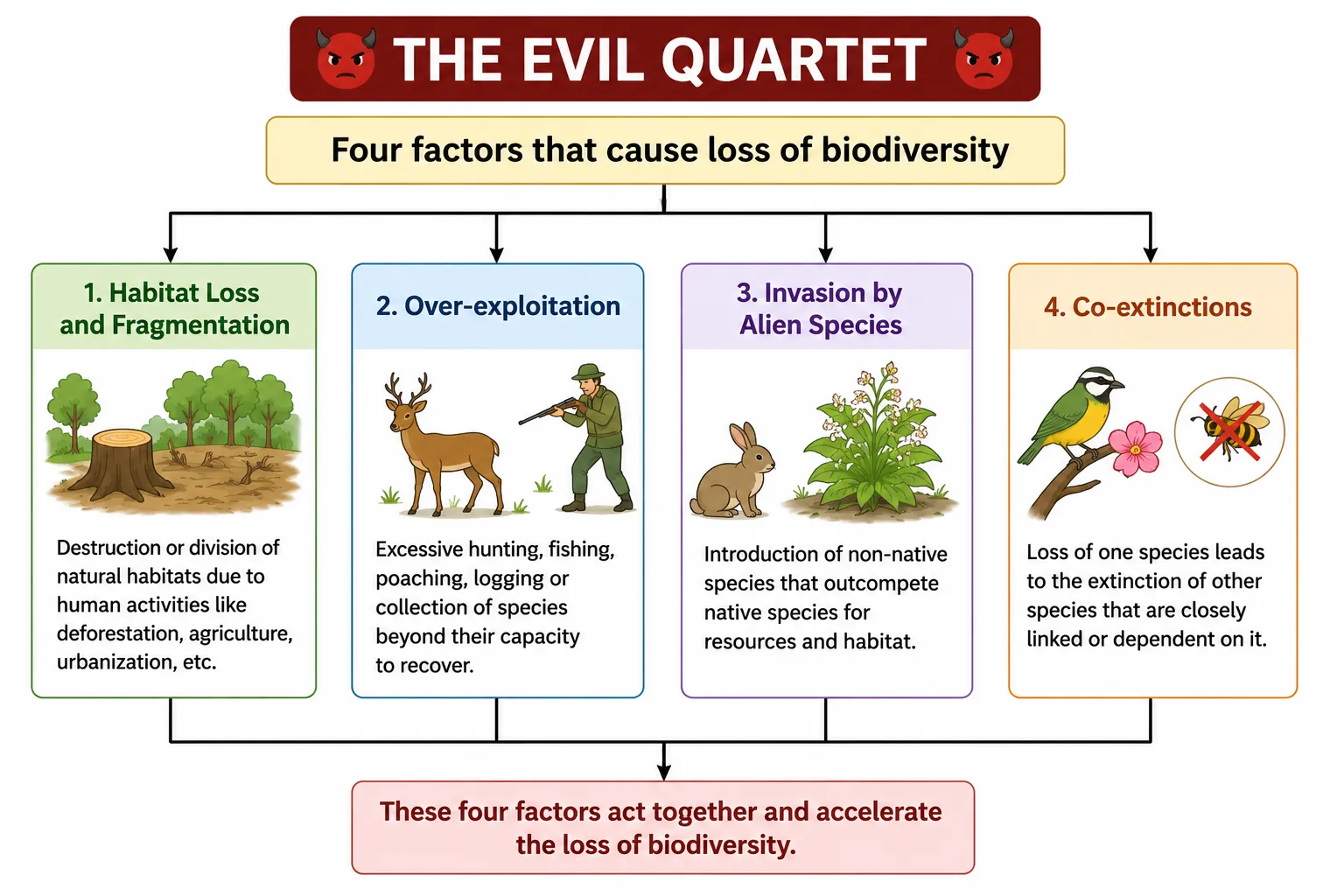
- The Evil Quartet: The four major causes of biodiversity loss: Habitat loss and fragmentation, Over-exploitation, Alien species invasions, and Co-extinctions.
- Species-Area Relationship Formula: Alexander von Humboldt observed that within a region, species richness increases with increasing explored area, but only up to a limit.
The equation is: \(S = C A^Z\)
On a logarithmic scale: \(\log S = \log C + Z \log A\)
(Where \(S\) = Species richness, \(A\) = Area, \(Z\) = slope of the line, \(C\) = Y-intercept).
Full NCERT Solutions (Step-by-Step)
Here are the complete, step-by-step NCERT Solutions for Class 12 Biology Chapter 15.
Question 1: Name the three important components of biodiversity.
Step 1: Genetic diversity. Variation of genes within a species.
Step 2: Species diversity. Variety of species within a particular region.
Step 3: Ecological (Ecosystem) diversity. Variety of ecosystems in a given geographical area.
Question 2: How do ecologists estimate the total number of species present in the world?
Step 1: The Challenge. Ecologists cannot count every single species on Earth manually. Instead, they use a statistical method.
Step 2: The Methodology. They calculate the rate of discovery of new species among groups of insects in tropical and temperate regions.
Step 3: Extrapolation. By comparing the species richness of exhaustively studied groups of insects in both regions, they extrapolate this ratio to other groups of animals and plants to estimate the total global species richness (which Robert May estimated at around 7 million).
Question 3: Give three hypotheses for explaining why tropics show greatest levels of species richness.
Step 1: Speciation is a function of time. Tropical latitudes have remained relatively undisturbed for millions of years (unlike temperate regions subjected to frequent glaciations). This long evolutionary time allowed for greater species diversification.
Step 2: Stable Environment. Tropical environments are less seasonal, more constant, and predictable. Such stability promotes niche specialization and leads to greater species richness.
Step 3: More Solar Energy. Tropics receive more direct solar energy, which contributes to higher productivity. Higher productivity indirectly supports greater biological diversity.
Question 4: What is the significance of the slope of regression in a species-area relationship?
Step 1: General Significance. The slope of regression (\(Z\)) has a great significance in the species-area relationship.
Step 2: Normal Range. Ecologists have found that the value of the \(Z\)-line ranges between 0.1 and 0.2, regardless of the taxonomic group or the region (e.g., plants in Britain, birds in California).
Step 3: Large Area Range. However, if you analyze the species-area relationship over very large areas like entire continents, the slope is much steeper, with \(Z\) values ranging from 0.6 to 1.2.
Step 4: Conclusion. This signifies that the larger the area explored, the faster the rate at which new species are found.
Question 5: What are the major causes of species losses in a geographical region?
Step 1: Habitat loss and fragmentation. The most important cause. Clearing forests for agriculture or human settlement destroys natural habitats.
Step 2: Over-exploitation. When human 'need' turns to 'greed', it leads to the over-harvesting of species (e.g., Steller's sea cow, passenger pigeon).
Step 3: Alien species invasions. Introducing non-native species intentionally or accidentally causes the decline of indigenous species (e.g., Nile perch introduced into Lake Victoria wiped out cichlid fish).
Step 4: Co-extinctions. When a species becomes extinct, the plant and animal species associated with it in an obligatory way also become extinct (e.g., host fish and its unique parasites).
Question 6: How is biodiversity important for ecosystem functioning?
Step 1: Productivity & Stability. David Tilman's experiments showed that plots with more species showed less year-to-year variation in total biomass and were more productive.
Step 2: Rivet Popper Hypothesis. Proposed by Paul Ehrlich. He compared an ecosystem to an airplane and species to the rivets joining its parts.
Step 3: Conclusion. Popping a few rivets (species extinction) might not cause immediate harm, but if a crucial rivet on the wing (keystone species) is removed, the plane (ecosystem) will crash. Hence, rich biodiversity is crucial for ecosystem health and human survival.
Question 7: What are sacred groves? What is their role in conservation?
Step 1: Definition. Sacred groves are tracts of forest set aside, and all the trees and wildlife within are venerated and given total protection by the local communities due to religious and cultural beliefs.
Step 2: Role in Conservation. They serve as refuges for a large number of rare and threatened plants. Since local people strictly protect these areas, logging and hunting are completely prohibited. Examples include Khasi and Jaintia Hills in Meghalaya, and Aravalli Hills of Rajasthan.
Question 8: Among the ecosystem services are control of floods and soil erosion. How is this achieved by the biotic components of the ecosystem?
Step 1: Control of soil erosion. The roots of plants tightly bind the soil particles together, preventing the wind and water from washing away the top fertile layer.
Step 2: Control of floods. Plant cover slows down the flow of rainwater. The roots create channels in the soil, allowing water to seep down and recharge groundwater, which drastically reduces surface runoff and prevents severe flooding.
Question 9: The species diversity of plants (22 per cent) is much less than that of animals (72 per cent). What could be the explanations to how animals achieved greater diversification?
Step 1: Neural Complexity. Animals have a complex nervous system that allows them to receive stimuli and adapt to changes in their environment quickly.
Step 2: Mobility. Unlike plants, animals are highly mobile. This allows them to escape predators, avoid unfavorable conditions, and migrate to better habitats.
Step 3: Structural Advantages. Insects, which form the largest group among animals, possess a tough exoskeleton made of chitin, allowing them to survive in extreme and diverse environments.
Question 10: Can you think of a situation where we deliberately want to make a species extinct? How would you justify it?
Step 1: The Situation. Yes, we might deliberately want to drive disease-causing organisms (pathogens) or deadly parasites to extinction. Examples: The Polio virus, the smallpox virus, or the Plasmodium parasite (which causes malaria).
Step 2: The Justification. These organisms cause immense human suffering, fatal diseases, and high mortality rates. Eradicating them saves millions of human lives and improves global health.
Step 3: Ecological Impact. Their extinction does not harm the larger ecological balance since they are solely dependent on causing disease in humans.
Extra Important Questions (Board Style)
To ensure you are fully prepared for the Board Exam Questions 2026, here are 15 extra practice questions!
Multiple Choice Questions (MCQs)
1. Which of the following is an example of ex-situ conservation?
a) Biosphere Reserve
b) National Park
c) Wildlife Sanctuary
d) Seed Bank
Step 1: Explanation. Ex-situ means conserving outside the natural habitat. Seed banks preserve genetic material artificially.
2. The term "Biodiversity" was popularized by:
a) Robert May
b) Edward Wilson
c) Paul Ehrlich
d) Alexander von Humboldt
Step 1: Identification. Edward Wilson, a sociobiologist, popularized the term.
3. Which group of vertebrates comprises the highest number of endangered species?
a) Mammals
b) Fishes
c) Reptiles
d) Amphibians
Step 1: Identification. Amphibians are highly vulnerable to habitat and environmental changes.
Short Answer Questions (2 Marks)
4. Differentiate between Endemic and Exotic species.
Step 1: Endemic species. These are native to a specific geographical area and found nowhere else (e.g., Lion-tailed macaque in Western Ghats).
Step 2: Exotic species. Exotic (alien) species are introduced from another geographical region into a new environment (e.g., Water hyacinth in India).
5. What is the 'Sixth Extinction'? How is it different from the previous five?
Step 1: Definition. The 'Sixth Extinction' refers to the current ongoing wave of species extinction.
Step 2: Difference. It is different from the previous five mass extinctions because it is entirely driven by human activities, and the rate of extinction is estimated to be 100 to 1,000 times faster than the natural background rate.
6. State the impact of introducing the Nile Perch into Lake Victoria.
Step 1: The Impact. The introduction of the Nile Perch (an alien predator fish) into Lake Victoria in East Africa led to the extinction of an ecologically unique assemblage of more than 200 species of native cichlid fish in the lake.
Long Answer Questions (3-5 Marks)
7. Discuss the 'Broadly Utilitarian' arguments for conserving biodiversity.
Step 1: Oxygen Production. The Amazon rainforest is estimated to produce 20% of the total oxygen in Earth's atmosphere.
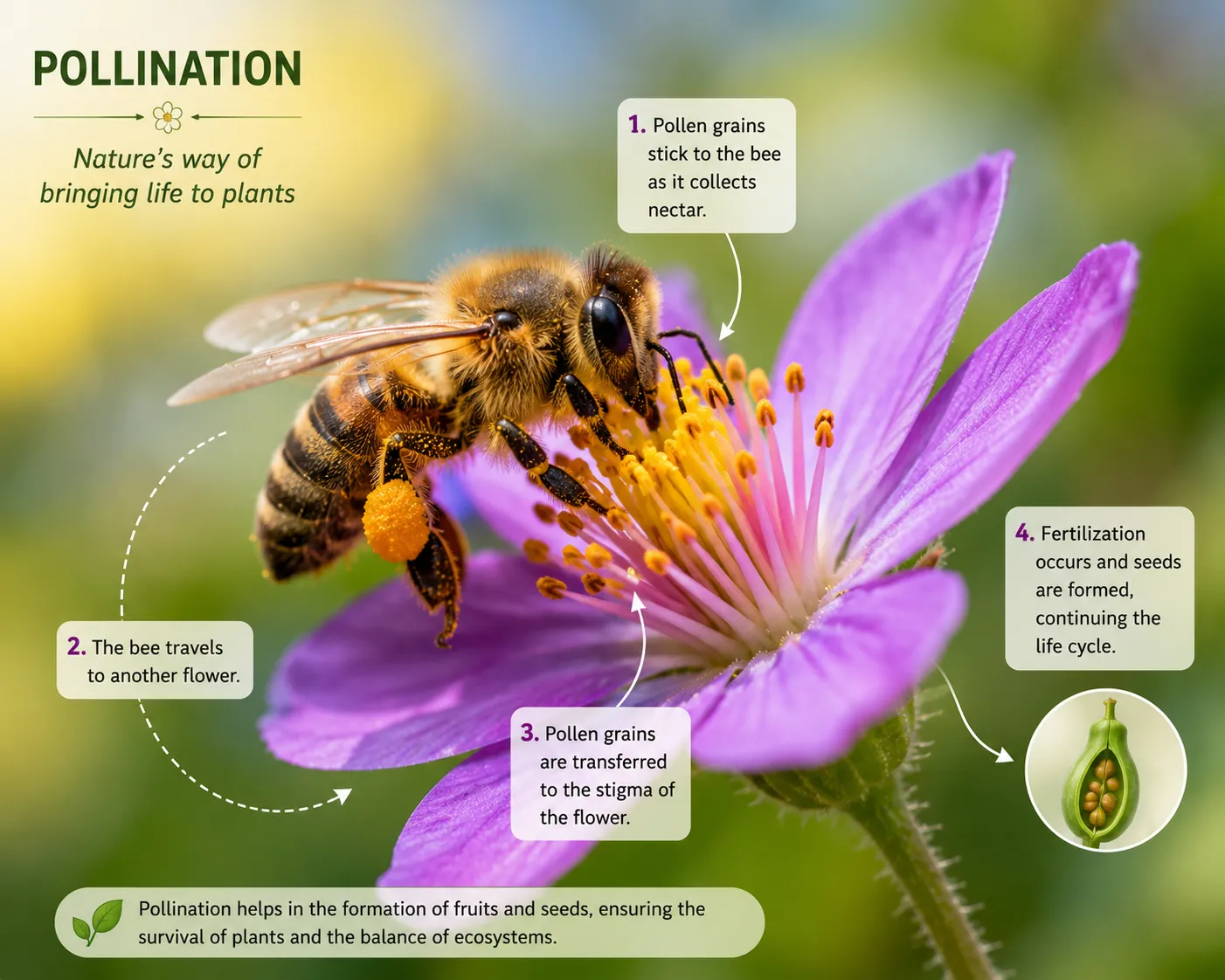
Step 2: Pollination. Bees, birds, and bats pollinate crops. Without them, we wouldn't have fruits or seeds.
Step 3: Aesthetic value. The sheer beauty of nature, walking in thick woods, or watching a spring flower bloom has intangible value that cannot be priced.
8. Explain the Rivet Popper hypothesis.
Step 1: The Setup. If passengers start popping rivets to take home (causing species to go extinct), it might not affect flight safety initially (proper ecosystem functioning).
Step 2: The Consequence. However, as more rivets are removed, the plane becomes dangerously weak.
Step 3: The Keystone species. Crucially, removing a rivet from the wing (a keystone species that drives major ecosystem functions) is far more dangerous than removing one from an inside seat.
9. What are 'Biodiversity Hotspots'? Name the hotspots present in India.
Step 1: Definition. Biodiversity hotspots are regions with very high levels of species richness and a high degree of endemism, but they are also under severe threat of habitat loss.
Step 2: Indian Hotspots. India has 3 main biodiversity hotspots:
1. Western Ghats and Sri Lanka
2. Indo-Burma
3. Himalayas
Case-Based Questions
10. Read the following passage and answer the questions.
A survey of a tropical rainforest showed that extensive logging and clearing of land for agriculture caused the forest area to shrink by 50% over the last decade. As a result, several large mammal species disappeared from the region, and soon after, certain plant species that relied on these mammals for seed dispersal also began to die out.
(a) Which specific cause from the 'Evil Quartet' is primarily highlighted in the first sentence? (1 Mark)
(b) Name the biological phenomenon that explains the death of the plant species following the disappearance of the mammals. (2 Marks)
Step 1: (a) Identification. Habitat loss and fragmentation.
Step 2: (b) Phenomenon. Co-extinction. When the mammals (seed dispersers) went extinct locally, the plant species dependent on them obligatorily also faced extinction.
Assertion-Reason Questions
Options:
a) Both A and R are true and R is the correct explanation of A.
b) Both A and R are true but R is not the correct explanation of A.
c) A is true but R is false.
d) A is false but R is true.
11. Assertion (A): The biological diversity is higher in the tropical latitudes compared to temperate ones.
Reason (R): Tropics have experienced frequent glaciations in the past.
Step 1: Explanation. Tropics remained relatively undisturbed by glaciations, which is why they have high diversity.
12. Assertion (A): Cryopreservation is an in-situ conservation method.
Reason (R): Gametes of threatened species can be preserved in viable and fertile conditions for long periods using liquid nitrogen.
Step 1: Explanation. Cryopreservation is an ex-situ (off-site) conservation technique.
13. Assertion (A): Genetic diversity helps in the formation of new species (speciation).
Reason (R): Variation at the genetic level increases the adaptability of a species to changing environmental conditions.
Step 1: Verification. Correct.
14. Assertion (A): Introduction of the African catfish (Clarias gariepinus) is an example of alien species invasion.
Reason (R): It poses a threat to the indigenous catfishes in our rivers.
Step 1: Verification. Correct.
15. Assertion (A): The value of 'Z' (slope of regression) lies in the range of 0.6 to 1.2 for small geographical areas.
Reason (R): Species-area relationship is a rectangular hyperbola for a wide variety of taxa.
Step 1: Explanation. The value of Z for small areas is 0.1 to 0.2. It is 0.6 to 1.2 for very large continents.
Common Mistakes Students Make
- Confusing In-situ and Ex-situ: Just remember, In-situ means "Inside" their natural home (National Parks, Sanctuaries). Ex-situ means "Exit" their home, kept somewhere artificially (Zoos, Botanical Gardens, Seed Banks).
- Forgetting the Evil Quartet names: Many students write "pollution" as one of the quartet. It is NOT part of the classic four. Stick to: Habitat Loss, Overexploitation, Alien Invasion, and Co-extinction.
- Species-Area Relationship: Students often forget the log formula. Always write \(\log S = \log C + Z \log A\) clearly to get full marks.
Exam Preparation Tips
- Make a Mind Map: Create a quick mind map for "Conservation Strategies" dividing them into In-situ and Ex-situ with examples under each. This will save you a lot of time during last-minute revision.
- Highlight Key Terms: The CBSE examiner looks for specific keywords. Always underline words like Endemism, Co-extinction, Rivet Popper Hypothesis, and Latitudinal Gradient in your answers.
- Time Management: Since this chapter has no complex diagrams, you can finish answering these questions quickly to save time for tougher chapters like Genetics.
Frequently Asked Questions (FAQs)
1. Is Chapter 15 Biodiversity and Conservation important for the 2026 boards?
2. Where can I download the updated NCERT Biology Class 12 PDF?
3. Which questions are most important from Chapter 15?
4. What does the Z-value indicate in the species-area relationship?
5. How is National Park different from a Wildlife Sanctuary?
Conclusion: Lucky, mastering Chapter 15 is one of the easiest ways to secure solid marks in your Biology board exams! Because the content is relatable and theory-based, a little bit of smart study is all you need. Revise the key concepts regularly, practice your PYQs, and download these notes so you can easily review the NCERT Solutions before your exam. Prepare for the 2026 boards confidently—you've absolutely got this!