Molecular Basis of Inheritance Solutions
Welcome to examspark.in! Main Lucky hoon, aur aaj hum CBSE Class 12 Biology Chapter 6, Molecular Basis of Inheritance ko detail mein samjhenge. Genetics ka yeh core chapter board exams aur NEET ke liye super important aur highly scoring hai. Is post mein aapko easy-to-understand Updated NCERT Solutions aur Board Exam Questions 2026 milenge. Let's make this complex chapter simple and secure those top marks!
Learning Objectives
After completing this chapter, students will be able to:
- Understand the chemical structure of DNA and RNA.
- Explain the packaging of the DNA double helix inside a cell.
- Describe the mechanisms of DNA Replication, Transcription, and Translation (Central Dogma).
- Decode the Genetic Code and understand its salient features.
- Analyze the regulation of gene expression using the Lac Operon model.
- Grasp the concepts and applications of the Human Genome Project (HGP) and DNA Fingerprinting.
Key Concepts & Definitions
- Nucleotide: The basic building block of nucleic acids. It consists of three components: a nitrogenous base, a pentose sugar, and a phosphate group.
- Central Dogma: Proposed by Francis Crick, it explains the flow of genetic information: DNA → RNA → Protein.
- Transcription: The process of copying genetic information from one strand of DNA into mRNA.
- Translation: The process of polymerizing amino acids to form a polypeptide chain (protein), guided by the sequence on mRNA.
- Genetic Code: The sequence of nucleotides in DNA and RNA that determines the specific amino acid sequence in the synthesis of proteins.
- Operon: A unit of genomic DNA containing a cluster of genes under the control of a single promoter (e.g., the Lac Operon in E. coli).
- Chargaff's Rule: In any double-stranded DNA, the ratio of Adenine (A) to Thymine (T) and Guanine (G) to Cytosine (C) is constant and equals one. So, A = T and G = C.
Full NCERT Solutions (Step-by-Step)
Here are the complete, step-by-step CBSE Class 12 Biology Chapter 6 solutions. Har step ko dhyan se samjhiye kyunki yeh basics hain!
Question 1: Group the following as nitrogenous bases and nucleosides: Adenine, Cytidine, Thymine, Guanosine, Uracil and Cytosine.
Step 1: Nitrogenous bases. Adenine, Thymine, Uracil, Cytosine.
Step 2: Nucleosides. Cytidine, Guanosine.
(Hint: Nucleoside = Nitrogenous base + Sugar. They usually end in '-dine' or '-sine'.)
Question 2: If a double-stranded DNA has 20 per cent of cytosine, calculate the per cent of adenine in the DNA.
Step 1: Apply Chargaff's Rule. According to Chargaff's rule, in a double-stranded DNA, the amount of Cytosine (C) is equal to Guanine (G), and Adenine (A) is equal to Thymine (T).
Step 2: Calculate G and C total. Given, Cytosine (C) = 20%. Therefore, Guanine (G) = 20%. Total C + G = 20% + 20% = 40%.
Step 3: Calculate remaining A and T. Remaining DNA (A + T) = 100% - 40% = 60%.
Step 4: Find Adenine. Since A = T, the percentage of Adenine (A) = 60% / 2 = 30%.
Question 3: If the sequence of one strand of DNA is written as follows: 5'-ATGCATGCATGCATGCATGCATGCATGC-3'. Write down the sequence of complementary strand in 5' → 3' direction.
Step 1: Find 3' to 5' complement. First, let's write the complementary strand in the 3' → 5' direction using base pairing rules (A pairs with T, G pairs with C):
Original: 5'-ATGCATGCATGCATGCATGCATGCATGC-3'
Complementary: 3'-TACGTACGTACGTACGTACGTACGTACG-5'
Step 2: Reverse for 5' to 3'. Now, to write it in the requested 5' → 3' direction, we simply reverse the string:
5'-GCATGCATGCATGCATGCATGCATGCAT-3'
Question 4: If the sequence of the coding strand in a transcription unit is written as follows: 5'-ATGCATGCATGCATGCATGCATGCATGC-3'. Write down the sequence of mRNA.
Step 1: Understand the rule. The sequence of mRNA is exactly the same as the coding strand of DNA, except that Thymine (T) is replaced by Uracil (U).
Step 2: Write mRNA sequence.
5'-AUGCAUGCAUGCAUGCAUGCAUGCAUGC-3'
Question 5: Which property of DNA double helix led Watson and Crick to hypothesise semi-conservative mode of DNA replication? Explain.
Step 1: The Property. The property that led Watson and Crick to hypothesize the semi-conservative mode of DNA replication is Complementary Base Pairing.
Step 2: Explanation. Because Adenine specifically pairs with Thymine, and Guanine pairs with Cytosine, the sequence of one strand strictly dictates the sequence of the other. If the two strands of a DNA molecule are separated, each strand can act as a template to synthesize a new, perfectly complementary strand. Thus, the new DNA molecules will have one old (parental) strand and one newly synthesized strand. This is the essence of semi-conservative replication.
Question 6: Depending upon the chemical nature of the template (DNA or RNA) and the nature of nucleic acids synthesised from it (DNA or RNA), list the types of nucleic acid polymerases.
There are different types of polymerases based on what they read (template) and what they build (product):
Step 1: DNA-dependent DNA polymerase: Uses a DNA template to synthesize new DNA (used in DNA Replication).
Step 2: DNA-dependent RNA polymerase: Uses a DNA template to synthesize RNA (used in Transcription).
Step 3: RNA-dependent DNA polymerase (Reverse Transcriptase): Uses an RNA template to synthesize DNA (found in retroviruses like HIV).
Step 4: RNA-dependent RNA polymerase: Uses an RNA template to synthesize RNA (found in some RNA viruses).
Question 7: How did Hershey and Chase differentiate between DNA and protein in their experiment while proving that DNA is the genetic material?
Hershey and Chase used radioactive isotopes to distinguish between DNA and protein in bacteriophages:
Step 1: Labeling Protein. They grew some viruses on a medium containing radioactive Sulfur ($^{35}S$). Since sulfur is found in proteins but not in DNA, the viral protein coats became radioactive.
Step 2: Labeling DNA. They grew other viruses on a medium containing radioactive Phosphorus ($^{32}P$). Since phosphorus is found in DNA but not in proteins, the viral DNA became radioactive.
Step 3: The Experiment & Result. They allowed these labeled viruses to infect E. coli bacteria separately. After infection, they blended and centrifuged the mixture. Bacteria infected with $^{32}P$ viruses were radioactive, meaning DNA entered the bacteria. Bacteria infected with $^{35}S$ viruses were not radioactive; the radioactivity remained in the supernatant (viral coats). This proved that DNA, not protein, is the genetic material transferred to host cells.
Question 8: Differentiate between the following: (a) Repetitive DNA and Satellite DNA (b) mRNA and tRNA (c) Template strand and Coding strand
(a) Repetitive DNA vs Satellite DNA
Step 1: Repetitive DNA. These are stretches of DNA sequences that are repeated many times in the human genome. They make up a large portion of our DNA.
Step 2: Satellite DNA. It is a specific type of repetitive DNA that forms a separate, smaller peak during density gradient centrifugation (away from the bulk genomic DNA). Examples include micro-satellites and mini-satellites, which are highly polymorphic and used in DNA fingerprinting.
(b) mRNA vs tRNA
Step 1: mRNA (Messenger RNA). It acts as a template for protein synthesis. It carries the genetic code (codons) from DNA in the nucleus to the ribosomes in the cytoplasm.
Step 2: tRNA (Transfer RNA). It acts as an adapter molecule. It reads the genetic code on mRNA via its anticodon loop and brings the specific amino acids to the ribosome during translation.
(c) Template strand vs Coding strand
Step 1: Template Strand. The DNA strand with 3' → 5' polarity that is physically read by RNA polymerase to synthesize mRNA.
Step 2: Coding Strand. The DNA strand with 5' → 3' polarity. It does not code for RNA physically, but its nucleotide sequence is exactly identical to the newly formed mRNA (except T is replaced by U).
Question 9: List two essential roles of ribosome during translation.
Step 1: Structural Support & Binding. The ribosome provides the physical site where mRNA and tRNA come together to interact perfectly. Its smaller subunit binds to mRNA, while the larger subunit has sites (A, P, E) for tRNA binding.
Step 2: Catalytic Role. The larger subunit acts as a catalyst (ribozyme) to form peptide bonds between adjacent amino acids to build the polypeptide chain.
Question 10: In the medium where E. coli was growing, lactose was added, which induced the lac operon. Then, why does lac operon shut down some time after addition of lactose in the medium?
Step 1: Induction phase. When lactose is added, it acts as an inducer, binding to the repressor protein and turning the operon ON. This allows the synthesis of β-galactosidase, which breaks down the lactose into glucose and galactose for energy.
Step 2: Shut down phase. Once the bacteria consume all the lactose in the medium, there is no more inducer left to bind the repressor. The free repressor protein becomes active again, binds tightly to the operator region, and blocks RNA polymerase. Thus, the lac operon shuts down automatically to save cellular energy.
Question 11: Explain (in one or two lines) the function of the following: (a) Promoter (b) tRNA (c) Exons
Step 1: (a) Promoter. It is a specific DNA sequence located at the 5' end of the transcription unit where RNA polymerase binds and initiates transcription.
Step 2: (b) tRNA. It acts as an adapter molecule that reads the mRNA codon via its anticodon and transports the corresponding amino acid to the ribosome.
Step 3: (c) Exons. These are the coding sequences in eukaryotic split genes that appear in the mature, processed mRNA and are translated into proteins.
Question 12: Why is the Human Genome project called a mega project?
Step 1: Massive Scale. The Human Genome Project (HGP) is called a mega project because of its massive scale and scope. It aimed to sequence all the $3\times10^9$ base pairs of the human genome.
Step 2: Effort & Capital. It required immense capital investment (approx. 9 billion US dollars), high-speed computational devices for data storage and analysis (giving birth to Bioinformatics), and took 13 years of coordinated effort from scientists globally.
Question 13: What is DNA fingerprinting? Mention its application.
Step 1: Definition. DNA fingerprinting is a technique used to identify individuals based on variations in their DNA sequences, specifically by analyzing regions called Variable Number of Tandem Repeats (VNTRs), which are unique to each person.
Step 2: Applications.
1. Solving crimes by matching DNA from suspects with biological evidence (blood, hair, semen) at crime scenes.
2. Resolving paternity/maternity disputes to determine the biological parents of a child.
3. Studying genetic diversity and evolutionary biology.
Question 14: Briefly describe the following: (a) Transcription (b) Polymorphism (c) Translation (d) Bioinformatics
Step 1: (a) Transcription. The process of copying genetic information from the template strand of a DNA molecule into a single-stranded RNA molecule, catalyzed by the enzyme RNA polymerase.
Step 2: (b) Polymorphism. Genetic variation occurring in a population at a frequency greater than 0.01. In DNA, it refers to inheritable mutations (like single nucleotide polymorphisms) that are the basis of genetic mapping and DNA fingerprinting.
Step 3: (c) Translation. The cellular process occurring on ribosomes where the genetic code carried by mRNA is decoded to produce a specific sequence of amino acids, forming a polypeptide (protein).
Step 4: (d) Bioinformatics. An interdisciplinary field that develops tools and software to store, analyze, and retrieve vast amounts of biological data, specifically genomic sequences generated by projects like the HGP.
EXTRA IMPORTANT QUESTIONS (BOARD STYLE)
ExamSpark par humari koshish rehti hai ki aapko complete practice mile. Here are 15 important questions that are highly expected in the 2026 Board Exams!
Multiple Choice Questions (1 Mark)
1. Which enzyme is responsible for joining the Okazaki fragments during DNA replication?
A) DNA polymerase
B) DNA ligase
C) Helicase
D) Primase
Step 1: Logic. B) DNA ligase. (Difficulty: Easy)
2. The AUG codon has dual functions. It codes for Methionine and also acts as:
A) Stop codon
B) Start codon
C) Anticodon
D) Intron
Step 1: Logic. B) Start codon. (Difficulty: Easy)
3. In eukaryotes, RNA polymerase III catalyzes the transcription of:
A) mRNA
B) rRNA
C) tRNA, 5S rRNA, and snRNAs
D) hnRNA
Step 1: Logic. C) tRNA, 5S rRNA, and snRNAs. (Difficulty: Medium)
Short Answer Questions (2-3 Marks)
4. What is the 'Transforming Principle' discovered by Frederick Griffith?
Step 1: The Experiment. In 1928, Griffith conducted experiments with Streptococcus pneumoniae. He observed that when heat-killed S-strain (pathogenic) bacteria were mixed with live R-strain (non-pathogenic) bacteria, the R-strain became pathogenic.
Step 2: Conclusion. He concluded that some "transforming principle" was transferred from the dead S-strain to the R-strain, causing this genetic change (which was later proven to be DNA).
5. Why is capping and tailing necessary for hnRNA in eukaryotes?
Step 1: Context. In eukaryotes, the primary transcript (hnRNA) is unstable and contains both exons and introns.
Step 2: Capping. Capping (adding methyl guanosine triphosphate at 5' end) protects the RNA from degradation by exonucleases.
Step 3: Tailing. Tailing (adding poly-A tail at 3' end) helps in the transport of mature mRNA out of the nucleus and provides stability.
6. State the differences between Euchromatin and Heterochromatin.
Step 1: Euchromatin. Loosely packed, lightly stained region of chromatin that is transcriptionally active.
Step 2: Heterochromatin. Densely packed, darkly stained region of chromatin that is transcriptionally inactive.
Long Answer Questions (5 Marks)
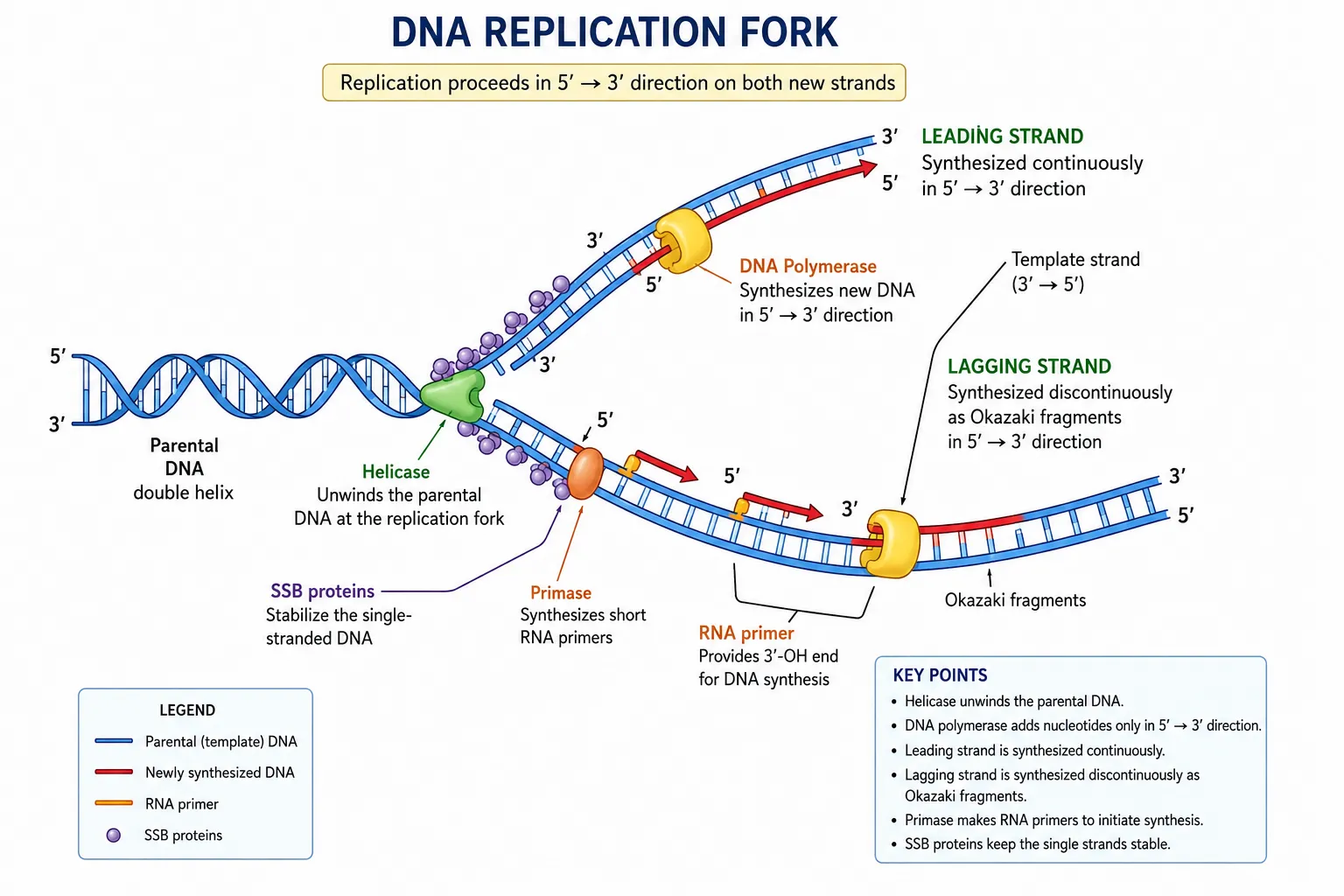
7. Explain the process of DNA replication with the help of a replication fork. Name the enzymes involved.
Step 1: Unwinding. Helicase enzyme unwinds the DNA double helix, creating a Y-shaped replication fork.
Step 2: Primer Synthesis. Primase synthesizes a short RNA primer to initiate the process.
Step 3: Polymerization. DNA Polymerase adds nucleotides in the 5' → 3' direction.
Step 4: Leading and Lagging Strands. On the 3' → 5' template, replication is continuous (Leading strand). On the 5' → 3' template, replication is discontinuous, forming short Okazaki fragments (Lagging strand).
Step 5: Joining. DNA Ligase joins the Okazaki fragments.
8. Describe the regulation of gene expression with the Lac Operon model in E. coli.
The lac operon is an inducible operon system regulated by a repressor.
Step 1: In absence of lactose. The regulatory gene (i gene) produces a repressor protein that binds to the operator (o) region. This blocks RNA polymerase, so structural genes (z, y, a) are not transcribed.
Step 2: In presence of lactose (inducer). Lactose binds to the repressor protein and changes its shape, making it inactive. The operator is now free. RNA polymerase binds to the promoter and transcribes the structural genes into polycistronic mRNA, which translates into enzymes (β-galactosidase, permease, transacetylase) needed for lactose metabolism.
9. What are the salient features of the Genetic Code?
Step 1: Triplet nature. The code consists of 3 bases (codon). Total 64 codons; 61 code for amino acids, 3 are stop codons.
Step 2: Unambiguous & Specific. One codon codes for only one specific amino acid.
Step 3: Degenerate. Some amino acids are coded by more than one codon.
Step 4: Comma-less. The code is read continuously on mRNA with no punctuations.
Step 5: Universal. From bacteria to humans, a specific codon (e.g., UUU) codes for the same amino acid (Phenylalanine).
Case-Based Questions (4 Marks)
Read the passage and answer: Meselson and Stahl grew E. coli in a medium containing $^{15}NH_4Cl$ as the only nitrogen source for many generations. The heavy DNA could be distinguished from normal DNA by centrifugation in a cesium chloride (CsCl) density gradient. Then they transferred the cells to a medium with normal $^{14}NH_4Cl$.
10. (a) What was the main objective of this experiment?
(b) After one generation (20 minutes) in the $^{14}N$ medium, what was the density of the extracted DNA?
(c) Explain why CsCl density gradient was used.
Step 1: (a) Objective. To experimentally prove that DNA replication is semi-conservative.
Step 2: (b) Density. The DNA extracted was hybrid or intermediate density (containing one $^{15}N$ strand and one $^{14}N$ strand).
Step 3: (c) CsCl Gradient. Heavy DNA ($^{15}N$) and light DNA ($^{14}N$) have the same chemical properties but different molecular weights. CsCl centrifugation separates molecules purely based on their density.
Assertion-Reason Questions (1 Mark Each)
Directions: Choose the correct option.
A) Both A and R are true, and R is the correct explanation of A.
B) Both A and R are true, but R is NOT the correct explanation.
C) A is true, but R is false.
D) A is false, but R is true.
11. Assertion (A): DNA is structurally and chemically more stable than RNA.
Reason (R): RNA has a 2'-OH group on its ribose sugar which makes it highly reactive and degradable.
Step 1: Verification. A) Both A and R are true, and R is the correct explanation. (Difficulty: Medium)
12. Assertion (A): The genetic code is universal.
Reason (R): The codon UUU codes for Phenylalanine in both bacteria and humans.
Step 1: Verification. A) Both A and R are true, and R is the correct explanation. (Difficulty: Easy)
13. Assertion (A): Transcription occurs continuously in the 3' → 5' direction.
Reason (R): RNA polymerase catalyzes polymerization only in the 5' → 3' direction.
Step 1: Verification. D) Assertion is false, but Reason is true. (Transcription occurs in the 5' → 3' direction along the newly synthesized RNA, reading the template 3' → 5'). (Difficulty: Hard)
Common Mistakes Students Make
- Template vs Coding Strand Confusion: Always remember, the Template strand runs 3' → 5' and is read by RNA Polymerase. The Coding strand runs 5' → 3' and looks exactly like the mRNA (with T instead of U). Students often mix up these polarities.
- Uracil (U) vs Thymine (T): While transcribing DNA to RNA in exams, students mistakenly pair Adenine with Thymine. In RNA, Adenine (A) pairs with Uracil (U).
- Lac Operon Repressor Trap: Students think the inducer (lactose) binds to the operator. Wrong! The inducer binds to the repressor protein, inactivating it, so the repressor leaves the operator.
- Forgetting Enzymes: Writing just "Polymerase" is not enough. Be specific: DNA-dependent DNA polymerase for replication, and DNA-dependent RNA polymerase for transcription.
Exam Preparation Tips
- Draw to Remember: Practice drawing the DNA Double Helix, Replication Fork, and Lac Operon at least 3 times. Visual memory works best for this chapter.
- Central Dogma Clarity: Be crystal clear on where Replication, Transcription, and Translation happen. (In Eukaryotes: Nucleus, Nucleus, Cytoplasm respectively).
- Learn the Scientists: CBSE loves matching questions! Make a quick table matching Scientists with their discoveries (e.g., Griffith - Transformation; Hershey & Chase - Genetic material proof; Watson & Crick - DNA double helix).
- Do not skip HGP & DNA Fingerprinting: These topics are theoretically heavy but guarantee direct 3 to 5 mark questions in board exams.
Frequently Asked Questions (FAQs)
Is Chapter 6 Biology Class 12 hard?
What is the weightage of Molecular Basis of Inheritance in CBSE 2026?
What is the central dogma of molecular biology?
How to prepare Molecular Basis of Inheritance for NEET?
Conclusion:
Alright future toppers, that wraps up Molecular Basis of Inheritance. Genetics lagti mushkil hai, but ek baar Central Dogma clear ho jaye, toh you can tackle any board question easily. I highly encourage you to revise these concepts regularly, practice the diagrams, and solve previous year questions (PYQs). Don't forget to download the notes from examspark.in and prepare for your 2026 Board Exams with full confidence. You've got this! Stay curious, keep learning! — Lucky (Founder, examspark.in)